



 Chat with AI
Exam 36: Communities of Organisms

Exam 1: The Nature of Science and the Characteristics of Life75 Questions
Exam 2: Organizing the Diversity of Life75 Questions
Exam 3: Major Groups of Living Organisms74 Questions
Exam 4: Chemical Building Blocks77 Questions
Exam 5: Cell Structure and Internal Compartments76 Questions
Exam 6: Cell Membranes, Transport, and Communication73 Questions
Exam 7: Energy and Enzymes68 Questions
Exam 8: Photosynthesis and Cellular Respiration70 Questions
Exam 9: Cell Division77 Questions
Exam 10: Patterns of Inheritance65 Questions
Exam 11: Chromosomes and Human Genetics70 Questions
Exam 12: DNA62 Questions
Exam 13: From Gene to Protein73 Questions
Exam 14: Control of Gene Expression66 Questions
Exam 15: DNA Technology64 Questions
Exam 16: How Evolution Works65 Questions
Exam 17: Evolution of Populations64 Questions
Exam 18: Adaptation and Speciation66 Questions
Exam 19: The Evolutionary History of Life69 Questions
Exam 20: Maintaining the Internal Environment66 Questions
Exam 21: Animal Nutrition and Digestion68 Questions
Exam 22: Gas Exchange68 Questions
Exam 23: The Circulatory System68 Questions
Exam 24: Animal Hormones69 Questions
Exam 25: The Nervous System69 Questions
Exam 26: Sensing the Environment66 Questions
Exam 27: Skeletons, Muscles, and Movement65 Questions
Exam 28: Defenses against Disease67 Questions
Exam 29: Reproduction and Development68 Questions
Exam 30: Animal Behavior61 Questions
Exam 31: Plant Structure, Nutrition, and Transport63 Questions
Exam 32: Plant Growth and Reproduction67 Questions
Exam 33: The Biosphere67 Questions
Exam 34: Growth of Populations65 Questions
Exam 35: Interactions among Organisms70 Questions
Exam 36: Communities of Organisms65 Questions
Exam 37: Ecosystems68 Questions
Exam 38: Global Change65 Questions
Exam 39: Biodiversity and People72 Questions
Exam 40: Cancer: Cell Division Out of Control69 Questions
Exam 41: Harnessing the Human Genome62 Questions
Exam 42: Humans and Evolution60 Questions
Exam 43: Smoking--Beyond Lung Cancer63 Questions
Exam 44: Feeding a Hungry Planet55 Questions
Exam 45: Building a Sustainable Society47 Questions
Select questions type


Which of the following organisms is a producer?

Free
(Multiple Choice)
4.8/5  (70)
(70) Correct Answer: Verified
D
Organisms that eat producers are known as
Free
(Multiple Choice)
4.8/5 (79)
(79) Correct Answer:Verified
VerifiedC
All of the following disturbances except _____ would be considered natural.
Free
(Multiple Choice)
5.0/5 (82)
(82) Correct Answer:Verified
VerifiedD
The process that establishes new communities and restores disturbed communities is termed
(Multiple Choice)
4.9/5 (80)
(80) In a typical prairie food web energy moves from grass to grasshopper to field mouse to fox. Which organism is the tertiary consumer?
(Multiple Choice)
4.9/5 (84)
(84) The sea star Pisaster ochraceus was removed from selected intertidal communities along the Washington coast. After 10 years how did those communities compare to control communities?
(Multiple Choice)
5.0/5 (78)
(78) The removal of a keystone species from a community usually results in
(Multiple Choice)
4.9/5 (72)
(72) A farmer and his family raise 100 acres of corn, 12 chickens, and two cows. What is the keystone species?
(Multiple Choice)
4.8/5 (89)
(89) A community may begin when new _______ is formed, such as when rock and soil are deposited by a retreating glacier.
(Short Answer)
4.9/5 (82)
(82) As the figure below illustrates, communities vary tremendously in size from as large as an entire forest to the digestive system of a single deer. 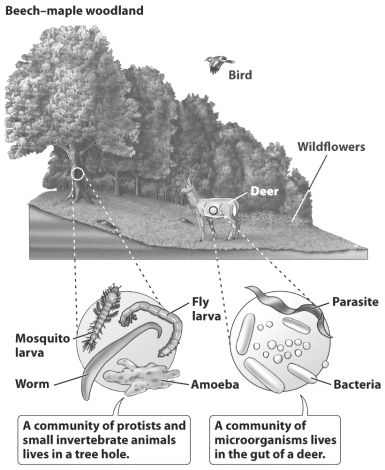 How can biologists recognize where one community ends and a second begins?
 (Multiple Choice)
4.9/5 (74)
(74) Which of the following statements about human-caused disturbances to communities is true?
(Multiple Choice)
4.9/5 (97)
(97) Which of the following best characterizes humans' method of obtaining energy?
(Multiple Choice)
5.0/5 (79)
(79) Black oak trees are one of the earliest colonists after bare sand dunes are created.
(True/False)
4.8/5 (68)
(68) All of the following except the _____ could be part of the same food chain.
(Multiple Choice)
4.8/5 (79)
(79) Why is the existence of food webs important even though food chains also exist?
(Multiple Choice)
4.9/5 (75)
(75) 
Filters
- Essay(0)
- Multiple Choice(0)
- Short Answer(0)
- True False(0)
- Matching(0)