



 Chat with AI
Exam 36: Communities of Organisms

Exam 1: The Nature of Science and the Characteristics of Life75 Questions
Exam 2: Organizing the Diversity of Life75 Questions
Exam 3: Major Groups of Living Organisms74 Questions
Exam 4: Chemical Building Blocks77 Questions
Exam 5: Cell Structure and Internal Compartments76 Questions
Exam 6: Cell Membranes, Transport, and Communication73 Questions
Exam 7: Energy and Enzymes68 Questions
Exam 8: Photosynthesis and Cellular Respiration70 Questions
Exam 9: Cell Division77 Questions
Exam 10: Patterns of Inheritance65 Questions
Exam 11: Chromosomes and Human Genetics70 Questions
Exam 12: DNA62 Questions
Exam 13: From Gene to Protein73 Questions
Exam 14: Control of Gene Expression66 Questions
Exam 15: DNA Technology64 Questions
Exam 16: How Evolution Works65 Questions
Exam 17: Evolution of Populations64 Questions
Exam 18: Adaptation and Speciation66 Questions
Exam 19: The Evolutionary History of Life69 Questions
Exam 20: Maintaining the Internal Environment66 Questions
Exam 21: Animal Nutrition and Digestion68 Questions
Exam 22: Gas Exchange68 Questions
Exam 23: The Circulatory System68 Questions
Exam 24: Animal Hormones69 Questions
Exam 25: The Nervous System69 Questions
Exam 26: Sensing the Environment66 Questions
Exam 27: Skeletons, Muscles, and Movement65 Questions
Exam 28: Defenses against Disease67 Questions
Exam 29: Reproduction and Development68 Questions
Exam 30: Animal Behavior61 Questions
Exam 31: Plant Structure, Nutrition, and Transport63 Questions
Exam 32: Plant Growth and Reproduction67 Questions
Exam 33: The Biosphere67 Questions
Exam 34: Growth of Populations65 Questions
Exam 35: Interactions among Organisms70 Questions
Exam 36: Communities of Organisms65 Questions
Exam 37: Ecosystems68 Questions
Exam 38: Global Change65 Questions
Exam 39: Biodiversity and People72 Questions
Exam 40: Cancer: Cell Division Out of Control69 Questions
Exam 41: Harnessing the Human Genome62 Questions
Exam 42: Humans and Evolution60 Questions
Exam 43: Smoking--Beyond Lung Cancer63 Questions
Exam 44: Feeding a Hungry Planet55 Questions
Exam 45: Building a Sustainable Society47 Questions
Select questions type


In a typical prairie food web, energy moves from grass to grasshopper to field mouse to fox. Which organism is the primary consumer?
(Multiple Choice)
4.7/5  (72)
(72) _________ are those organisms obtaining energy by eating all or portions of other organisms or their remains.
(Short Answer)
4.9/5 (84)
(84) The climate of a given location can change over time for two reasons: global climate change and
(Multiple Choice)
4.7/5 (67)
(67) Which of the following experiments would help to identify a keystone species?
(Multiple Choice)
4.7/5 (74)
(74) A _______ is an association of populations of different species that live in the same area.
(Short Answer)
4.8/5 (77)
(77) Communities change with respect to several timescales; an example of long-term change would be
(Multiple Choice)
4.9/5 (85)
(85) Which of the following can occur when the climate of an area changes?
(Multiple Choice)
4.9/5 (71)
(71) Which of the following is not a producer in an aquatic biome?
(Multiple Choice)
4.8/5 (82)
(82) __________ consumers feed on primary consumers as part or all of their diet.
(Short Answer)
4.8/5 (83)
(83) Communities always recover quickly from disturbances caused by humans.
(True/False)
4.8/5 (73)
(73) Because island communities evolve in isolation, one of the most serious threats to their biodiversity is
(Multiple Choice)
4.7/5 (65)
(65) Once a climax community develops, is it likely to remain that way indefinitely?
(Multiple Choice)
4.8/5 (82)
(82) Human-caused changes in ecological communities can be considered unique because
(Multiple Choice)
4.8/5 (67)
(67) Into which category would a human be assigned when eating pepperoni pizza?
(Multiple Choice)
4.8/5 (87)
(87) Pancake batter consists of flour, eggs, butter, salt, baking powder, sugar, and milk. When we eat pancakes, we are acting as
(Multiple Choice)
4.8/5 (75)
(75) The figure below illustrates how, although pines first established themselves as the dominant tree in the Lake Michigan sand dune community, black oaks ultimately become the dominant species. 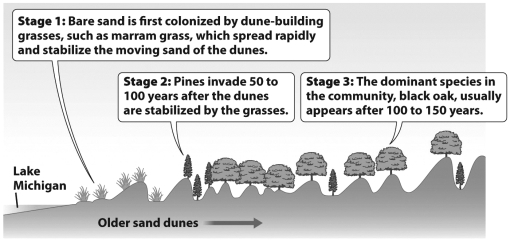 What best explains the gradual reduction of the pine?
 (Multiple Choice)
4.9/5 (67)
(67) If initially present, a climax community will reform immediately after a habitat disturbance.
(True/False)
4.7/5 (78)
(78) Anthropogenic, or human-caused, changes to ecological communities typically
(Multiple Choice)
4.7/5 (86)
(86) 
Filters
- Essay(0)
- Multiple Choice(0)
- Short Answer(0)
- True False(0)
- Matching(0)