



 Chat with AI
Exam 36: Communities of Organisms

Exam 1: The Nature of Science and the Characteristics of Life75 Questions
Exam 2: Organizing the Diversity of Life75 Questions
Exam 3: Major Groups of Living Organisms74 Questions
Exam 4: Chemical Building Blocks77 Questions
Exam 5: Cell Structure and Internal Compartments76 Questions
Exam 6: Cell Membranes, Transport, and Communication73 Questions
Exam 7: Energy and Enzymes68 Questions
Exam 8: Photosynthesis and Cellular Respiration70 Questions
Exam 9: Cell Division77 Questions
Exam 10: Patterns of Inheritance65 Questions
Exam 11: Chromosomes and Human Genetics70 Questions
Exam 12: DNA62 Questions
Exam 13: From Gene to Protein73 Questions
Exam 14: Control of Gene Expression66 Questions
Exam 15: DNA Technology64 Questions
Exam 16: How Evolution Works65 Questions
Exam 17: Evolution of Populations64 Questions
Exam 18: Adaptation and Speciation66 Questions
Exam 19: The Evolutionary History of Life69 Questions
Exam 20: Maintaining the Internal Environment66 Questions
Exam 21: Animal Nutrition and Digestion68 Questions
Exam 22: Gas Exchange68 Questions
Exam 23: The Circulatory System68 Questions
Exam 24: Animal Hormones69 Questions
Exam 25: The Nervous System69 Questions
Exam 26: Sensing the Environment66 Questions
Exam 27: Skeletons, Muscles, and Movement65 Questions
Exam 28: Defenses against Disease67 Questions
Exam 29: Reproduction and Development68 Questions
Exam 30: Animal Behavior61 Questions
Exam 31: Plant Structure, Nutrition, and Transport63 Questions
Exam 32: Plant Growth and Reproduction67 Questions
Exam 33: The Biosphere67 Questions
Exam 34: Growth of Populations65 Questions
Exam 35: Interactions among Organisms70 Questions
Exam 36: Communities of Organisms65 Questions
Exam 37: Ecosystems68 Questions
Exam 38: Global Change65 Questions
Exam 39: Biodiversity and People72 Questions
Exam 40: Cancer: Cell Division Out of Control69 Questions
Exam 41: Harnessing the Human Genome62 Questions
Exam 42: Humans and Evolution60 Questions
Exam 43: Smoking--Beyond Lung Cancer63 Questions
Exam 44: Feeding a Hungry Planet55 Questions
Exam 45: Building a Sustainable Society47 Questions
Select questions type


A community whose species are not replaced by other species is classified as a _______ community.
(Short Answer)
4.7/5  (76)
(76) Food webs, like the one in the figure below, help biologists predict the impact to a community that changes in species abundance might produce. 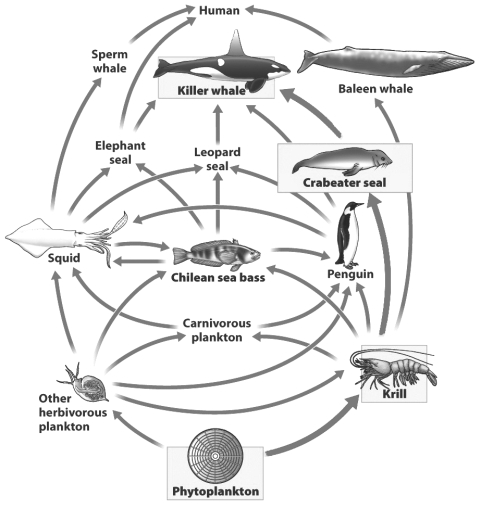 After studying the food web above, select a reasonable outcome following the complete disappearance of leopard seals.
 (Multiple Choice)
4.8/5 (90)
(90) A _______ is a single sequence of who eats whom in a community.
(Short Answer)
5.0/5 (70)
(70) In which of the following situations would secondary rather than primary succession be most likely to occur?
(Multiple Choice)
4.9/5 (88)
(88) Which of the following could represent the linear flow of energy within a food web?
(Multiple Choice)
4.9/5 (63)
(63) Why would a food web rather than a food chain be the preferred way to represent the movement of food through the community?
(Multiple Choice)
4.7/5 (80)
(80) All natural communities consist of an equivalent number of species.
(True/False)
4.9/5 (82)
(82) The process by which communities recover from _______ is known as secondary succession.
(Short Answer)
4.9/5 (72)
(72) Secondary succession is more common following a disturbance than primary succession because _____ typically remain intact.
(Short Answer)
4.9/5 (67)
(67) Although an icon of the western United States, the horse is not a native species; horses were introduced by Spanish explorers in the early 1500s. What does the integration of the horse to the semiarid grassland communities of the Southwest suggest?
(Multiple Choice)
4.8/5 (76)
(76) _______ are organisms that make their food from an external energy source, such as the sun.
(Short Answer)
4.9/5 (72)
(72) Succession has a major impact on the species makeup of a community at any given point in time.
(True/False)
4.9/5 (83)
(83) Into which category would a human be assigned when eating chicken?
(Multiple Choice)
4.8/5 (82)
(82) In a typical prairie food web, energy moves from grass to grasshopper to field mouse to fox. Which organism is the primary producer?
(Multiple Choice)
4.7/5 (78)
(78) The general process by which species in a community are replaced over time is called _______.
(Short Answer)
4.8/5 (78)
(78) If the original organisms that colonized Hawaii came from other places on Earth, why are the organisms that now live on Hawaii so different from organisms that live elsewhere on Earth?
(Multiple Choice)
4.9/5 (90)
(90) In a typical prairie food web, energy moves from grass to grasshopper to field mouse to fox. Which organism is the secondary consumer?
(Multiple Choice)
4.8/5 (89)
(89) Which of the following choices best explains, from an ecological perspective, why there are laws that require a wildlife survey before certain building or other land-use projects may proceed?
(Multiple Choice)
4.8/5 (71)
(71) Which of the following statements about communities is true?
(Multiple Choice)
4.7/5 (82)
(82) A _______ species has, relative to its own abundance, a large impact on the type and abundance of other species in its community.
(Short Answer)
4.8/5 (77)
(77) 
Filters
- Essay(0)
- Multiple Choice(0)
- Short Answer(0)
- True False(0)
- Matching(0)