



 Chat with AI
Exam 19: The Evolutionary History of Life

Exam 1: The Nature of Science and the Characteristics of Life75 Questions
Exam 2: Organizing the Diversity of Life75 Questions
Exam 3: Major Groups of Living Organisms74 Questions
Exam 4: Chemical Building Blocks77 Questions
Exam 5: Cell Structure and Internal Compartments76 Questions
Exam 6: Cell Membranes, Transport, and Communication73 Questions
Exam 7: Energy and Enzymes68 Questions
Exam 8: Photosynthesis and Cellular Respiration70 Questions
Exam 9: Cell Division77 Questions
Exam 10: Patterns of Inheritance65 Questions
Exam 11: Chromosomes and Human Genetics70 Questions
Exam 12: DNA62 Questions
Exam 13: From Gene to Protein73 Questions
Exam 14: Control of Gene Expression66 Questions
Exam 15: DNA Technology64 Questions
Exam 16: How Evolution Works65 Questions
Exam 17: Evolution of Populations64 Questions
Exam 18: Adaptation and Speciation66 Questions
Exam 19: The Evolutionary History of Life69 Questions
Exam 20: Maintaining the Internal Environment66 Questions
Exam 21: Animal Nutrition and Digestion68 Questions
Exam 22: Gas Exchange68 Questions
Exam 23: The Circulatory System68 Questions
Exam 24: Animal Hormones69 Questions
Exam 25: The Nervous System69 Questions
Exam 26: Sensing the Environment66 Questions
Exam 27: Skeletons, Muscles, and Movement65 Questions
Exam 28: Defenses against Disease67 Questions
Exam 29: Reproduction and Development68 Questions
Exam 30: Animal Behavior61 Questions
Exam 31: Plant Structure, Nutrition, and Transport63 Questions
Exam 32: Plant Growth and Reproduction67 Questions
Exam 33: The Biosphere67 Questions
Exam 34: Growth of Populations65 Questions
Exam 35: Interactions among Organisms70 Questions
Exam 36: Communities of Organisms65 Questions
Exam 37: Ecosystems68 Questions
Exam 38: Global Change65 Questions
Exam 39: Biodiversity and People72 Questions
Exam 40: Cancer: Cell Division Out of Control69 Questions
Exam 41: Harnessing the Human Genome62 Questions
Exam 42: Humans and Evolution60 Questions
Exam 43: Smoking--Beyond Lung Cancer63 Questions
Exam 44: Feeding a Hungry Planet55 Questions
Exam 45: Building a Sustainable Society47 Questions
Select questions type


The extinction of dinosaurs caused an end to the _______ between them and the mammals, thus allowing mammals to evolve to fill some ecological roles the dinosaurs had previously filled.

Free
(Short Answer)
4.8/5  (75)
(75) Correct Answer: Verified
competition
After the extinction of the dinosaurs the adaptive radiation of _______ set the stage for the eventual evolution of humans.
Free
(Short Answer)
4.7/5 (87)
(87) Correct Answer:Verified
Verifiedmammals
During the time of Pangaea (left in the figure below), an ancestor of modern crocodiles inhabited the region marked by the star in this map. 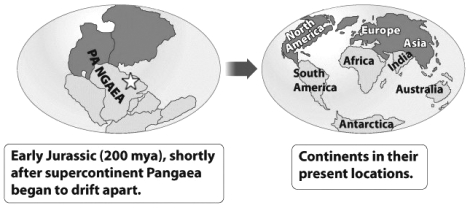 Where would you expect to find fossils of this animal today (the map on the right)?
Free
(Multiple Choice)
4.9/5 (86)
(86) Correct Answer:Verified
VerifiedC
For insects, could there be a connection between being the first organism to fly and being the most diverse terrestrial organism today?
(Multiple Choice)
4.9/5 (73)
(73) Many organisms decompose rapidly after death; some organisms had soft bodies; and some areas where organisms died have undergone massive geologic changes. For these reasons, the ______ record is incomplete.
(Short Answer)
5.0/5 (81)
(81) The evolution of higher taxonomic groups occurs in the same way as the evolution of populations.
(True/False)
4.8/5 (79)
(79) Descendants of _______ were among the first organisms to colonize land.
(Short Answer)
4.8/5 (85)
(85) The Cambrian explosion resulted in the evolution of more than 17, 000 species of an animal known as the trilobite. The shear number of trilobite fossils found in modern times suggests that trilobites were very abundant, perhaps the rulers of the seas. Today, no living descendants of this group exist. What happened?
(Multiple Choice)
4.9/5 (85)
(85) Why might many new species form in the aftermath of a mass extinction?
(Multiple Choice)
4.7/5 (75)
(75) You are looking at the side of a cliff with many clearly visible layers of rock. In the top layer you find the fossil of a mouse. In the next layer down you find the fossil of a frog. Two layers down from that you find the fossil of a beetle, and in the deepest layer the fossil of a millipede. This is evidence that
(Multiple Choice)
4.7/5 (82)
(82) Oxygen was one of the original gases in abundant in Earth's atmosphere before the evolution of life.
(True/False)
4.8/5 (72)
(72) Which of the following statements about the fossil record is true?
(Multiple Choice)
4.9/5 (78)
(78) The first eukaryotes evolved approximately ________ years ago.
(Multiple Choice)
4.9/5 (78)
(78) Fossil anklebones from the ancestors of whales and the anklebones of hippopotamuses have the same shape, which is an adaptation for running on land. This suggests that
(Multiple Choice)
4.9/5 (70)
(70) Scientists use existing fossils to predict what the transitional forms between organisms might look like. Why is it so hard for scientists to find fossils of these transitional forms?
(Multiple Choice)
4.7/5 (85)
(85) The first group of vertebrates that could complete their life cycle without returning to water were
(Multiple Choice)
4.8/5 (90)
(90) Ninety-five percent of marine invertebrate species went extinct during the _______ mass extinction
(Short Answer)
4.7/5 (77)
(77) 
Filters
- Essay(0)
- Multiple Choice(0)
- Short Answer(0)
- True False(0)
- Matching(0)