



 Chat with AI
Exam 19: The Evolutionary History of Life

Exam 1: The Nature of Science and the Characteristics of Life75 Questions
Exam 2: Organizing the Diversity of Life75 Questions
Exam 3: Major Groups of Living Organisms74 Questions
Exam 4: Chemical Building Blocks77 Questions
Exam 5: Cell Structure and Internal Compartments76 Questions
Exam 6: Cell Membranes, Transport, and Communication73 Questions
Exam 7: Energy and Enzymes68 Questions
Exam 8: Photosynthesis and Cellular Respiration70 Questions
Exam 9: Cell Division77 Questions
Exam 10: Patterns of Inheritance65 Questions
Exam 11: Chromosomes and Human Genetics70 Questions
Exam 12: DNA62 Questions
Exam 13: From Gene to Protein73 Questions
Exam 14: Control of Gene Expression66 Questions
Exam 15: DNA Technology64 Questions
Exam 16: How Evolution Works65 Questions
Exam 17: Evolution of Populations64 Questions
Exam 18: Adaptation and Speciation66 Questions
Exam 19: The Evolutionary History of Life69 Questions
Exam 20: Maintaining the Internal Environment66 Questions
Exam 21: Animal Nutrition and Digestion68 Questions
Exam 22: Gas Exchange68 Questions
Exam 23: The Circulatory System68 Questions
Exam 24: Animal Hormones69 Questions
Exam 25: The Nervous System69 Questions
Exam 26: Sensing the Environment66 Questions
Exam 27: Skeletons, Muscles, and Movement65 Questions
Exam 28: Defenses against Disease67 Questions
Exam 29: Reproduction and Development68 Questions
Exam 30: Animal Behavior61 Questions
Exam 31: Plant Structure, Nutrition, and Transport63 Questions
Exam 32: Plant Growth and Reproduction67 Questions
Exam 33: The Biosphere67 Questions
Exam 34: Growth of Populations65 Questions
Exam 35: Interactions among Organisms70 Questions
Exam 36: Communities of Organisms65 Questions
Exam 37: Ecosystems68 Questions
Exam 38: Global Change65 Questions
Exam 39: Biodiversity and People72 Questions
Exam 40: Cancer: Cell Division Out of Control69 Questions
Exam 41: Harnessing the Human Genome62 Questions
Exam 42: Humans and Evolution60 Questions
Exam 43: Smoking--Beyond Lung Cancer63 Questions
Exam 44: Feeding a Hungry Planet55 Questions
Exam 45: Building a Sustainable Society47 Questions
Select questions type


The appearance of eukaryotes may have been delayed until more _______ accumulated in Earth's atmosphere.
(Multiple Choice)
4.7/5  (86)
(86) The figure below shows the number of living families that existed on Earth during the last 540 million years. The sudden decreases in family number at 445, 360, 250, 200 and 65 million years ago represent Earth's five mass extinction events. 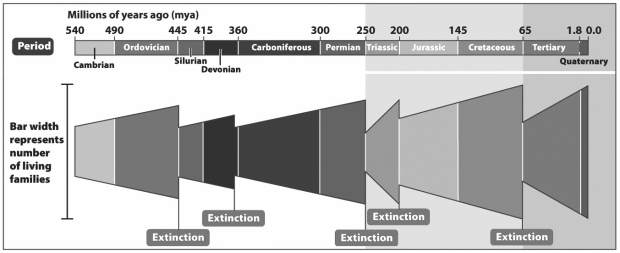 Based on this data, which mass extinction had the biggest impact on the overall diversity of life on Earth?
 (Multiple Choice)
4.9/5 (91)
(91) Which of the following represents the order in which terrestrial life evolved?
(Multiple Choice)
4.9/5 (89)
(89) Examine the graph below. 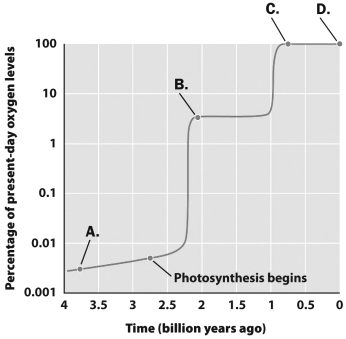 At which labeled point in this graph are the first eukaryotes thought to have evolved?
 (Multiple Choice)
4.9/5 (83)
(83) Which of the following is not a key step in the evolutionary transition from reptiles to mammals?
(Multiple Choice)
4.9/5 (87)
(87) North America and Europe are slowly but surely drifting away from one another.
(True/False)
4.7/5 (77)
(77) Life evolved on land long after there had been life in the oceans. Which of the following had to occur before organisms were able to live on land?
(Multiple Choice)
4.9/5 (81)
(81) 
Filters
- Essay(0)
- Multiple Choice(0)
- Short Answer(0)
- True False(0)
- Matching(0)