



 Chat with AI
Exam 4: Chemical Building Blocks

Exam 1: The Nature of Science and the Characteristics of Life75 Questions
Exam 2: Organizing the Diversity of Life75 Questions
Exam 3: Major Groups of Living Organisms74 Questions
Exam 4: Chemical Building Blocks77 Questions
Exam 5: Cell Structure and Internal Compartments76 Questions
Exam 6: Cell Membranes, Transport, and Communication73 Questions
Exam 7: Energy and Enzymes68 Questions
Exam 8: Photosynthesis and Cellular Respiration70 Questions
Exam 9: Cell Division77 Questions
Exam 10: Patterns of Inheritance65 Questions
Exam 11: Chromosomes and Human Genetics70 Questions
Exam 12: DNA62 Questions
Exam 13: From Gene to Protein73 Questions
Exam 14: Control of Gene Expression66 Questions
Exam 15: DNA Technology64 Questions
Exam 16: How Evolution Works65 Questions
Exam 17: Evolution of Populations64 Questions
Exam 18: Adaptation and Speciation66 Questions
Exam 19: The Evolutionary History of Life69 Questions
Exam 20: Maintaining the Internal Environment66 Questions
Exam 21: Animal Nutrition and Digestion68 Questions
Exam 22: Gas Exchange68 Questions
Exam 23: The Circulatory System68 Questions
Exam 24: Animal Hormones69 Questions
Exam 25: The Nervous System69 Questions
Exam 26: Sensing the Environment66 Questions
Exam 27: Skeletons, Muscles, and Movement65 Questions
Exam 28: Defenses against Disease67 Questions
Exam 29: Reproduction and Development68 Questions
Exam 30: Animal Behavior61 Questions
Exam 31: Plant Structure, Nutrition, and Transport63 Questions
Exam 32: Plant Growth and Reproduction67 Questions
Exam 33: The Biosphere67 Questions
Exam 34: Growth of Populations65 Questions
Exam 35: Interactions among Organisms70 Questions
Exam 36: Communities of Organisms65 Questions
Exam 37: Ecosystems68 Questions
Exam 38: Global Change65 Questions
Exam 39: Biodiversity and People72 Questions
Exam 40: Cancer: Cell Division Out of Control69 Questions
Exam 41: Harnessing the Human Genome62 Questions
Exam 42: Humans and Evolution60 Questions
Exam 43: Smoking--Beyond Lung Cancer63 Questions
Exam 44: Feeding a Hungry Planet55 Questions
Exam 45: Building a Sustainable Society47 Questions
Select questions type


Oxygen has six electrons in its outer shell that can hold up to eight electrons. As a result, oxygen can form up to _____ covalent bonds.

Free
(Short Answer)
4.9/5  (80)
(80) Correct Answer: Verified
two
Nucleic acids contain phosphorus but not sulfur.
Free
(True/False)
4.9/5 (66)
(66) Correct Answer:Verified
VerifiedTrue
Oil and water do not mix together well because
Free
(Multiple Choice)
4.9/5 (65)
(65) Correct Answer:Verified
VerifiedA
Most lipids contain one or more _____ _____, long, hydrophobic hydrocarbon chains.
(Short Answer)
4.9/5 (86)
(86) The process of partial hydrogenation turns liquid plant lipids into semi-solid lipids by
(Multiple Choice)
4.8/5 (58)
(58) In the figure below, a negative ion is surrounded by water molecules. 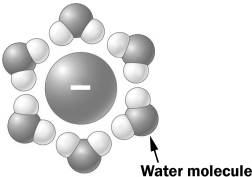 The water molecules are oriented as shown above because the slightly _____________ in the water molecule is (are) attracted to the ion.
 (Multiple Choice)
4.9/5 (75)
(75) A _______ is a compound that maintains the pH of a solution by taking up or releasing hydrogen ions.
(Short Answer)
4.8/5 (72)
(72) _____ are the most hydrophobic of the four classes of organic compounds because they are made of hydrocarbon chains that repel water.
(Short Answer)
4.8/5 (82)
(82) In the equation 3H₂+N₂→2NH₃, how many molecules of hydrogen gas (H₂) are present?
(Multiple Choice)
4.9/5 (74)
(74) _________ are types of proteins that speed up the rate of chemical reactions in the cell.
(Short Answer)
4.8/5 (92)
(92) The figure below shows two hydrogen atoms.  How many covalent bonds will form between these two atoms?
 (Multiple Choice)
4.9/5 (92)
(92) An atom that becomes charged due to the gain or loss of an electron is called an _______.
(Short Answer)
4.8/5 (77)
(77) A monosaccharide is made up of several sugar molecules strung together.
(True/False)
4.9/5 (75)
(75) ________ ________ are a type of organic compound that plays roles in both heredity and the energy delivery in cells.
(Short Answer)
4.8/5 (83)
(83) 
Filters
- Essay(0)
- Multiple Choice(0)
- Short Answer(0)
- True False(0)
- Matching(0)