



 Chat with AI
Exam 35: Interactions among Organisms

Exam 1: The Nature of Science and the Characteristics of Life75 Questions
Exam 2: Organizing the Diversity of Life75 Questions
Exam 3: Major Groups of Living Organisms74 Questions
Exam 4: Chemical Building Blocks77 Questions
Exam 5: Cell Structure and Internal Compartments76 Questions
Exam 6: Cell Membranes, Transport, and Communication73 Questions
Exam 7: Energy and Enzymes68 Questions
Exam 8: Photosynthesis and Cellular Respiration70 Questions
Exam 9: Cell Division77 Questions
Exam 10: Patterns of Inheritance65 Questions
Exam 11: Chromosomes and Human Genetics70 Questions
Exam 12: DNA62 Questions
Exam 13: From Gene to Protein73 Questions
Exam 14: Control of Gene Expression66 Questions
Exam 15: DNA Technology64 Questions
Exam 16: How Evolution Works65 Questions
Exam 17: Evolution of Populations64 Questions
Exam 18: Adaptation and Speciation66 Questions
Exam 19: The Evolutionary History of Life69 Questions
Exam 20: Maintaining the Internal Environment66 Questions
Exam 21: Animal Nutrition and Digestion68 Questions
Exam 22: Gas Exchange68 Questions
Exam 23: The Circulatory System68 Questions
Exam 24: Animal Hormones69 Questions
Exam 25: The Nervous System69 Questions
Exam 26: Sensing the Environment66 Questions
Exam 27: Skeletons, Muscles, and Movement65 Questions
Exam 28: Defenses against Disease67 Questions
Exam 29: Reproduction and Development68 Questions
Exam 30: Animal Behavior61 Questions
Exam 31: Plant Structure, Nutrition, and Transport63 Questions
Exam 32: Plant Growth and Reproduction67 Questions
Exam 33: The Biosphere67 Questions
Exam 34: Growth of Populations65 Questions
Exam 35: Interactions among Organisms70 Questions
Exam 36: Communities of Organisms65 Questions
Exam 37: Ecosystems68 Questions
Exam 38: Global Change65 Questions
Exam 39: Biodiversity and People72 Questions
Exam 40: Cancer: Cell Division Out of Control69 Questions
Exam 41: Harnessing the Human Genome62 Questions
Exam 42: Humans and Evolution60 Questions
Exam 43: Smoking--Beyond Lung Cancer63 Questions
Exam 44: Feeding a Hungry Planet55 Questions
Exam 45: Building a Sustainable Society47 Questions
Select questions type


The corals in tropical reefs have a mutualistic relationship with

Free
(Multiple Choice)
4.9/5  (83)
(83) Correct Answer: Verified
A
Antibiotic therapy sometimes reduces the population of gut-inhabiting microorganisms. Bloating and diarrhea often follow until the populations reestablish themselves. This observation suggests that these microorganisms participate in a ____ relationship with humans.
Free
(Multiple Choice)
4.7/5 (84)
(84) Correct Answer:Verified
VerifiedC
If a bird eats a monarch butterfly, the bird will vomit. Monarchs are brightly colored. This example demonstrates _______ coloration.
Free
(Short Answer)
4.9/5 (85)
(85) Correct Answer:Verified
Verifiedwarning
The fact that some organisms live in herds or flocks in order to protect themselves from predators is an example of _______ modification.
(Short Answer)
4.8/5 (82)
(82) The evolution of the animal immune system was probably driven by
(Multiple Choice)
4.9/5 (73)
(73) Examine the graph below. 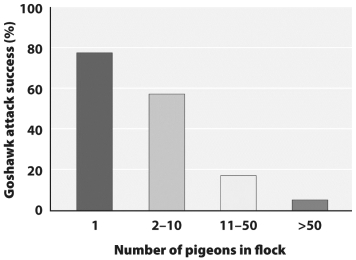 Research indicates that goshawk predation is much less effective when prey species, like wood pigeons, are in large flocks. If this is true why do any small flocks exist at all?
 (Multiple Choice)
4.9/5 (92)
(92) In the course of observing cacti from several islands, researchers noted that on islands where cacti had been grazed by cows, they developed more spines per plant. This example shows that
(Multiple Choice)
4.9/5 (66)
(66) A deer and a caterpillar are peacefully munching on the leaves of the same apple tree. This is an example of
(Multiple Choice)
4.9/5 (81)
(81) The relationship between house pets and people would be best described as
(Multiple Choice)
4.9/5 (73)
(73) A praying mantis captures and devours many pest insects. The relationship between the mantis and a grasshopper it is eating is one of
(Multiple Choice)
4.8/5 (75)
(75) Responses that are directly stimulated by an attack from herbivores are _______ responses.
(Short Answer)
4.8/5 (65)
(65) The release of a parasitic wasp in California helped control the infestation of scale insects on citrus trees. However, it also caused the near-extinction of a different species of parasitic wasp. Should we consider this experiment an unqualified success?
(Multiple Choice)
5.0/5 (79)
(79) Human cells contain mitochondria, which are responsible for processing the energy needed by our cells. Remember that the ancestors of mitochondria may once have been free-living prokaryotes. If mitochondria were still considered to be separate organisms within our cells, which of the following would best describe our relationship with them?
(Multiple Choice)
5.0/5 (78)
(78) When two similar species inhabit in the same area, they may over time evolve to become more different and
(Multiple Choice)
4.9/5 (82)
(82) The interactions among organisms that reside in the same community or ecosystem are unlikely to have much effect on the physical aspects of those systems.
(True/False)
4.8/5 (78)
(78) Flies belonging to the family Phoridae inject their eggs into fire ants. A larva that hatches from the egg devours the ant from the inside. The larva would be called a
(Multiple Choice)
4.8/5 (81)
(81) During exploitation, consumer organisms never cause their prey to become extinct.
(True/False)
4.7/5 (62)
(62) A species can participate in several symbiotic relationships simultaneously; for example, the invasive fire tree competes with native vegetation for soil nutrients and maintains a mutualistic relationship with root bacteria.
(True/False)
4.9/5 (88)
(88) 
Filters
- Essay(0)
- Multiple Choice(0)
- Short Answer(0)
- True False(0)
- Matching(0)