



 Chat with AI
Exam 35: Interactions among Organisms

Exam 1: The Nature of Science and the Characteristics of Life75 Questions
Exam 2: Organizing the Diversity of Life75 Questions
Exam 3: Major Groups of Living Organisms74 Questions
Exam 4: Chemical Building Blocks77 Questions
Exam 5: Cell Structure and Internal Compartments76 Questions
Exam 6: Cell Membranes, Transport, and Communication73 Questions
Exam 7: Energy and Enzymes68 Questions
Exam 8: Photosynthesis and Cellular Respiration70 Questions
Exam 9: Cell Division77 Questions
Exam 10: Patterns of Inheritance65 Questions
Exam 11: Chromosomes and Human Genetics70 Questions
Exam 12: DNA62 Questions
Exam 13: From Gene to Protein73 Questions
Exam 14: Control of Gene Expression66 Questions
Exam 15: DNA Technology64 Questions
Exam 16: How Evolution Works65 Questions
Exam 17: Evolution of Populations64 Questions
Exam 18: Adaptation and Speciation66 Questions
Exam 19: The Evolutionary History of Life69 Questions
Exam 20: Maintaining the Internal Environment66 Questions
Exam 21: Animal Nutrition and Digestion68 Questions
Exam 22: Gas Exchange68 Questions
Exam 23: The Circulatory System68 Questions
Exam 24: Animal Hormones69 Questions
Exam 25: The Nervous System69 Questions
Exam 26: Sensing the Environment66 Questions
Exam 27: Skeletons, Muscles, and Movement65 Questions
Exam 28: Defenses against Disease67 Questions
Exam 29: Reproduction and Development68 Questions
Exam 30: Animal Behavior61 Questions
Exam 31: Plant Structure, Nutrition, and Transport63 Questions
Exam 32: Plant Growth and Reproduction67 Questions
Exam 33: The Biosphere67 Questions
Exam 34: Growth of Populations65 Questions
Exam 35: Interactions among Organisms70 Questions
Exam 36: Communities of Organisms65 Questions
Exam 37: Ecosystems68 Questions
Exam 38: Global Change65 Questions
Exam 39: Biodiversity and People72 Questions
Exam 40: Cancer: Cell Division Out of Control69 Questions
Exam 41: Harnessing the Human Genome62 Questions
Exam 42: Humans and Evolution60 Questions
Exam 43: Smoking--Beyond Lung Cancer63 Questions
Exam 44: Feeding a Hungry Planet55 Questions
Exam 45: Building a Sustainable Society47 Questions
Select questions type


A tapeworm is living in the intestine of a human and absorbing nutrients. The relationship is one of
(Multiple Choice)
4.8/5  (82)
(82) The figure below shows that the cohabitating ground finches on Pinta Island experienced character displacement, with birds specializing in either smaller seeds or larger seeds. 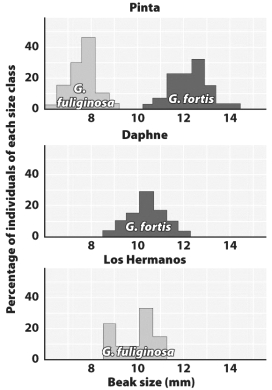 Predict the outcome of this coinhabitation if large and small seeds had not been initially available.
 (Multiple Choice)
4.8/5 (87)
(87) The relationship among plants growing in a woodland and living in high density with limited resources can best be described as
(Multiple Choice)
4.9/5 (74)
(74) If an animal is an herbivore, does that mean it cannot have interactions with organisms other than the plants it eats?
(Multiple Choice)
4.8/5 (74)
(74) Beech drops are plants that no longer photosynthesize. They obtain nutrition by extending their roots into a beech tree and intercepting the flow of sap. Beech drops would be considered a _______ of beech trees.
(Multiple Choice)
4.9/5 (90)
(90) As the figure below illustrates, the distribution of numerous intertidal organisms is restricted to bands or zones. The upper limit to the zone is determined by tolerance to physical factors like desiccation while the lower boundary is determined by a biological interaction such as competition. 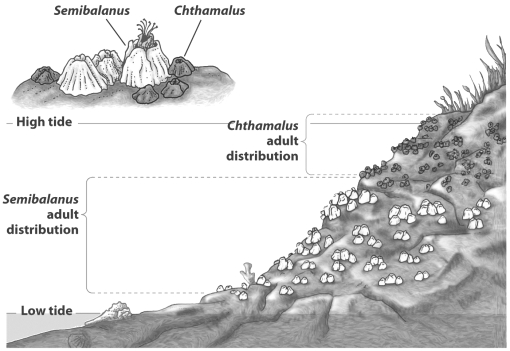 What could account for the lower limit for Semibalanus?
 (Multiple Choice)
4.9/5 (80)
(80) Some algae and fungi live in associations known as lichens, which allow both to survive in a harsher environment than either could normally live in alone. This association is an example of
(Multiple Choice)
4.9/5 (87)
(87) Pollinators carry seeds in their digestive tracts and later deposit them far from the plant that they fed on.
(True/False)
4.9/5 (81)
(81) The terms mutualistic and symbiotic can be used interchangeably; any mutualistic relationship is an example of symbiosis while any symbiotic relationship is also mutualistic.
(True/False)
4.8/5 (86)
(86) The bacteria in yogurt can colonize the human intestine and participate in a symbiotic relationship called ______.
(Short Answer)
4.9/5 (63)
(63) An animal eats fruit from a plant and later deposits seed in its feces far from the plant. This is an example of a
(Multiple Choice)
4.9/5 (71)
(71) The relationship between humans and domesticated livestock is
(Multiple Choice)
4.8/5 (72)
(72) Which of the following symbols represents a mutualistic relationship?
(Multiple Choice)
4.9/5 (74)
(74) Female ducks frequently deposit fertile eggs in the nests of unattended neighboring ducks. These eggs hatch and are then reared by the foster parent. What term best describes this behavior?
(Multiple Choice)
4.8/5 (80)
(80) Which of the following statements about competition is false?
(Multiple Choice)
4.8/5 (88)
(88) The consumer in a predator/prey interaction can be a selective force in the evolution of the prey species.
(True/False)
4.7/5 (79)
(79) 
Filters
- Essay(0)
- Multiple Choice(0)
- Short Answer(0)
- True False(0)
- Matching(0)