



 Chat with AI
Exam 24: Animal Hormones

Exam 1: The Nature of Science and the Characteristics of Life75 Questions
Exam 2: Organizing the Diversity of Life75 Questions
Exam 3: Major Groups of Living Organisms74 Questions
Exam 4: Chemical Building Blocks77 Questions
Exam 5: Cell Structure and Internal Compartments76 Questions
Exam 6: Cell Membranes, Transport, and Communication73 Questions
Exam 7: Energy and Enzymes68 Questions
Exam 8: Photosynthesis and Cellular Respiration70 Questions
Exam 9: Cell Division77 Questions
Exam 10: Patterns of Inheritance65 Questions
Exam 11: Chromosomes and Human Genetics70 Questions
Exam 12: DNA62 Questions
Exam 13: From Gene to Protein73 Questions
Exam 14: Control of Gene Expression66 Questions
Exam 15: DNA Technology64 Questions
Exam 16: How Evolution Works65 Questions
Exam 17: Evolution of Populations64 Questions
Exam 18: Adaptation and Speciation66 Questions
Exam 19: The Evolutionary History of Life69 Questions
Exam 20: Maintaining the Internal Environment66 Questions
Exam 21: Animal Nutrition and Digestion68 Questions
Exam 22: Gas Exchange68 Questions
Exam 23: The Circulatory System68 Questions
Exam 24: Animal Hormones69 Questions
Exam 25: The Nervous System69 Questions
Exam 26: Sensing the Environment66 Questions
Exam 27: Skeletons, Muscles, and Movement65 Questions
Exam 28: Defenses against Disease67 Questions
Exam 29: Reproduction and Development68 Questions
Exam 30: Animal Behavior61 Questions
Exam 31: Plant Structure, Nutrition, and Transport63 Questions
Exam 32: Plant Growth and Reproduction67 Questions
Exam 33: The Biosphere67 Questions
Exam 34: Growth of Populations65 Questions
Exam 35: Interactions among Organisms70 Questions
Exam 36: Communities of Organisms65 Questions
Exam 37: Ecosystems68 Questions
Exam 38: Global Change65 Questions
Exam 39: Biodiversity and People72 Questions
Exam 40: Cancer: Cell Division Out of Control69 Questions
Exam 41: Harnessing the Human Genome62 Questions
Exam 42: Humans and Evolution60 Questions
Exam 43: Smoking--Beyond Lung Cancer63 Questions
Exam 44: Feeding a Hungry Planet55 Questions
Exam 45: Building a Sustainable Society47 Questions
Select questions type


Which of the following statements about the functions follicle stimulating hormone (FSH) and luteinizing hormone (LH) is false?

Free
(Multiple Choice)
4.9/5  (83)
(83) Correct Answer: Verified
D
During menopause, lower levels of estrogen cause a woman's bone to break down, releasing calcium to the body. How might this affect the levels of calcitonin and parathyroid hormone (PTH) in an otherwise healthy woman going through menopause?
Free
(Multiple Choice)
5.0/5 (75)
(75) Correct Answer:Verified
VerifiedA
In humans, sex hormones only begin to work after birth.
Free
(True/False)
4.8/5 (72)
(72) Correct Answer:Verified
VerifiedFalse
A single hormone can have different effects on different tissues.
(True/False)
4.9/5 (87)
(87) In human females, the release of an egg from its follicle is called _________.
(Short Answer)
4.8/5 (91)
(91) The pancreas regulates _______ levels in the blood by producing a pair of antagonistic hormones.
(Short Answer)
4.8/5 (84)
(84) Which of the following statements about the human reproductive system is true?
(Multiple Choice)
4.7/5 (84)
(84) The graph below shows the levels of gonadotropins throughout the menstrual cycle.
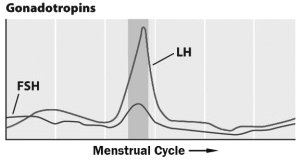 The darker gray region of the graph corresponds to the period when __________ occurs in the ovaries.
 (Short Answer)
4.9/5 (72)
(72) Which of the following statements about gonadotropins is false?
(Multiple Choice)
4.8/5 (94)
(94) The 28-day menstrual cycle is regulated by __________ and _____________, both of which are produced in the female gonad.
(Short Answer)
4.7/5 (77)
(77) The high levels of progesterone seen after ovulation in the human female are produced by a specific region of the ovary known as the __________ ___________, which disappears if pregnancy doesn't occur.
(Short Answer)
4.8/5 (82)
(82) By what mechanism do most hormones travel through the organism that produces them?
(Multiple Choice)
4.7/5 (85)
(85) The hormone-producing tissues of animals make up the _______ system.
(Short Answer)
4.9/5 (91)
(91) In human females, eggs begin to develop at puberty due to the release of
(Multiple Choice)
4.7/5 (68)
(68) Some hormones do not need receptors and can directly interact with genes in a target cell's nucleus.
(True/False)
4.7/5 (68)
(68) Serotonin, one of the hormones thought to be involved in depression, is a water-soluble molecule. Where on the target cell would you expect to find receptors for this hormone?
(Multiple Choice)
4.9/5 (89)
(89) A single hormone molecule can have dramatic effects on a target cell, because it
(Multiple Choice)
4.9/5 (75)
(75) 
Filters
- Essay(0)
- Multiple Choice(0)
- Short Answer(0)
- True False(0)
- Matching(0)