



 Chat with AI
Exam 24: Animal Hormones

Exam 1: The Nature of Science and the Characteristics of Life75 Questions
Exam 2: Organizing the Diversity of Life75 Questions
Exam 3: Major Groups of Living Organisms74 Questions
Exam 4: Chemical Building Blocks77 Questions
Exam 5: Cell Structure and Internal Compartments76 Questions
Exam 6: Cell Membranes, Transport, and Communication73 Questions
Exam 7: Energy and Enzymes68 Questions
Exam 8: Photosynthesis and Cellular Respiration70 Questions
Exam 9: Cell Division77 Questions
Exam 10: Patterns of Inheritance65 Questions
Exam 11: Chromosomes and Human Genetics70 Questions
Exam 12: DNA62 Questions
Exam 13: From Gene to Protein73 Questions
Exam 14: Control of Gene Expression66 Questions
Exam 15: DNA Technology64 Questions
Exam 16: How Evolution Works65 Questions
Exam 17: Evolution of Populations64 Questions
Exam 18: Adaptation and Speciation66 Questions
Exam 19: The Evolutionary History of Life69 Questions
Exam 20: Maintaining the Internal Environment66 Questions
Exam 21: Animal Nutrition and Digestion68 Questions
Exam 22: Gas Exchange68 Questions
Exam 23: The Circulatory System68 Questions
Exam 24: Animal Hormones69 Questions
Exam 25: The Nervous System69 Questions
Exam 26: Sensing the Environment66 Questions
Exam 27: Skeletons, Muscles, and Movement65 Questions
Exam 28: Defenses against Disease67 Questions
Exam 29: Reproduction and Development68 Questions
Exam 30: Animal Behavior61 Questions
Exam 31: Plant Structure, Nutrition, and Transport63 Questions
Exam 32: Plant Growth and Reproduction67 Questions
Exam 33: The Biosphere67 Questions
Exam 34: Growth of Populations65 Questions
Exam 35: Interactions among Organisms70 Questions
Exam 36: Communities of Organisms65 Questions
Exam 37: Ecosystems68 Questions
Exam 38: Global Change65 Questions
Exam 39: Biodiversity and People72 Questions
Exam 40: Cancer: Cell Division Out of Control69 Questions
Exam 41: Harnessing the Human Genome62 Questions
Exam 42: Humans and Evolution60 Questions
Exam 43: Smoking--Beyond Lung Cancer63 Questions
Exam 44: Feeding a Hungry Planet55 Questions
Exam 45: Building a Sustainable Society47 Questions
Select questions type


Steroid hormones bind to receptors located in the cytoplasm of the cell because
(Multiple Choice)
4.9/5  (80)
(80) In response to a dangerous situation, your body has produced epinephrine and norepinephrine. As the danger dissipates, how might the pancreas respond?
(Multiple Choice)
4.8/5 (71)
(71) A person who starts producing high levels of calcitonin probably has
(Multiple Choice)
4.8/5 (86)
(86) Four to six weeks after conception, sex hormones trigger the production of the appropriate male or female ________, or sex organs, in an embryo.
(Short Answer)
4.8/5 (68)
(68) The development of all female reproductive structures is under the control of a single hormone.
(True/False)
4.9/5 (81)
(81) The parathyroid gland of a person with hyperparathyroidism produces very high levels of parathyroid hormone (PTH). You would expect a person with this condition to have
(Multiple Choice)
4.8/5 (79)
(79) You are walking in the woods and suddenly find yourself between a mother bear and her two cubs. All four nervous systems would send the same emergency message to the
(Multiple Choice)
4.8/5 (71)
(71) Which of the following would be least affected by gonadotropins?
(Multiple Choice)
4.9/5 (69)
(69) Four stages in the process of balancing glucose levels in the blood are highlighted by letters in the figure below. 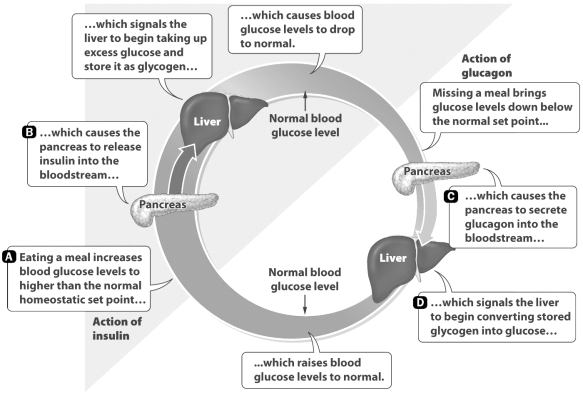 Which letter corresponds to the stage that is impacted by type 2 diabetes?
 (Multiple Choice)
4.8/5 (79)
(79) Antidiuretic hormone (ADH) is produced by your pituitary gland when your brain detects lower than optimum levels of water in the body. In the kidneys, ADH promotes the uptake of water, creating more concentrated urine. ADH gets from the pituitary gland to the kidney through the
(Multiple Choice)
4.9/5 (87)
(87) Luteinizing hormone and follicle-stimulating hormone both come from the pituitary gland.
(True/False)
4.7/5 (75)
(75) 
Filters
- Essay(0)
- Multiple Choice(0)
- Short Answer(0)
- True False(0)
- Matching(0)