



 Chat with AI
Exam 39: Biodiversity and People

Exam 1: The Nature of Science and the Characteristics of Life75 Questions
Exam 2: Organizing the Diversity of Life75 Questions
Exam 3: Major Groups of Living Organisms74 Questions
Exam 4: Chemical Building Blocks77 Questions
Exam 5: Cell Structure and Internal Compartments76 Questions
Exam 6: Cell Membranes, Transport, and Communication73 Questions
Exam 7: Energy and Enzymes68 Questions
Exam 8: Photosynthesis and Cellular Respiration70 Questions
Exam 9: Cell Division77 Questions
Exam 10: Patterns of Inheritance65 Questions
Exam 11: Chromosomes and Human Genetics70 Questions
Exam 12: DNA62 Questions
Exam 13: From Gene to Protein73 Questions
Exam 14: Control of Gene Expression66 Questions
Exam 15: DNA Technology64 Questions
Exam 16: How Evolution Works65 Questions
Exam 17: Evolution of Populations64 Questions
Exam 18: Adaptation and Speciation66 Questions
Exam 19: The Evolutionary History of Life69 Questions
Exam 20: Maintaining the Internal Environment66 Questions
Exam 21: Animal Nutrition and Digestion68 Questions
Exam 22: Gas Exchange68 Questions
Exam 23: The Circulatory System68 Questions
Exam 24: Animal Hormones69 Questions
Exam 25: The Nervous System69 Questions
Exam 26: Sensing the Environment66 Questions
Exam 27: Skeletons, Muscles, and Movement65 Questions
Exam 28: Defenses against Disease67 Questions
Exam 29: Reproduction and Development68 Questions
Exam 30: Animal Behavior61 Questions
Exam 31: Plant Structure, Nutrition, and Transport63 Questions
Exam 32: Plant Growth and Reproduction67 Questions
Exam 33: The Biosphere67 Questions
Exam 34: Growth of Populations65 Questions
Exam 35: Interactions among Organisms70 Questions
Exam 36: Communities of Organisms65 Questions
Exam 37: Ecosystems68 Questions
Exam 38: Global Change65 Questions
Exam 39: Biodiversity and People72 Questions
Exam 40: Cancer: Cell Division Out of Control69 Questions
Exam 41: Harnessing the Human Genome62 Questions
Exam 42: Humans and Evolution60 Questions
Exam 43: Smoking--Beyond Lung Cancer63 Questions
Exam 44: Feeding a Hungry Planet55 Questions
Exam 45: Building a Sustainable Society47 Questions
Select questions type


The number of species of organisms on Earth is estimated to range between

Free
(Multiple Choice)
4.8/5  (68)
(68) Correct Answer: Verified
C
Examine the figure below, which shows a housing development. 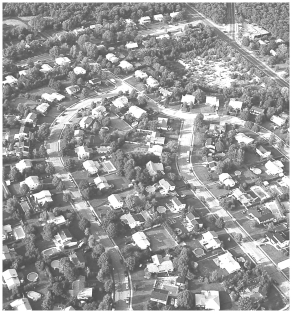 In what way(s) does this use of the land differ from the forest present prior to the construction of the development?
Free
(Multiple Choice)
4.9/5 (83)
(83) Correct Answer:Verified
VerifiedC
Anthropologists note that the arrival of humans almost always corresponds to the disappearance of large carnivorous animal species. What type of problem would the loss of these animals cause?
Free
(Multiple Choice)
4.8/5 (77)
(77) Correct Answer:Verified
VerifiedA
Human developments like housing, shopping centers, or highways typically
(Multiple Choice)
4.9/5 (74)
(74) Nonnative species can be accidentally or intentionally introduced into a new habitat; in most instances
(Multiple Choice)
4.8/5 (90)
(90) Those events during which many species become _______ are called mass extinction events.
(Short Answer)
4.8/5 (77)
(77) _______ activity appears to have the potential to cause a decline in the diversity of life on Earth equal to those of past mass extinctions.
(Short Answer)
4.9/5 (70)
(70) Ocean reefs typically require millions of years to recover from mass extinctions.
(True/False)
4.7/5 (85)
(85) _______ is the term used to describe the variety of the world's species of organisms.
(Short Answer)
4.9/5 (84)
(84) As a byproduct of their photosynthesis, _______ produce most of the oxygen in the atmosphere.
(Short Answer)
4.8/5 (80)
(80) Abandoned woodpecker cavities are used by many songbirds unable to create their own. The starling, an invasive species in N. America, aggressively competes for these cavities. Either a(n) _______ in woodpecker populations or a(n) _______ in the starling population has the potential to further reduce songbird populations.
(Multiple Choice)
4.7/5 (70)
(70) It is estimated that as many as 74 species become extinct daily; if a species has become extinct,
(Multiple Choice)
4.8/5 (72)
(72) Numerous threats to biodiversity have recently been identified, however, ______ is(are) not included among them.
(Multiple Choice)
4.7/5 (87)
(87) As humans, our primary concern(s) with the present mass extinction should be that
(Multiple Choice)
5.0/5 (61)
(61) Where would you expect to find the largest number of different species?
(Multiple Choice)
4.8/5 (79)
(79) At least five mass extinction events have occurred during the history of life; the event that impacted the dinosaurs took place
(Multiple Choice)
4.8/5 (86)
(86) Housing developments tend to stabilize surrounding habitats by creating roadways, which channel runoff and minimize erosion.
(True/False)
4.9/5 (87)
(87) Those organisms whose distinctive features are primarily microscopic are challenging to study; thus, the most poorly known kingdoms are the Fungi, the Bacteria, and the __________ .
(Short Answer)
4.9/5 (85)
(85) A current hypothesis suggests the decline in amphibian reproductive success is caused by an increased exposure to _______ light that in turn is related to global climate change.
(Short Answer)
4.8/5 (93)
(93) 
Filters
- Essay(0)
- Multiple Choice(0)
- Short Answer(0)
- True False(0)
- Matching(0)