



 Chat with AI
Exam 18: Adaptation and Speciation

Exam 1: The Nature of Science and the Characteristics of Life75 Questions
Exam 2: Organizing the Diversity of Life75 Questions
Exam 3: Major Groups of Living Organisms74 Questions
Exam 4: Chemical Building Blocks77 Questions
Exam 5: Cell Structure and Internal Compartments76 Questions
Exam 6: Cell Membranes, Transport, and Communication73 Questions
Exam 7: Energy and Enzymes68 Questions
Exam 8: Photosynthesis and Cellular Respiration70 Questions
Exam 9: Cell Division77 Questions
Exam 10: Patterns of Inheritance65 Questions
Exam 11: Chromosomes and Human Genetics70 Questions
Exam 12: DNA62 Questions
Exam 13: From Gene to Protein73 Questions
Exam 14: Control of Gene Expression66 Questions
Exam 15: DNA Technology64 Questions
Exam 16: How Evolution Works65 Questions
Exam 17: Evolution of Populations64 Questions
Exam 18: Adaptation and Speciation66 Questions
Exam 19: The Evolutionary History of Life69 Questions
Exam 20: Maintaining the Internal Environment66 Questions
Exam 21: Animal Nutrition and Digestion68 Questions
Exam 22: Gas Exchange68 Questions
Exam 23: The Circulatory System68 Questions
Exam 24: Animal Hormones69 Questions
Exam 25: The Nervous System69 Questions
Exam 26: Sensing the Environment66 Questions
Exam 27: Skeletons, Muscles, and Movement65 Questions
Exam 28: Defenses against Disease67 Questions
Exam 29: Reproduction and Development68 Questions
Exam 30: Animal Behavior61 Questions
Exam 31: Plant Structure, Nutrition, and Transport63 Questions
Exam 32: Plant Growth and Reproduction67 Questions
Exam 33: The Biosphere67 Questions
Exam 34: Growth of Populations65 Questions
Exam 35: Interactions among Organisms70 Questions
Exam 36: Communities of Organisms65 Questions
Exam 37: Ecosystems68 Questions
Exam 38: Global Change65 Questions
Exam 39: Biodiversity and People72 Questions
Exam 40: Cancer: Cell Division Out of Control69 Questions
Exam 41: Harnessing the Human Genome62 Questions
Exam 42: Humans and Evolution60 Questions
Exam 43: Smoking--Beyond Lung Cancer63 Questions
Exam 44: Feeding a Hungry Planet55 Questions
Exam 45: Building a Sustainable Society47 Questions
Select questions type


Which of the following does not provide an example of geographic isolation?

Free
(Multiple Choice)
4.9/5  (70)
(70) Correct Answer: Verified
D
An organism is polyploid if it has more than two complete sets of ________.
Free
(Short Answer)
4.8/5 (85)
(85) Correct Answer:Verified
Verifiedchromosomes
Which of the following most likely is not an adaptation by plants to attract animals for assistance with mating?
Free
(Multiple Choice)
4.9/5 (74)
(74) Correct Answer:Verified
VerifiedC
Geographic isolation limits the _______ between populations of a species.
(Multiple Choice)
4.7/5 (81)
(81) For two populations to accumulate enough genetic differences to cause speciation, the factors that promote these differences
(Multiple Choice)
4.8/5 (81)
(81) Great controversy exists regarding the "hobbits" of Flores Island. Which of the following arguments would not support the hypothesis that hobbits are the same species as modern humans?
(Multiple Choice)
4.9/5 (66)
(66) Which of the following is a postzygotic isolating mechanism?
(Multiple Choice)
4.9/5 (82)
(82) Which of the following is responsible for the nearly perfect match in color pattern between a species of praying mantis (an insect) and the leaves on which it rests?
(Multiple Choice)
4.8/5 (84)
(84) Two species live in the same area but breed in different parts of their habitat. These species are
(Multiple Choice)
4.9/5 (76)
(76) The death of zygotes produced by the mating of individuals of two different populations is an example of how ___________ barriers can lead to reproductive isolation.
(Short Answer)
4.9/5 (88)
(88) In the figure below (left), two populations of one species of fruit flies are raised for several generations on different nutrients (starch and maltose). On the right, the members of the two populations were reintroduced and the mating frequencies of flies from the two different populations were recorded. 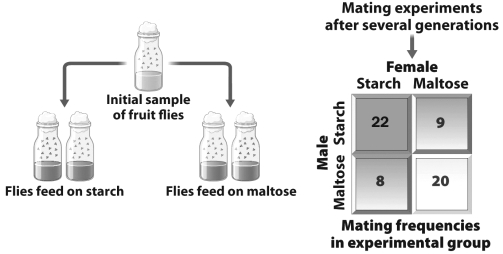 Which of the following is true?
 (Multiple Choice)
4.9/5 (80)
(80) The Eastern skunk cabbage, which blooms in very early spring, produces chemicals that smell like decaying meat. This plant has probably become adapted to mate with the assistance of
(Multiple Choice)
4.9/5 (72)
(72) Groups of organisms that live in regions with high mountains usually contain more species than those that live in nonmountainous regions.
(True/False)
4.8/5 (69)
(69) Which of the following is an example of reproductive isolation?
(Multiple Choice)
4.9/5 (87)
(87) Using reproductive isolation as a method of defining a species is not useful for
(Multiple Choice)
4.8/5 (68)
(68) 
Filters
- Essay(0)
- Multiple Choice(0)
- Short Answer(0)
- True False(0)
- Matching(0)