



 Chat with AI
Exam 18: Adaptation and Speciation

Exam 1: The Nature of Science and the Characteristics of Life75 Questions
Exam 2: Organizing the Diversity of Life75 Questions
Exam 3: Major Groups of Living Organisms74 Questions
Exam 4: Chemical Building Blocks77 Questions
Exam 5: Cell Structure and Internal Compartments76 Questions
Exam 6: Cell Membranes, Transport, and Communication73 Questions
Exam 7: Energy and Enzymes68 Questions
Exam 8: Photosynthesis and Cellular Respiration70 Questions
Exam 9: Cell Division77 Questions
Exam 10: Patterns of Inheritance65 Questions
Exam 11: Chromosomes and Human Genetics70 Questions
Exam 12: DNA62 Questions
Exam 13: From Gene to Protein73 Questions
Exam 14: Control of Gene Expression66 Questions
Exam 15: DNA Technology64 Questions
Exam 16: How Evolution Works65 Questions
Exam 17: Evolution of Populations64 Questions
Exam 18: Adaptation and Speciation66 Questions
Exam 19: The Evolutionary History of Life69 Questions
Exam 20: Maintaining the Internal Environment66 Questions
Exam 21: Animal Nutrition and Digestion68 Questions
Exam 22: Gas Exchange68 Questions
Exam 23: The Circulatory System68 Questions
Exam 24: Animal Hormones69 Questions
Exam 25: The Nervous System69 Questions
Exam 26: Sensing the Environment66 Questions
Exam 27: Skeletons, Muscles, and Movement65 Questions
Exam 28: Defenses against Disease67 Questions
Exam 29: Reproduction and Development68 Questions
Exam 30: Animal Behavior61 Questions
Exam 31: Plant Structure, Nutrition, and Transport63 Questions
Exam 32: Plant Growth and Reproduction67 Questions
Exam 33: The Biosphere67 Questions
Exam 34: Growth of Populations65 Questions
Exam 35: Interactions among Organisms70 Questions
Exam 36: Communities of Organisms65 Questions
Exam 37: Ecosystems68 Questions
Exam 38: Global Change65 Questions
Exam 39: Biodiversity and People72 Questions
Exam 40: Cancer: Cell Division Out of Control69 Questions
Exam 41: Harnessing the Human Genome62 Questions
Exam 42: Humans and Evolution60 Questions
Exam 43: Smoking--Beyond Lung Cancer63 Questions
Exam 44: Feeding a Hungry Planet55 Questions
Exam 45: Building a Sustainable Society47 Questions
Select questions type


The classification of bacterial species does not fit the usual definition of species. This is because bacteria
(Multiple Choice)
4.8/5  (71)
(71) Geographic isolation can result in speciation but usually only over long periods of time.
(True/False)
4.7/5 (73)
(73) Populations of weaver ants work together to "sew" leaves into a living nest. The nest building behavior of weaver ants
(Multiple Choice)
4.8/5 (74)
(74) Speciation can occur when populations of a species are separated by a barrier becoming ________ isolated and subsequently become reproductively isolated from one another.
(Short Answer)
4.8/5 (65)
(65) A flower is red, has a long tube formed by fusion of petals, has nectar at the base of the tube, has no landing platform, and opens during the day. It has probably become adapted to mate with the assistance of
(Multiple Choice)
5.0/5 (78)
(78) Sympatric speciation can occur in the absence of geographic isolation.
(True/False)
4.9/5 (82)
(82) The offspring of two individuals of different species that interbreed are known as _____________.
(Short Answer)
5.0/5 (88)
(88) The soapberry bugs shown in the figure below adapted to a change in food source in as fast as 30 years. 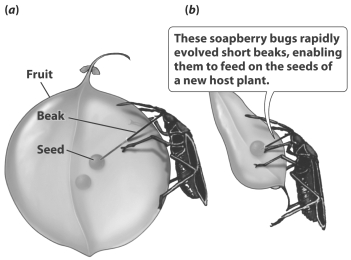 For evolution to occur this quickly,
 (Multiple Choice)
4.8/5 (73)
(73) Pre- and postzygotic barriers can keep species ________ isolated from each other, even if they live in the same area.
(Short Answer)
4.7/5 (72)
(72) Even though humans are causing the extinction of large numbers of species, the process of speciation should replace them within a few decades.
(True/False)
4.8/5 (75)
(75) Some species of orchids attract insects to assist them in reproduction by producing flowers that look like female bees. The flowers fool male bees into attempting to mate with them. This example shows adaptive evolution by
(Multiple Choice)
4.7/5 (70)
(70) Sympatric speciation requires geographic isolation of populations.
(True/False)
4.9/5 (64)
(64) _________ speciation occurs when a new species arises in the absence of geographic isolation.
(Short Answer)
4.8/5 (77)
(77) The faster a cheetah can run, the more likely it is to capture its prey. Cheetahs with longer legs are able to run faster than those with shorter legs. Although the existing cheetah population shows a variety of leg lengths, cheetah legs are not increasing in length from one generation to the next. Which of the following is the most likely explanation?
(Multiple Choice)
4.9/5 (78)
(78) An ecological ________ can limit a population's ability to adapt to its environment, as the organisms must compromise between what is possible developmentally and what is possible genetically.
(Short Answer)
4.9/5 (76)
(76) The improvement of the match between organisms and their environments over time is called ________ evolution.
(Short Answer)
4.9/5 (82)
(82) 
Filters
- Essay(0)
- Multiple Choice(0)
- Short Answer(0)
- True False(0)
- Matching(0)