



 Chat with AI
Exam 31: Plant Structure, Nutrition, and Transport

Exam 1: The Nature of Science and the Characteristics of Life75 Questions
Exam 2: Organizing the Diversity of Life75 Questions
Exam 3: Major Groups of Living Organisms74 Questions
Exam 4: Chemical Building Blocks77 Questions
Exam 5: Cell Structure and Internal Compartments76 Questions
Exam 6: Cell Membranes, Transport, and Communication73 Questions
Exam 7: Energy and Enzymes68 Questions
Exam 8: Photosynthesis and Cellular Respiration70 Questions
Exam 9: Cell Division77 Questions
Exam 10: Patterns of Inheritance65 Questions
Exam 11: Chromosomes and Human Genetics70 Questions
Exam 12: DNA62 Questions
Exam 13: From Gene to Protein73 Questions
Exam 14: Control of Gene Expression66 Questions
Exam 15: DNA Technology64 Questions
Exam 16: How Evolution Works65 Questions
Exam 17: Evolution of Populations64 Questions
Exam 18: Adaptation and Speciation66 Questions
Exam 19: The Evolutionary History of Life69 Questions
Exam 20: Maintaining the Internal Environment66 Questions
Exam 21: Animal Nutrition and Digestion68 Questions
Exam 22: Gas Exchange68 Questions
Exam 23: The Circulatory System68 Questions
Exam 24: Animal Hormones69 Questions
Exam 25: The Nervous System69 Questions
Exam 26: Sensing the Environment66 Questions
Exam 27: Skeletons, Muscles, and Movement65 Questions
Exam 28: Defenses against Disease67 Questions
Exam 29: Reproduction and Development68 Questions
Exam 30: Animal Behavior61 Questions
Exam 31: Plant Structure, Nutrition, and Transport63 Questions
Exam 32: Plant Growth and Reproduction67 Questions
Exam 33: The Biosphere67 Questions
Exam 34: Growth of Populations65 Questions
Exam 35: Interactions among Organisms70 Questions
Exam 36: Communities of Organisms65 Questions
Exam 37: Ecosystems68 Questions
Exam 38: Global Change65 Questions
Exam 39: Biodiversity and People72 Questions
Exam 40: Cancer: Cell Division Out of Control69 Questions
Exam 41: Harnessing the Human Genome62 Questions
Exam 42: Humans and Evolution60 Questions
Exam 43: Smoking--Beyond Lung Cancer63 Questions
Exam 44: Feeding a Hungry Planet55 Questions
Exam 45: Building a Sustainable Society47 Questions
Select questions type


Approximately 90 percent of all plants are angiosperms. What unique feature(s) could account for their tremendous success?

Free
(Multiple Choice)
4.7/5  (69)
(69) Correct Answer: Verified
A
What best explains why sugar maple trees are tapped on the sun-warmed south side of the trunk?
Free
(Multiple Choice)
4.8/5 (85)
(85) Correct Answer:Verified
VerifiedC
Fibrous root systems have one predominant root and many smaller roots near the top of the main root.
Free
(True/False)
4.9/5 (90)
(90) Correct Answer:Verified
VerifiedFalse
Which of the following "carnivorous" plants has (have) moving parts that help them capture prey?
(Multiple Choice)
4.7/5 (77)
(77) In terms of their energy needs, solar energy is converted to chemical energy primarily within the plant's
(Multiple Choice)
4.9/5 (80)
(80) Plants are protected from herbivores by ______ tissue, which also controls gas exchange.
(Short Answer)
4.8/5 (81)
(81) Most above-ground plant growth occurs with the repeated addition of ______ units.
(Short Answer)
4.8/5 (66)
(66) Although plants require nine macronutrients, plants fertilizers typically provide just nitrogen, phosphorus, and ________.
(Short Answer)
5.0/5 (74)
(74) Worldwide, humans obtain more than 80 percent of their calories from
(Multiple Choice)
4.8/5 (85)
(85) Most carnivorous plants obtain energy through photosynthesis; they consume insects to obtain _______ .
(Short Answer)
4.8/5 (83)
(83) The figure below illustrates how food is transported in phloem tissue. 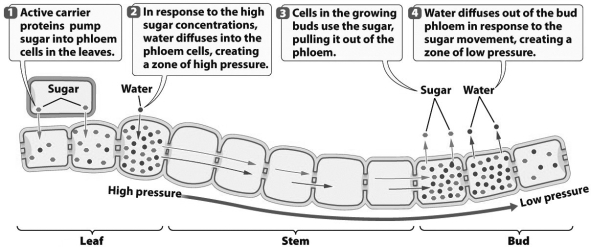 At what step(s) during the movement of sugar is metabolic energy provided by the plant?
 (Multiple Choice)
4.9/5 (75)
(75) Like other organisms, plants are composed of proteins, lipids, carbohydrates, and nucleic acids. Based on this, which of the following would be a micronutrient?
(Multiple Choice)
4.8/5 (75)
(75) The basic plant body consists of a root system and a _____ system.
(Short Answer)
4.8/5 (80)
(80) The tension produced during transpiration _________ a column of water extending all the way to the roots through the xyxlem.
(Short Answer)
4.9/5 (80)
(80) 
Filters
- Essay(0)
- Multiple Choice(0)
- Short Answer(0)
- True False(0)
- Matching(0)