



 Chat with AI
Exam 31: Plant Structure, Nutrition, and Transport

Exam 1: The Nature of Science and the Characteristics of Life75 Questions
Exam 2: Organizing the Diversity of Life75 Questions
Exam 3: Major Groups of Living Organisms74 Questions
Exam 4: Chemical Building Blocks77 Questions
Exam 5: Cell Structure and Internal Compartments76 Questions
Exam 6: Cell Membranes, Transport, and Communication73 Questions
Exam 7: Energy and Enzymes68 Questions
Exam 8: Photosynthesis and Cellular Respiration70 Questions
Exam 9: Cell Division77 Questions
Exam 10: Patterns of Inheritance65 Questions
Exam 11: Chromosomes and Human Genetics70 Questions
Exam 12: DNA62 Questions
Exam 13: From Gene to Protein73 Questions
Exam 14: Control of Gene Expression66 Questions
Exam 15: DNA Technology64 Questions
Exam 16: How Evolution Works65 Questions
Exam 17: Evolution of Populations64 Questions
Exam 18: Adaptation and Speciation66 Questions
Exam 19: The Evolutionary History of Life69 Questions
Exam 20: Maintaining the Internal Environment66 Questions
Exam 21: Animal Nutrition and Digestion68 Questions
Exam 22: Gas Exchange68 Questions
Exam 23: The Circulatory System68 Questions
Exam 24: Animal Hormones69 Questions
Exam 25: The Nervous System69 Questions
Exam 26: Sensing the Environment66 Questions
Exam 27: Skeletons, Muscles, and Movement65 Questions
Exam 28: Defenses against Disease67 Questions
Exam 29: Reproduction and Development68 Questions
Exam 30: Animal Behavior61 Questions
Exam 31: Plant Structure, Nutrition, and Transport63 Questions
Exam 32: Plant Growth and Reproduction67 Questions
Exam 33: The Biosphere67 Questions
Exam 34: Growth of Populations65 Questions
Exam 35: Interactions among Organisms70 Questions
Exam 36: Communities of Organisms65 Questions
Exam 37: Ecosystems68 Questions
Exam 38: Global Change65 Questions
Exam 39: Biodiversity and People72 Questions
Exam 40: Cancer: Cell Division Out of Control69 Questions
Exam 41: Harnessing the Human Genome62 Questions
Exam 42: Humans and Evolution60 Questions
Exam 43: Smoking--Beyond Lung Cancer63 Questions
Exam 44: Feeding a Hungry Planet55 Questions
Exam 45: Building a Sustainable Society47 Questions
Select questions type


The most abundant plant cell type in ground tissue is ______ .
(Short Answer)
4.8/5  (83)
(83) In the figure below, the line with the arrowheads indicates the cell-wall pathway for an absorbed nutrient. 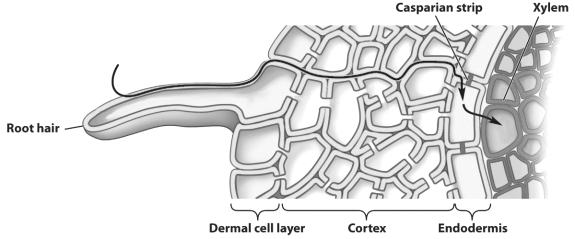 What structure actually regulates the entry of nutrients into the plant's interior?
 (Multiple Choice)
4.9/5 (79)
(79) The simplest plants, lacking even vascular tissues, are the _____ .
(Short Answer)
4.9/5 (74)
(74) Like other organisms, plants are composed of proteins, lipids, carbohydrates, and nucleic acids. Based on this, which of the following would be a macronutrient?
(Multiple Choice)
4.9/5 (76)
(76) Plants can generate the pressures needed to transport sugars produced by photosynthesis great distances by
(Multiple Choice)
4.9/5 (80)
(80) Flowers, rather than leaves, develop when a small number of genes are turned on.
(True/False)
4.8/5 (72)
(72) Aphids are insects that feed on plant sap, which they obtain by puncturing xylem cells in the plant's leaves.
(True/False)
4.8/5 (66)
(66) What observation indicates that the thorns on a rose bush are modified stem?
(Multiple Choice)
4.9/5 (64)
(64) Dermal hairs are more common on plants living at high elevations because at higher elevations
(Multiple Choice)
4.8/5 (76)
(76) Plants have two types of vascular tissue, xylem, which transports ______, and phloem, which transports sugars.
(Short Answer)
5.0/5 (89)
(89) Examine the plant in the figure below. 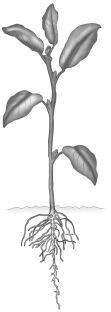 The plant shown is most likely a dicot because of the presence of
 (Multiple Choice)
5.0/5 (81)
(81) 
Filters
- Essay(0)
- Multiple Choice(0)
- Short Answer(0)
- True False(0)
- Matching(0)