



 Chat with AI
Exam 30: Animal Behavior

Exam 1: The Nature of Science and the Characteristics of Life75 Questions
Exam 2: Organizing the Diversity of Life75 Questions
Exam 3: Major Groups of Living Organisms74 Questions
Exam 4: Chemical Building Blocks77 Questions
Exam 5: Cell Structure and Internal Compartments76 Questions
Exam 6: Cell Membranes, Transport, and Communication73 Questions
Exam 7: Energy and Enzymes68 Questions
Exam 8: Photosynthesis and Cellular Respiration70 Questions
Exam 9: Cell Division77 Questions
Exam 10: Patterns of Inheritance65 Questions
Exam 11: Chromosomes and Human Genetics70 Questions
Exam 12: DNA62 Questions
Exam 13: From Gene to Protein73 Questions
Exam 14: Control of Gene Expression66 Questions
Exam 15: DNA Technology64 Questions
Exam 16: How Evolution Works65 Questions
Exam 17: Evolution of Populations64 Questions
Exam 18: Adaptation and Speciation66 Questions
Exam 19: The Evolutionary History of Life69 Questions
Exam 20: Maintaining the Internal Environment66 Questions
Exam 21: Animal Nutrition and Digestion68 Questions
Exam 22: Gas Exchange68 Questions
Exam 23: The Circulatory System68 Questions
Exam 24: Animal Hormones69 Questions
Exam 25: The Nervous System69 Questions
Exam 26: Sensing the Environment66 Questions
Exam 27: Skeletons, Muscles, and Movement65 Questions
Exam 28: Defenses against Disease67 Questions
Exam 29: Reproduction and Development68 Questions
Exam 30: Animal Behavior61 Questions
Exam 31: Plant Structure, Nutrition, and Transport63 Questions
Exam 32: Plant Growth and Reproduction67 Questions
Exam 33: The Biosphere67 Questions
Exam 34: Growth of Populations65 Questions
Exam 35: Interactions among Organisms70 Questions
Exam 36: Communities of Organisms65 Questions
Exam 37: Ecosystems68 Questions
Exam 38: Global Change65 Questions
Exam 39: Biodiversity and People72 Questions
Exam 40: Cancer: Cell Division Out of Control69 Questions
Exam 41: Harnessing the Human Genome62 Questions
Exam 42: Humans and Evolution60 Questions
Exam 43: Smoking--Beyond Lung Cancer63 Questions
Exam 44: Feeding a Hungry Planet55 Questions
Exam 45: Building a Sustainable Society47 Questions
Select questions type


An advertisement that utilizes images of pizza takes advantage of ________ that plays a large role in purchasing decisions.

Free
(Multiple Choice)
4.9/5  (69)
(69) Correct Answer: Verified
B
Reading this question involves communication only at the level of fixed behaviors.
Free
(True/False)
4.9/5 (88)
(88) Correct Answer:Verified
VerifiedFalse
Which of the following statements about group living is false?
Free
(Multiple Choice)
4.8/5 (92)
(92) Correct Answer:Verified
VerifiedB
The release of chemicals called _______ by one individual helps other individuals identify and locate that individual.
(Short Answer)
4.9/5 (72)
(72) A SWAT team and hostage negotiators working together is an example of
(Multiple Choice)
4.9/5 (77)
(77) The consumption of ________ both alters our behavior and decreases our ability to regulate behavior
(Short Answer)
4.8/5 (89)
(89) An organism that exhibits _______ behavior helps other members of the group survive or reproduce while decreasing its own chances of doing so.
(Short Answer)
4.8/5 (83)
(83) Herring gull chicks beg for food when they see a red dot, whether it is on their parent's beak or on an odd-shaped model. This begging is an example of a _______ behavior.
(Short Answer)
4.8/5 (70)
(70) Fixed behaviors allow a more flexible response to a given situation than learned behaviors do.
(True/False)
4.9/5 (84)
(84) If you decided to take this course based on talking to other people, you were
(Multiple Choice)
4.9/5 (75)
(75) A worker ant that defends the colony and gives up the ability to reproduce is exhibiting an orientation behavior.
(True/False)
4.8/5 (77)
(77) When a mother nurses her child for the first time, the sucking of the infant stimulates the release of milk. Within a few weeks of birth, the cry of the infant stimulates the same response. Which of these is a fixed behavior?
(Multiple Choice)
4.7/5 (80)
(80) For some species, aiding in the rearing of siblings in a group rather than reproducing on your own is the best way to ensure that an individual's genes are passed on to the next generation.
(True/False)
4.9/5 (74)
(74) Since a frog has a more complex nervous system then a slug, the behaviors of a frog should be more complex than those of a slug.
(True/False)
4.9/5 (70)
(70) Which of the following statements about fixed behaviors is false?
(Multiple Choice)
4.9/5 (81)
(81) Based on the data presented in the graph below, begging in response to a red dot is a learned behavior.
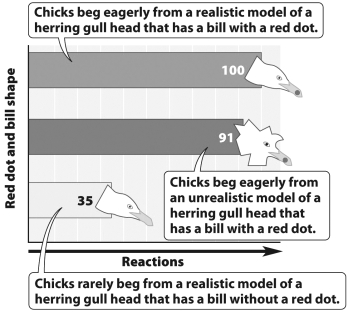
(True/False)
4.9/5 (85)
(85) 
Filters
- Essay(0)
- Multiple Choice(0)
- Short Answer(0)
- True False(0)
- Matching(0)