



 Chat with AI
Exam 39: Biodiversity and People

Exam 1: The Nature of Science and the Characteristics of Life75 Questions
Exam 2: Organizing the Diversity of Life75 Questions
Exam 3: Major Groups of Living Organisms74 Questions
Exam 4: Chemical Building Blocks77 Questions
Exam 5: Cell Structure and Internal Compartments76 Questions
Exam 6: Cell Membranes, Transport, and Communication73 Questions
Exam 7: Energy and Enzymes68 Questions
Exam 8: Photosynthesis and Cellular Respiration70 Questions
Exam 9: Cell Division77 Questions
Exam 10: Patterns of Inheritance65 Questions
Exam 11: Chromosomes and Human Genetics70 Questions
Exam 12: DNA62 Questions
Exam 13: From Gene to Protein73 Questions
Exam 14: Control of Gene Expression66 Questions
Exam 15: DNA Technology64 Questions
Exam 16: How Evolution Works65 Questions
Exam 17: Evolution of Populations64 Questions
Exam 18: Adaptation and Speciation66 Questions
Exam 19: The Evolutionary History of Life69 Questions
Exam 20: Maintaining the Internal Environment66 Questions
Exam 21: Animal Nutrition and Digestion68 Questions
Exam 22: Gas Exchange68 Questions
Exam 23: The Circulatory System68 Questions
Exam 24: Animal Hormones69 Questions
Exam 25: The Nervous System69 Questions
Exam 26: Sensing the Environment66 Questions
Exam 27: Skeletons, Muscles, and Movement65 Questions
Exam 28: Defenses against Disease67 Questions
Exam 29: Reproduction and Development68 Questions
Exam 30: Animal Behavior61 Questions
Exam 31: Plant Structure, Nutrition, and Transport63 Questions
Exam 32: Plant Growth and Reproduction67 Questions
Exam 33: The Biosphere67 Questions
Exam 34: Growth of Populations65 Questions
Exam 35: Interactions among Organisms70 Questions
Exam 36: Communities of Organisms65 Questions
Exam 37: Ecosystems68 Questions
Exam 38: Global Change65 Questions
Exam 39: Biodiversity and People72 Questions
Exam 40: Cancer: Cell Division Out of Control69 Questions
Exam 41: Harnessing the Human Genome62 Questions
Exam 42: Humans and Evolution60 Questions
Exam 43: Smoking--Beyond Lung Cancer63 Questions
Exam 44: Feeding a Hungry Planet55 Questions
Exam 45: Building a Sustainable Society47 Questions
Select questions type


Introduced species that aggressively compete with and displace native species are often called a(n) ____________ species.
(Short Answer)
4.9/5  (80)
(80) Habitat loss is a serious problem in the world's rainforests, but is an insignificant issue in the world's temperate zones.
(True/False)
4.8/5 (88)
(88) After a mass extinction, surviving species often _______ into new groups that rapidly recolonize the planet.
(Short Answer)
4.9/5 (86)
(86) On occasion introduced species like the Chinese ring-necked pheasant have created beneficial recreational opportunities, however, in most instances their impact is detrimental.
(True/False)
4.9/5 (67)
(67) The colonization of new areas by humans, both past and present, has several distinctive features; one of the most common is the
(Multiple Choice)
4.8/5 (82)
(82) Nonnative organisms can be serious threats to native species when they
(Multiple Choice)
4.9/5 (76)
(76) Attacked by chestnut blight, the American chestnut is now a rare tree in eastern forests. The disease is caused by a European fungus and illustrates the potential damage that _______ can cause.
(Multiple Choice)
5.0/5 (71)
(71) Characteristic types of environments or places in which different species can live are called ___________.
(Short Answer)
4.9/5 (83)
(83) The earth's average temperature appears to be slowly increasing, and heralds a new era in environmental challenges for numerous species. Most evidence supports the hypothesis that climatic change is the result of
(Multiple Choice)
4.8/5 (73)
(73) The figure below shows various groups drawn in sizes proportional to their contribution to known biodiversity. 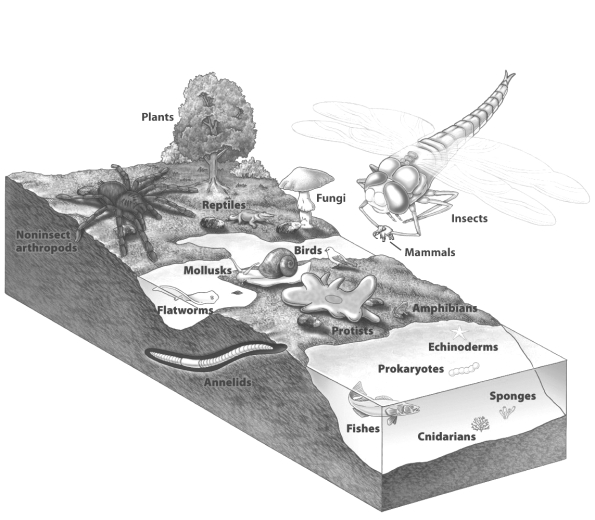 If the current extinction crisis continues, in future versions of the diagram, _______ will most likely be _______.
 (Multiple Choice)
4.9/5 (80)
(80) 
Filters
- Essay(0)
- Multiple Choice(0)
- Short Answer(0)
- True False(0)
- Matching(0)