



 Chat with AI
Exam 42: Humans and Evolution

Exam 1: The Nature of Science and the Characteristics of Life75 Questions
Exam 2: Organizing the Diversity of Life75 Questions
Exam 3: Major Groups of Living Organisms74 Questions
Exam 4: Chemical Building Blocks77 Questions
Exam 5: Cell Structure and Internal Compartments76 Questions
Exam 6: Cell Membranes, Transport, and Communication73 Questions
Exam 7: Energy and Enzymes68 Questions
Exam 8: Photosynthesis and Cellular Respiration70 Questions
Exam 9: Cell Division77 Questions
Exam 10: Patterns of Inheritance65 Questions
Exam 11: Chromosomes and Human Genetics70 Questions
Exam 12: DNA62 Questions
Exam 13: From Gene to Protein73 Questions
Exam 14: Control of Gene Expression66 Questions
Exam 15: DNA Technology64 Questions
Exam 16: How Evolution Works65 Questions
Exam 17: Evolution of Populations64 Questions
Exam 18: Adaptation and Speciation66 Questions
Exam 19: The Evolutionary History of Life69 Questions
Exam 20: Maintaining the Internal Environment66 Questions
Exam 21: Animal Nutrition and Digestion68 Questions
Exam 22: Gas Exchange68 Questions
Exam 23: The Circulatory System68 Questions
Exam 24: Animal Hormones69 Questions
Exam 25: The Nervous System69 Questions
Exam 26: Sensing the Environment66 Questions
Exam 27: Skeletons, Muscles, and Movement65 Questions
Exam 28: Defenses against Disease67 Questions
Exam 29: Reproduction and Development68 Questions
Exam 30: Animal Behavior61 Questions
Exam 31: Plant Structure, Nutrition, and Transport63 Questions
Exam 32: Plant Growth and Reproduction67 Questions
Exam 33: The Biosphere67 Questions
Exam 34: Growth of Populations65 Questions
Exam 35: Interactions among Organisms70 Questions
Exam 36: Communities of Organisms65 Questions
Exam 37: Ecosystems68 Questions
Exam 38: Global Change65 Questions
Exam 39: Biodiversity and People72 Questions
Exam 40: Cancer: Cell Division Out of Control69 Questions
Exam 41: Harnessing the Human Genome62 Questions
Exam 42: Humans and Evolution60 Questions
Exam 43: Smoking--Beyond Lung Cancer63 Questions
Exam 44: Feeding a Hungry Planet55 Questions
Exam 45: Building a Sustainable Society47 Questions
Select questions type


Hominids adapted to life on the ground approximately _______ years ago.
(Multiple Choice)
4.9/5  (70)
(70) During the last 75,000 years human brain size appears to have decreased slightly.
(True/False)
4.7/5 (65)
(65) Which of the following is not an advantage of being bipedal?
(Multiple Choice)
4.8/5 (79)
(79) What potential effect might the current amount of gene flow among human populations have on these populations?
(Multiple Choice)
4.8/5 (78)
(78) If the Neandertals are not the direct ancestors of humans, is it still possible for humans and Neandertals to be related?
(Multiple Choice)
4.7/5 (77)
(77) By about a half million years ago, our human ancestors were probably hunting large game and using fire.
(True/False)
4.7/5 (87)
(87) The human population today is large, highly technological, and mobile. Which of the following is not true?
(Multiple Choice)
4.9/5 (82)
(82) Based on the "out-of-Africa" hypothesis, which of the following is the most likely reason why species like Neandertals and Homo floresiensis do not exist today?
(Multiple Choice)
4.7/5 (90)
(90) Which of the following is not true about archaic Homo sapiens species?
(Multiple Choice)
5.0/5 (74)
(74) In 1883, Alexander Graham Bell (inventor of the telephone), after determining that deafness was hereditary in nature, suggested that two individuals who are deaf should not marry (and, therefore, produce children). This is an example of
(Multiple Choice)
4.9/5 (79)
(79) The term that describes the upright walking of humans on two legs is _______.
(Short Answer)
4.9/5 (80)
(80) Examine figure below. 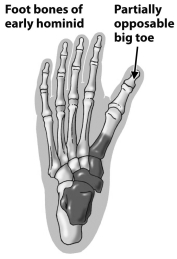 What does the positioning of the toe indicated by the arrow suggest about the owner of this fossil hominid foot?
 (Multiple Choice)
4.8/5 (81)
(81) In the classification of Homo sapiens, which of the following is incorrect?
(Multiple Choice)
4.8/5 (72)
(72) On a trip to the rainforest, a scientist finds a new species of animal. It looks a bit like a mouse, but it has opposable thumbs and lives in trees. Which of the following terms is least likely to apply to this animal?
(Multiple Choice)
4.8/5 (78)
(78) 
Filters
- Essay(0)
- Multiple Choice(0)
- Short Answer(0)
- True False(0)
- Matching(0)