



 Chat with AI
Exam 17: Evolution of Populations

Exam 1: The Nature of Science and the Characteristics of Life75 Questions
Exam 2: Organizing the Diversity of Life75 Questions
Exam 3: Major Groups of Living Organisms74 Questions
Exam 4: Chemical Building Blocks77 Questions
Exam 5: Cell Structure and Internal Compartments76 Questions
Exam 6: Cell Membranes, Transport, and Communication73 Questions
Exam 7: Energy and Enzymes68 Questions
Exam 8: Photosynthesis and Cellular Respiration70 Questions
Exam 9: Cell Division77 Questions
Exam 10: Patterns of Inheritance65 Questions
Exam 11: Chromosomes and Human Genetics70 Questions
Exam 12: DNA62 Questions
Exam 13: From Gene to Protein73 Questions
Exam 14: Control of Gene Expression66 Questions
Exam 15: DNA Technology64 Questions
Exam 16: How Evolution Works65 Questions
Exam 17: Evolution of Populations64 Questions
Exam 18: Adaptation and Speciation66 Questions
Exam 19: The Evolutionary History of Life69 Questions
Exam 20: Maintaining the Internal Environment66 Questions
Exam 21: Animal Nutrition and Digestion68 Questions
Exam 22: Gas Exchange68 Questions
Exam 23: The Circulatory System68 Questions
Exam 24: Animal Hormones69 Questions
Exam 25: The Nervous System69 Questions
Exam 26: Sensing the Environment66 Questions
Exam 27: Skeletons, Muscles, and Movement65 Questions
Exam 28: Defenses against Disease67 Questions
Exam 29: Reproduction and Development68 Questions
Exam 30: Animal Behavior61 Questions
Exam 31: Plant Structure, Nutrition, and Transport63 Questions
Exam 32: Plant Growth and Reproduction67 Questions
Exam 33: The Biosphere67 Questions
Exam 34: Growth of Populations65 Questions
Exam 35: Interactions among Organisms70 Questions
Exam 36: Communities of Organisms65 Questions
Exam 37: Ecosystems68 Questions
Exam 38: Global Change65 Questions
Exam 39: Biodiversity and People72 Questions
Exam 40: Cancer: Cell Division Out of Control69 Questions
Exam 41: Harnessing the Human Genome62 Questions
Exam 42: Humans and Evolution60 Questions
Exam 43: Smoking--Beyond Lung Cancer63 Questions
Exam 44: Feeding a Hungry Planet55 Questions
Exam 45: Building a Sustainable Society47 Questions
Select questions type


In a population of 100,000 flies, 30,000 have the AA genotype, 20,000 carry the Aa genotype, and 50,000 have the aa genotype. What is the frequency of the A allele?
(Multiple Choice)
4.9/5  (65)
(65) Although they are protected in many countries, humans still hunt elephants for their ivory tusks. A mutation that results in tusk-less elephants in increasing in frequency in some elephant populations as a result of the evolutionary mechanism of __________ __________.
(Short Answer)
4.8/5 (91)
(91) When a population shrinks, causing low genetic variation or the fixation of a harmful allele, a genetic _______ has occurred.
(Short Answer)
4.8/5 (84)
(84) The allele frequency of a recessive allele is always less than the allele frequency of a dominant allele.
(True/False)
4.8/5 (94)
(94) Although millions of prairie chickens once occupied Illinois, in 1993 only 50 remained. Starting in 1992, scientists moved almost 300 prairie chickens from large populations in other states to Illinois to ________________ Illinois prairie chicken populations.
(Multiple Choice)
4.9/5 (91)
(91) Independent assortment of chromosomes, crossing-over, and fertilization are collectively known as _____________.
(Short Answer)
4.9/5 (91)
(91) Compared to a large mainland population, genetic drift in a small island population is
(Multiple Choice)
5.0/5 (64)
(64) ________ _________ is the only mechanism of evolutionary change that is not influenced by chance events.
(Short Answer)
4.8/5 (76)
(76) The Hardy-Weinberg equation can be used to determine the genotype frequencies of a population that is not evolving.
(True/False)
4.7/5 (72)
(72) Individuals in a population have different DNA sequences for various genes than other individuals in the same population.
(True/False)
4.8/5 (77)
(77) A population has a total of two alleles, G and g, for a given gene. Which one of the following sets of genotype frequencies is correctly expressed for that population?
(Multiple Choice)
4.8/5 (84)
(84) If the genotype values predicted by the Hardy-Weinberg equation are greatly different from the values found in the real population, we can say that the population is ________.
(Short Answer)
4.7/5 (83)
(83) Gene flow can occur when individuals move from one population to another. It can also occur
(Multiple Choice)
4.9/5 (83)
(83) Which of the following is not a step in the evolutionary process?
(Multiple Choice)
4.9/5 (85)
(85) Scientists studying the runoff of antibiotic resistance genes into ground water wells discovered in 2008 that concentrations of most resistance genes were diluted as water moved away from hog farms. One resistance gene, however, was found at higher concentrations in one well. Which of the following is a biologically valid explanation of this finding?
(Multiple Choice)
4.8/5 (63)
(63) According to the figure below, the r allele is less frequent in generation 2 of this flower population. 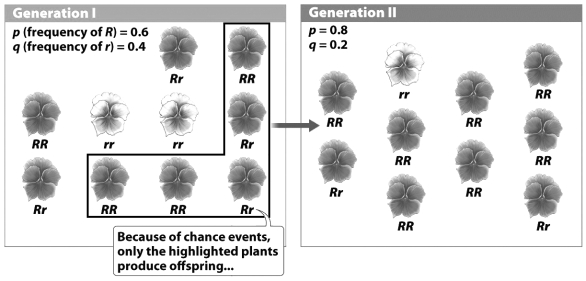 The frequency of r decreases in this population because
 (Multiple Choice)
4.8/5 (87)
(87) 
Filters
- Essay(0)
- Multiple Choice(0)
- Short Answer(0)
- True False(0)
- Matching(0)