



 Chat with AI
Exam 17: Evolution of Populations

Exam 1: The Nature of Science and the Characteristics of Life75 Questions
Exam 2: Organizing the Diversity of Life75 Questions
Exam 3: Major Groups of Living Organisms74 Questions
Exam 4: Chemical Building Blocks77 Questions
Exam 5: Cell Structure and Internal Compartments76 Questions
Exam 6: Cell Membranes, Transport, and Communication73 Questions
Exam 7: Energy and Enzymes68 Questions
Exam 8: Photosynthesis and Cellular Respiration70 Questions
Exam 9: Cell Division77 Questions
Exam 10: Patterns of Inheritance65 Questions
Exam 11: Chromosomes and Human Genetics70 Questions
Exam 12: DNA62 Questions
Exam 13: From Gene to Protein73 Questions
Exam 14: Control of Gene Expression66 Questions
Exam 15: DNA Technology64 Questions
Exam 16: How Evolution Works65 Questions
Exam 17: Evolution of Populations64 Questions
Exam 18: Adaptation and Speciation66 Questions
Exam 19: The Evolutionary History of Life69 Questions
Exam 20: Maintaining the Internal Environment66 Questions
Exam 21: Animal Nutrition and Digestion68 Questions
Exam 22: Gas Exchange68 Questions
Exam 23: The Circulatory System68 Questions
Exam 24: Animal Hormones69 Questions
Exam 25: The Nervous System69 Questions
Exam 26: Sensing the Environment66 Questions
Exam 27: Skeletons, Muscles, and Movement65 Questions
Exam 28: Defenses against Disease67 Questions
Exam 29: Reproduction and Development68 Questions
Exam 30: Animal Behavior61 Questions
Exam 31: Plant Structure, Nutrition, and Transport63 Questions
Exam 32: Plant Growth and Reproduction67 Questions
Exam 33: The Biosphere67 Questions
Exam 34: Growth of Populations65 Questions
Exam 35: Interactions among Organisms70 Questions
Exam 36: Communities of Organisms65 Questions
Exam 37: Ecosystems68 Questions
Exam 38: Global Change65 Questions
Exam 39: Biodiversity and People72 Questions
Exam 40: Cancer: Cell Division Out of Control69 Questions
Exam 41: Harnessing the Human Genome62 Questions
Exam 42: Humans and Evolution60 Questions
Exam 43: Smoking--Beyond Lung Cancer63 Questions
Exam 44: Feeding a Hungry Planet55 Questions
Exam 45: Building a Sustainable Society47 Questions
Select questions type


In fish undergoing sexual selection, females are more likely to mate with males lacking coloration because brightly colored males are more visible to predators.
(True/False)
4.8/5  (79)
(79) "Emigration" is the term that describes one or more individuals leaving their home population. Is the effect of emigration likely to have a greater genetic effect if the home population was large, or if the home population was small?
(Multiple Choice)
4.9/5 (80)
(80) Which of the following statements concerning evolution is false?
(Multiple Choice)
4.8/5 (80)
(80) _______ are the original source of genetic variation within a population.
(Short Answer)
5.0/5 (93)
(93) Two populations of geese live near each other. As time passes, the populations are becoming more genetically alike. This is probably due to gene _______.
(Short Answer)
4.7/5 (81)
(81) Does sexual reproduction alone necessarily cause evolution?
(Multiple Choice)
4.9/5 (68)
(68) If p is the frequency of the W allele in a population, why do we equate the WW individuals with the p² portion of the Hardy-Weinberg equation?
(Multiple Choice)
4.8/5 (71)
(71) If a given population has 30 RR individuals, 10 Rr individuals, and 10 rr individuals, what is the genotype frequency of Rr?
(Multiple Choice)
4.7/5 (78)
(78) While on a camping trip, you collect some white tadpoles from a pond and take them home. The tadpoles develop into white bullfrogs. When the frogs get too big, you release them into a local pond. The next year, several white bullfrogs are observed in the pond. This is an example of
(Multiple Choice)
4.9/5 (95)
(95) In many cases of ____________ selection, mates are chosen based on physical features or behaviors rather than fitness.
(Short Answer)
4.8/5 (92)
(92) Examine the graph below.
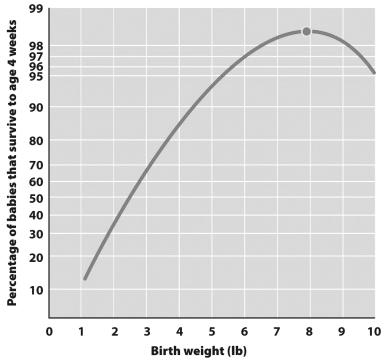 The shape of this graph indicates that birth weight in human babies is an example of _____________ selection.
 (Short Answer)
4.8/5 (74)
(74) Allele frequency refers to the rate of mutation in a population.
(True/False)
4.8/5 (83)
(83) What is the total number of alleles for the T gene present in a population of 100 individuals?
(Multiple Choice)
4.9/5 (81)
(81) 
Filters
- Essay(0)
- Multiple Choice(0)
- Short Answer(0)
- True False(0)
- Matching(0)