



 Chat with AI
Exam 22: Gas Exchange

Exam 1: The Nature of Science and the Characteristics of Life75 Questions
Exam 2: Organizing the Diversity of Life75 Questions
Exam 3: Major Groups of Living Organisms74 Questions
Exam 4: Chemical Building Blocks77 Questions
Exam 5: Cell Structure and Internal Compartments76 Questions
Exam 6: Cell Membranes, Transport, and Communication73 Questions
Exam 7: Energy and Enzymes68 Questions
Exam 8: Photosynthesis and Cellular Respiration70 Questions
Exam 9: Cell Division77 Questions
Exam 10: Patterns of Inheritance65 Questions
Exam 11: Chromosomes and Human Genetics70 Questions
Exam 12: DNA62 Questions
Exam 13: From Gene to Protein73 Questions
Exam 14: Control of Gene Expression66 Questions
Exam 15: DNA Technology64 Questions
Exam 16: How Evolution Works65 Questions
Exam 17: Evolution of Populations64 Questions
Exam 18: Adaptation and Speciation66 Questions
Exam 19: The Evolutionary History of Life69 Questions
Exam 20: Maintaining the Internal Environment66 Questions
Exam 21: Animal Nutrition and Digestion68 Questions
Exam 22: Gas Exchange68 Questions
Exam 23: The Circulatory System68 Questions
Exam 24: Animal Hormones69 Questions
Exam 25: The Nervous System69 Questions
Exam 26: Sensing the Environment66 Questions
Exam 27: Skeletons, Muscles, and Movement65 Questions
Exam 28: Defenses against Disease67 Questions
Exam 29: Reproduction and Development68 Questions
Exam 30: Animal Behavior61 Questions
Exam 31: Plant Structure, Nutrition, and Transport63 Questions
Exam 32: Plant Growth and Reproduction67 Questions
Exam 33: The Biosphere67 Questions
Exam 34: Growth of Populations65 Questions
Exam 35: Interactions among Organisms70 Questions
Exam 36: Communities of Organisms65 Questions
Exam 37: Ecosystems68 Questions
Exam 38: Global Change65 Questions
Exam 39: Biodiversity and People72 Questions
Exam 40: Cancer: Cell Division Out of Control69 Questions
Exam 41: Harnessing the Human Genome62 Questions
Exam 42: Humans and Evolution60 Questions
Exam 43: Smoking--Beyond Lung Cancer63 Questions
Exam 44: Feeding a Hungry Planet55 Questions
Exam 45: Building a Sustainable Society47 Questions
Select questions type


Ectothermic animals have a larger surface area available for gas exchange than endothermic animals.
(True/False)
4.8/5  (85)
(85) Which of the following describes the journey of a molecule of oxygen from the pharynx to an alveolus?
(Multiple Choice)
4.8/5 (75)
(75) The _______ of insects are tubes that allow oxygen in the atmosphere to reach the gas exchange surfaces inside the insects.
(Short Answer)
4.7/5 (82)
(82) People with sickle-cell anemia have deformed hemoglobin molecules and often suffer muscle pains, even at low levels of exertion. These symptoms might come about because the deformed hemoglobin
(Multiple Choice)
4.9/5 (80)
(80) Hemoglobin, like many other oxygen-binding pigments, contains the metallic element ____.
(Short Answer)
4.9/5 (89)
(89) Which of the following best describes the journey of an oxygen molecule in a lung?
(Multiple Choice)
4.9/5 (72)
(72) Which of the following would contain the lowest concentration of oxygen?
(Multiple Choice)
4.9/5 (74)
(74) If our skin were our gas exchange surface, it would have sufficient surface area to support our need for oxygen.
(True/False)
4.9/5 (80)
(80) The smaller the distance over which a gas must diffuse, the more slowly it will diffuse.
(True/False)
4.9/5 (85)
(85) Which of the following would not be a characteristic of an organ used for gas exchange?
(Multiple Choice)
4.9/5 (81)
(81) Once oxygen has entered the blood stream, its ultimate destination is the
(Multiple Choice)
4.9/5 (80)
(80) When we inhale, air moves in through the mouth or nose and next moves into the
(Multiple Choice)
4.9/5 (83)
(83) Which of the following is not a genetic adaptation that has evolved in people who live at high altitudes?
(Multiple Choice)
4.8/5 (72)
(72) The figure below illustrates the respiratory surface of an animal relative to its body surface. 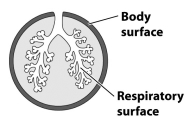 Would you expect this respiratory surface to be found in an aquatic or terrestrial animal?
 (Multiple Choice)
4.8/5 (65)
(65) The _______ that aquatic animals use for gas exchange have evolved several times, but they are always structured to provide the maximum surface area for gas exchange.
(Short Answer)
4.8/5 (71)
(71) Which of the following statements about gas concentrations in air and water is true?
(Multiple Choice)
4.7/5 (81)
(81) 
Filters
- Essay(0)
- Multiple Choice(0)
- Short Answer(0)
- True False(0)
- Matching(0)