



 Chat with AI
Exam 15: DNA Technology

Exam 1: The Nature of Science and the Characteristics of Life75 Questions
Exam 2: Organizing the Diversity of Life75 Questions
Exam 3: Major Groups of Living Organisms74 Questions
Exam 4: Chemical Building Blocks77 Questions
Exam 5: Cell Structure and Internal Compartments76 Questions
Exam 6: Cell Membranes, Transport, and Communication73 Questions
Exam 7: Energy and Enzymes68 Questions
Exam 8: Photosynthesis and Cellular Respiration70 Questions
Exam 9: Cell Division77 Questions
Exam 10: Patterns of Inheritance65 Questions
Exam 11: Chromosomes and Human Genetics70 Questions
Exam 12: DNA62 Questions
Exam 13: From Gene to Protein73 Questions
Exam 14: Control of Gene Expression66 Questions
Exam 15: DNA Technology64 Questions
Exam 16: How Evolution Works65 Questions
Exam 17: Evolution of Populations64 Questions
Exam 18: Adaptation and Speciation66 Questions
Exam 19: The Evolutionary History of Life69 Questions
Exam 20: Maintaining the Internal Environment66 Questions
Exam 21: Animal Nutrition and Digestion68 Questions
Exam 22: Gas Exchange68 Questions
Exam 23: The Circulatory System68 Questions
Exam 24: Animal Hormones69 Questions
Exam 25: The Nervous System69 Questions
Exam 26: Sensing the Environment66 Questions
Exam 27: Skeletons, Muscles, and Movement65 Questions
Exam 28: Defenses against Disease67 Questions
Exam 29: Reproduction and Development68 Questions
Exam 30: Animal Behavior61 Questions
Exam 31: Plant Structure, Nutrition, and Transport63 Questions
Exam 32: Plant Growth and Reproduction67 Questions
Exam 33: The Biosphere67 Questions
Exam 34: Growth of Populations65 Questions
Exam 35: Interactions among Organisms70 Questions
Exam 36: Communities of Organisms65 Questions
Exam 37: Ecosystems68 Questions
Exam 38: Global Change65 Questions
Exam 39: Biodiversity and People72 Questions
Exam 40: Cancer: Cell Division Out of Control69 Questions
Exam 41: Harnessing the Human Genome62 Questions
Exam 42: Humans and Evolution60 Questions
Exam 43: Smoking--Beyond Lung Cancer63 Questions
Exam 44: Feeding a Hungry Planet55 Questions
Exam 45: Building a Sustainable Society47 Questions
Select questions type


After electrophoresis has been performed, the stripes in one lane of a gel are
(Multiple Choice)
4.8/5  (72)
(72) Among these DNA fragments which would move most quickly during gel electrophoresis?
(Multiple Choice)
4.8/5 (90)
(90) If you knew the sequence of a gene in one organism, how could you determine if another organism had a similar gene?
(Multiple Choice)
4.9/5 (62)
(62) Which of the following DNA fragments would bind to the short probe, AAG?
(Multiple Choice)
4.9/5 (70)
(70) DNA _______ is the base pairing of DNA from two different sources.
(Short Answer)
4.9/5 (70)
(70) A segment of DNA in a test tube replicates and produces many copies of itself. What was probably in the test tube that enhanced this process?
(Multiple Choice)
4.9/5 (85)
(85) DNA moves toward the __________ charged end of an electrical field during gel electrophoresis.
(Short Answer)
4.8/5 (88)
(88) DNA _______ is the set of techniques with which scientists manipulate DNA.
(Short Answer)
4.9/5 (74)
(74) Growing a new house plant from a cutting taken from another plant is an example of whole organism cloning.
(True/False)
5.0/5 (80)
(80) During _______________ cloning, the nucleus of an egg cell is replaced with the nucleus of a somatic cell from the individual being cloned.
(Short Answer)
4.8/5 (81)
(81) A _______ is a small, circular portion of DNA that is found in bacteria and is not part of the main genome.
(Short Answer)
4.7/5 (85)
(85) Many different fragments of DNA from an oak tree genome are inserted into a plasmid vector, which is then taken up by bacteria that copy the inserted DNA every time they reproduce. This procedure is known as
(Multiple Choice)
4.8/5 (85)
(85) Human gene _______ seeks to correct genetic disorders by fixing the genes that cause the disorders.
(Short Answer)
4.7/5 (85)
(85) The figure below shows the first cycle in a polymerase chain reaction (PCR). 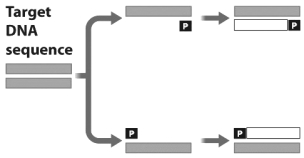 What is the role of the structure marked "P" in this figure?
 (Multiple Choice)
5.0/5 (87)
(87) Genetic engineering is a process in which specific sequences of DNA _______ are deliberately isolated, modified, and inserted back into a host organism.
(Short Answer)
4.9/5 (83)
(83) The goal of DNA __________ is to make many copies of a piece of recombinant DNA so that the DNA can be further manipulated and studied.
(Short Answer)
4.8/5 (89)
(89) 
Filters
- Essay(0)
- Multiple Choice(0)
- Short Answer(0)
- True False(0)
- Matching(0)