



 Chat with AI
Exam 11: Chromosomes and Human Genetics

Exam 1: The Nature of Science and the Characteristics of Life75 Questions
Exam 2: Organizing the Diversity of Life75 Questions
Exam 3: Major Groups of Living Organisms74 Questions
Exam 4: Chemical Building Blocks77 Questions
Exam 5: Cell Structure and Internal Compartments76 Questions
Exam 6: Cell Membranes, Transport, and Communication73 Questions
Exam 7: Energy and Enzymes68 Questions
Exam 8: Photosynthesis and Cellular Respiration70 Questions
Exam 9: Cell Division77 Questions
Exam 10: Patterns of Inheritance65 Questions
Exam 11: Chromosomes and Human Genetics70 Questions
Exam 12: DNA62 Questions
Exam 13: From Gene to Protein73 Questions
Exam 14: Control of Gene Expression66 Questions
Exam 15: DNA Technology64 Questions
Exam 16: How Evolution Works65 Questions
Exam 17: Evolution of Populations64 Questions
Exam 18: Adaptation and Speciation66 Questions
Exam 19: The Evolutionary History of Life69 Questions
Exam 20: Maintaining the Internal Environment66 Questions
Exam 21: Animal Nutrition and Digestion68 Questions
Exam 22: Gas Exchange68 Questions
Exam 23: The Circulatory System68 Questions
Exam 24: Animal Hormones69 Questions
Exam 25: The Nervous System69 Questions
Exam 26: Sensing the Environment66 Questions
Exam 27: Skeletons, Muscles, and Movement65 Questions
Exam 28: Defenses against Disease67 Questions
Exam 29: Reproduction and Development68 Questions
Exam 30: Animal Behavior61 Questions
Exam 31: Plant Structure, Nutrition, and Transport63 Questions
Exam 32: Plant Growth and Reproduction67 Questions
Exam 33: The Biosphere67 Questions
Exam 34: Growth of Populations65 Questions
Exam 35: Interactions among Organisms70 Questions
Exam 36: Communities of Organisms65 Questions
Exam 37: Ecosystems68 Questions
Exam 38: Global Change65 Questions
Exam 39: Biodiversity and People72 Questions
Exam 40: Cancer: Cell Division Out of Control69 Questions
Exam 41: Harnessing the Human Genome62 Questions
Exam 42: Humans and Evolution60 Questions
Exam 43: Smoking--Beyond Lung Cancer63 Questions
Exam 44: Feeding a Hungry Planet55 Questions
Exam 45: Building a Sustainable Society47 Questions
Select questions type


Which of the following processes is not a method of generating new combinations of alleles in the offspring of two individuals?
(Multiple Choice)
4.9/5  (73)
(73) The "actual results" in the experiment depicted in the figure below differ significantly from the "expected results" predicted by Mendel's laws. 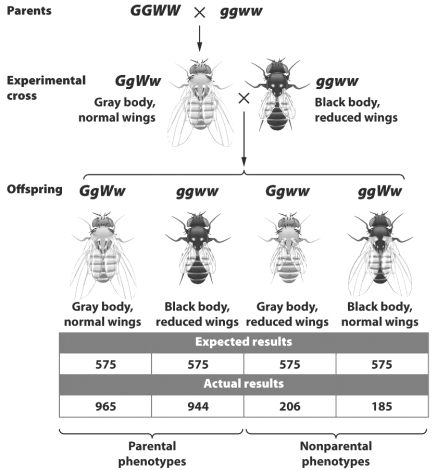 This variation from the expected results probably occurs because the gene for body color and the gene for wing length
 (Multiple Choice)
4.8/5 (79)
(79) Which of the following statements would be true if the linkage between two traits were complete?
(Multiple Choice)
4.9/5 (85)
(85) Why are X-linked recessive genetic disorders more commonly seen in males?
(Multiple Choice)
4.8/5 (87)
(87) Down syndrome results from trisomy of chromosome 21. Which of the following is not an example of how this may have happened?
(Multiple Choice)
4.9/5 (82)
(82) For a genetic disorder caused by a dominant allele, individuals with which of the following genotypes would be affected?
(Multiple Choice)
4.7/5 (86)
(86) The tendency to develop diseases, such as cancer and heart disease, is
(Multiple Choice)
4.8/5 (76)
(76) The figure below is a pedigree for cystic fibrosis, an autosomal recessive disorder. 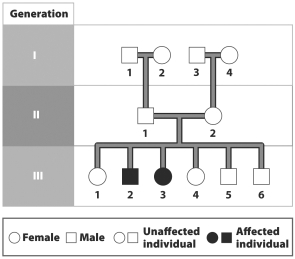 Which of the following is true?
 (Multiple Choice)
4.8/5 (71)
(71) Examine the figure below of a pedigree that diagrams an X-linked gene. 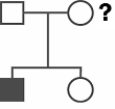 The genotype of the individual next to the question mark is
 (Multiple Choice)
4.7/5 (79)
(79) Which of the following genetic changes would not be heritable?
(Multiple Choice)
4.8/5 (86)
(86) A female who is a carrier of the sex-linked gene A has the genotype ________.
(Short Answer)
4.8/5 (69)
(69) The chance that any two siblings will be genetically identical is astronomically small.
(True/False)
5.0/5 (78)
(78) Males with a recessive X-linked recessive allele that causes a disorder don't always show symptoms because they can also carry a dominant allele on their Y chromosome.
(True/False)
4.9/5 (86)
(86) A parent that is a carrier for the recessive autosomal disorder B has the genotype __________.
(Short Answer)
4.9/5 (79)
(79) In humans, which of the following chromosomes would probably carry the fewest genes?
(Multiple Choice)
4.8/5 (96)
(96) An XX individual develops as a male. Which of the following statements offers the most likely explanation?
(Multiple Choice)
5.0/5 (88)
(88) 
Filters
- Essay(0)
- Multiple Choice(0)
- Short Answer(0)
- True False(0)
- Matching(0)