



 Chat with AI
Exam 37: Ecosystems

Exam 1: The Nature of Science and the Characteristics of Life75 Questions
Exam 2: Organizing the Diversity of Life75 Questions
Exam 3: Major Groups of Living Organisms74 Questions
Exam 4: Chemical Building Blocks77 Questions
Exam 5: Cell Structure and Internal Compartments76 Questions
Exam 6: Cell Membranes, Transport, and Communication73 Questions
Exam 7: Energy and Enzymes68 Questions
Exam 8: Photosynthesis and Cellular Respiration70 Questions
Exam 9: Cell Division77 Questions
Exam 10: Patterns of Inheritance65 Questions
Exam 11: Chromosomes and Human Genetics70 Questions
Exam 12: DNA62 Questions
Exam 13: From Gene to Protein73 Questions
Exam 14: Control of Gene Expression66 Questions
Exam 15: DNA Technology64 Questions
Exam 16: How Evolution Works65 Questions
Exam 17: Evolution of Populations64 Questions
Exam 18: Adaptation and Speciation66 Questions
Exam 19: The Evolutionary History of Life69 Questions
Exam 20: Maintaining the Internal Environment66 Questions
Exam 21: Animal Nutrition and Digestion68 Questions
Exam 22: Gas Exchange68 Questions
Exam 23: The Circulatory System68 Questions
Exam 24: Animal Hormones69 Questions
Exam 25: The Nervous System69 Questions
Exam 26: Sensing the Environment66 Questions
Exam 27: Skeletons, Muscles, and Movement65 Questions
Exam 28: Defenses against Disease67 Questions
Exam 29: Reproduction and Development68 Questions
Exam 30: Animal Behavior61 Questions
Exam 31: Plant Structure, Nutrition, and Transport63 Questions
Exam 32: Plant Growth and Reproduction67 Questions
Exam 33: The Biosphere67 Questions
Exam 34: Growth of Populations65 Questions
Exam 35: Interactions among Organisms70 Questions
Exam 36: Communities of Organisms65 Questions
Exam 37: Ecosystems68 Questions
Exam 38: Global Change65 Questions
Exam 39: Biodiversity and People72 Questions
Exam 40: Cancer: Cell Division Out of Control69 Questions
Exam 41: Harnessing the Human Genome62 Questions
Exam 42: Humans and Evolution60 Questions
Exam 43: Smoking--Beyond Lung Cancer63 Questions
Exam 44: Feeding a Hungry Planet55 Questions
Exam 45: Building a Sustainable Society47 Questions
Select questions type


A community of organisms together with the chemical and physical environment in which the organisms live is known as a(n) _______.
(Short Answer)
4.9/5  (94)
(94) Which of the following is the dominant type of organism in the two natural terrestrial ecosystems that have the greatest net primary productivity (NPP)?
(Multiple Choice)
4.8/5 (81)
(81) The marine ecosystem with the lowest net primary productivity is
(Multiple Choice)
4.7/5 (91)
(91) To best utilize the earth's NPP to feed the most people, diets should be modified to include _______ and gathering the maximum amount of energy available from a given biomass of producers.
(Multiple Choice)
4.7/5 (78)
(78) The energy in sunlight is directly associated with the synthesis of
(Multiple Choice)
4.9/5 (91)
(91) Other than the polar tundra, the least productive biomes tend to be
(Multiple Choice)
4.9/5 (78)
(78) Some biologically important substances are transferred between organisms and the physical environment in a cyclical pattern called a ________ cycle.
(Short Answer)
4.8/5 (86)
(86) The figure below illustrates how nutrients cycle between organic and inorganic reservoirs. Within each reservoir the nutrient may be available or unavailable for use. 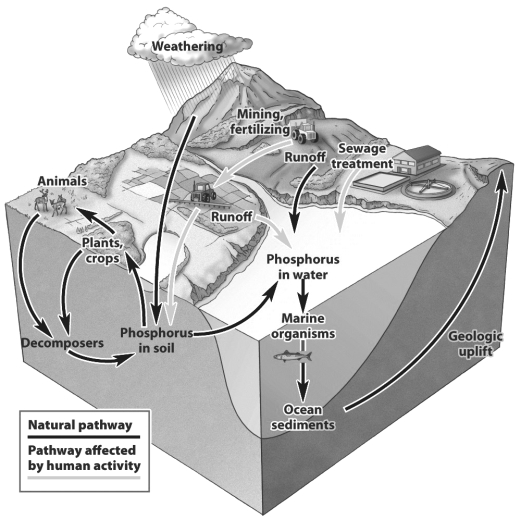 According to the figure above, what is the inorganic reservoir where phosphorus is unavailable?
 (Multiple Choice)
4.9/5 (79)
(79) Approximately 100 percent of the energy captured from the sun is passed from trophic level to trophic level.
(True/False)
4.8/5 (68)
(68) On average, what percentage of the energy from one trophic level of an energy pyramid is transferred to the next trophic level?
(Multiple Choice)
4.8/5 (78)
(78) In an ecosystem the assemblage of living organisms constitutes the _____ component.
(Short Answer)
4.9/5 (67)
(67) Over time the total amount of nutrients such as carbon and iron present on the earth increases by their addition from
(Multiple Choice)
4.8/5 (75)
(75) Once an organic molecule enters a metabolic pathway a significant percentage of its energy
(Multiple Choice)
5.0/5 (78)
(78) The term ecosystem services is used to describe beneficial activities performed by healthy ecosystems, some examples include
(Multiple Choice)
4.8/5 (88)
(88) Human actions such as logging, building on a floodplain, or diverting rivers increases the probability of severe _______.
(Short Answer)
4.7/5 (85)
(85) 
Filters
- Essay(0)
- Multiple Choice(0)
- Short Answer(0)
- True False(0)
- Matching(0)