Multiple Choice
In the Hubbard Brook Experimental Forest in New Hampshire, a portion of the forest was first clear-cut, then sprayed with herbicides for 3 years to prevent growth. A second portion of the forest was not clear-cut or sprayed and served as a control plot. The graph below shows that nitrate, a form of nitrogen that is important to plants, was lost from the ecosystem in streams at a much higher rate in the clear-cut portion of the forest than in the control portion. 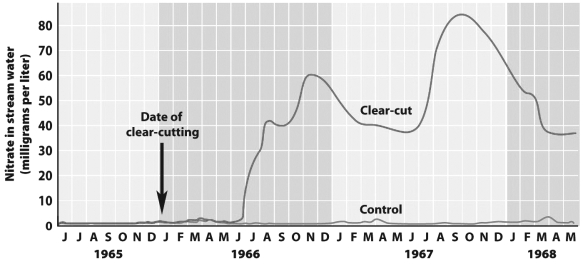
What best explains the small releases of nitrogen from the control portion of the forest at the Hubbarb Brook Experimental Forest?
A) Its nitrogen was sequestered in the forest biomass and temporarily unavailable.
B) With intact vegetation to intercept the acid rain that falls in the area it failed to reach the soil and chemically react to release the nitrogen.
C) With intact vegetation, rainwater washed little soil and nitrogen from the forest floor.
D) All of the above contributed to the small amount of nitrogen loss.
Correct Answer:

Verified
Correct Answer:
Verified
Q1: With respect to the following values,rain with
Q5: Which of the following groups of organisms
Q22: Biosphere II demonstrated that<br>A) living without the
Q23: Cutting a forest to produce paper bags
Q27: The rate of new biomass production by
Q41: Which of the following describes the ultimate
Q54: Rainfall with a low pH is called
Q59: In the absence of _,nutrient recycling within
Q60: Coral reefs and swamps are among Earth's
Q71: Essential elements required by producers are called