



 Chat with AI
Exam 38: Global Change

Exam 1: The Nature of Science and the Characteristics of Life75 Questions
Exam 2: Organizing the Diversity of Life75 Questions
Exam 3: Major Groups of Living Organisms74 Questions
Exam 4: Chemical Building Blocks77 Questions
Exam 5: Cell Structure and Internal Compartments76 Questions
Exam 6: Cell Membranes, Transport, and Communication73 Questions
Exam 7: Energy and Enzymes68 Questions
Exam 8: Photosynthesis and Cellular Respiration70 Questions
Exam 9: Cell Division77 Questions
Exam 10: Patterns of Inheritance65 Questions
Exam 11: Chromosomes and Human Genetics70 Questions
Exam 12: DNA62 Questions
Exam 13: From Gene to Protein73 Questions
Exam 14: Control of Gene Expression66 Questions
Exam 15: DNA Technology64 Questions
Exam 16: How Evolution Works65 Questions
Exam 17: Evolution of Populations64 Questions
Exam 18: Adaptation and Speciation66 Questions
Exam 19: The Evolutionary History of Life69 Questions
Exam 20: Maintaining the Internal Environment66 Questions
Exam 21: Animal Nutrition and Digestion68 Questions
Exam 22: Gas Exchange68 Questions
Exam 23: The Circulatory System68 Questions
Exam 24: Animal Hormones69 Questions
Exam 25: The Nervous System69 Questions
Exam 26: Sensing the Environment66 Questions
Exam 27: Skeletons, Muscles, and Movement65 Questions
Exam 28: Defenses against Disease67 Questions
Exam 29: Reproduction and Development68 Questions
Exam 30: Animal Behavior61 Questions
Exam 31: Plant Structure, Nutrition, and Transport63 Questions
Exam 32: Plant Growth and Reproduction67 Questions
Exam 33: The Biosphere67 Questions
Exam 34: Growth of Populations65 Questions
Exam 35: Interactions among Organisms70 Questions
Exam 36: Communities of Organisms65 Questions
Exam 37: Ecosystems68 Questions
Exam 38: Global Change65 Questions
Exam 39: Biodiversity and People72 Questions
Exam 40: Cancer: Cell Division Out of Control69 Questions
Exam 41: Harnessing the Human Genome62 Questions
Exam 42: Humans and Evolution60 Questions
Exam 43: Smoking--Beyond Lung Cancer63 Questions
Exam 44: Feeding a Hungry Planet55 Questions
Exam 45: Building a Sustainable Society47 Questions
Select questions type


Most plants can be considered carbon sinks; their net effect on atmospheric carbon is to reduce its concentration.
(True/False)
4.8/5  (83)
(83) Human activities presently fix more nitrogen than all natural sources combined.
(True/False)
4.8/5 (74)
(74) Scientists predict that current increases in atmospheric carbon dioxide concentrations will cause temperatures on Earth to rise, a phenomenon known as _______ _______.
(Short Answer)
4.8/5 (81)
(81) Since 1950 the commercial fishing industry has applied continuously improving technologies for harvesting marine fish. What has been the effect of improved fishing efficiencies on ocean communities?
(Multiple Choice)
4.8/5 (90)
(90) The graph below illustrates the relationship between fishing effort and the catch of large predatory fish, like tuna, during the past 40 years. 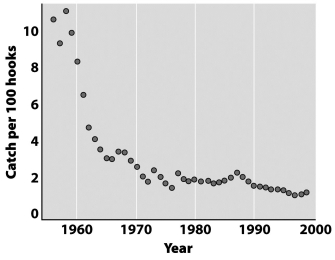 What best explains the pattern illustrated in this graph?
 (Multiple Choice)
4.9/5 (75)
(75) Land and water transformations have many unintended consequences. One of the most serious is
(Multiple Choice)
4.9/5 (69)
(69) What will happen in the future if humans continue to impact natural systems at the same rates as today?
(Multiple Choice)
4.8/5 (78)
(78) The best hope for slowing the recent rapid ecological changes is to decrease the impact of _______ on Earth to a sustainable level.
(Short Answer)
4.8/5 (73)
(73) When nitrogen is added to nitrogen-poor aquatic ecosystems, productivity _______ and the number of species _______.
(Multiple Choice)
4.8/5 (78)
(78) Ample evidence now exists that demonstrates that human activities are strongly associated with global warming.
(True/False)
4.8/5 (85)
(85) Net primary productivity is typically limited by the amount of nitrogen and phosphorus available to producers, when these nutrients are increased NPP increases as well.
(True/False)
4.7/5 (95)
(95) Changes to the physical and biotic features of the earth are called land and water transformations. Which of the following is an example of a water transformation?
(Multiple Choice)
4.9/5 (81)
(81) Global warming is likely to have much larger effects on some locations than others. Why are planners particularly concerned about California?
(Multiple Choice)
4.9/5 (76)
(76) The release of chlorofluorocarbons (CFCs) into the atmosphere has caused a(n)
(Multiple Choice)
4.8/5 (75)
(75) Nitrogen gas makes up approximately 20 percent of the air we breathe.
(True/False)
4.7/5 (81)
(81) Converting atmospheric nitrogen into chemical forms that can be used biologically is called fixation. Which of the following organisms can fix nitrogen?
(Multiple Choice)
5.0/5 (74)
(74) The figure below shows the predicted distribution of biomes following a 4ᵒ C increase in average global temperature. 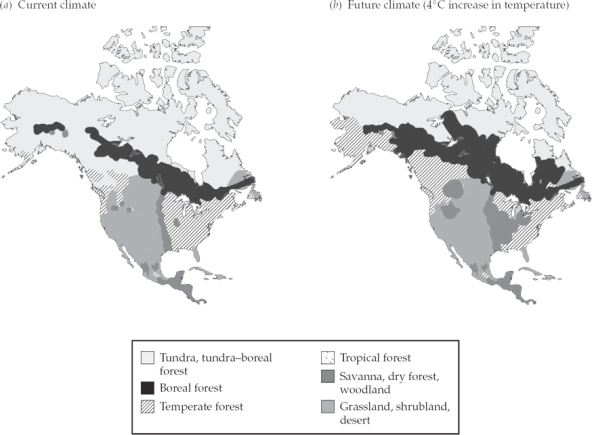 What biome in North America, in addition to deserts, becomes more common and how can the change be explained?
 (Multiple Choice)
4.9/5 (96)
(96) Because wetlands have relatively little economic value the percentage of the United States that is covered by wetlands has been relatively stable during the past 200 years.
(True/False)
4.8/5 (61)
(61) Ample evidence now exists to show that worldwide environmental changes are occurring; one example is
(Multiple Choice)
4.8/5 (90)
(90) 
Filters
- Essay(0)
- Multiple Choice(0)
- Short Answer(0)
- True False(0)
- Matching(0)