



 Chat with AI
Exam 38: Global Change

Exam 1: The Nature of Science and the Characteristics of Life75 Questions
Exam 2: Organizing the Diversity of Life75 Questions
Exam 3: Major Groups of Living Organisms74 Questions
Exam 4: Chemical Building Blocks77 Questions
Exam 5: Cell Structure and Internal Compartments76 Questions
Exam 6: Cell Membranes, Transport, and Communication73 Questions
Exam 7: Energy and Enzymes68 Questions
Exam 8: Photosynthesis and Cellular Respiration70 Questions
Exam 9: Cell Division77 Questions
Exam 10: Patterns of Inheritance65 Questions
Exam 11: Chromosomes and Human Genetics70 Questions
Exam 12: DNA62 Questions
Exam 13: From Gene to Protein73 Questions
Exam 14: Control of Gene Expression66 Questions
Exam 15: DNA Technology64 Questions
Exam 16: How Evolution Works65 Questions
Exam 17: Evolution of Populations64 Questions
Exam 18: Adaptation and Speciation66 Questions
Exam 19: The Evolutionary History of Life69 Questions
Exam 20: Maintaining the Internal Environment66 Questions
Exam 21: Animal Nutrition and Digestion68 Questions
Exam 22: Gas Exchange68 Questions
Exam 23: The Circulatory System68 Questions
Exam 24: Animal Hormones69 Questions
Exam 25: The Nervous System69 Questions
Exam 26: Sensing the Environment66 Questions
Exam 27: Skeletons, Muscles, and Movement65 Questions
Exam 28: Defenses against Disease67 Questions
Exam 29: Reproduction and Development68 Questions
Exam 30: Animal Behavior61 Questions
Exam 31: Plant Structure, Nutrition, and Transport63 Questions
Exam 32: Plant Growth and Reproduction67 Questions
Exam 33: The Biosphere67 Questions
Exam 34: Growth of Populations65 Questions
Exam 35: Interactions among Organisms70 Questions
Exam 36: Communities of Organisms65 Questions
Exam 37: Ecosystems68 Questions
Exam 38: Global Change65 Questions
Exam 39: Biodiversity and People72 Questions
Exam 40: Cancer: Cell Division Out of Control69 Questions
Exam 41: Harnessing the Human Genome62 Questions
Exam 42: Humans and Evolution60 Questions
Exam 43: Smoking--Beyond Lung Cancer63 Questions
Exam 44: Feeding a Hungry Planet55 Questions
Exam 45: Building a Sustainable Society47 Questions
Select questions type


As a group, the _______ gases allow light energy to pass through the atmosphere but absorb heat energy as it passes through the atmosphere to outer space.
(Short Answer)
4.8/5  (77)
(77) Why is the amount of nitrogen that cycles among organisms much smaller than the amount in the atmosphere?
(Multiple Choice)
4.8/5 (82)
(82) Which of the following represents the most significant anthropogenic modification to the nitrogen cycle?
(Multiple Choice)
4.9/5 (80)
(80) Having a sustainable impact on the Earth and our biosphere means that we must
(Multiple Choice)
4.8/5 (79)
(79) Wetlands are one of the few habitats to have escaped human-caused destruction; the worldwide distribution of wetlands has remained relatively stable for the past 200 years.
(True/False)
4.9/5 (77)
(77) When plants are initially exposed to elevated carbon dioxide levels most increase their rate of photosynthesis; how might plant communities be affected?
(Multiple Choice)
4.7/5 (82)
(82) Global levels of carbon dioxide have risen dramatically in the past 200 years.
(True/False)
4.8/5 (77)
(77) Carbon dioxide makes up approximately _______ percent of Earth's atmosphere.
(Multiple Choice)
4.7/5 (83)
(83) In the past 45 years, people who fish are catching fewer large carnivorous fishes worldwide. Which of the following statements best explains the significance of this fact?
(Multiple Choice)
4.9/5 (83)
(83) The figure below shows the relative concentration of polychlorinated biphenyls (PCBs) in several members of a lake food web. 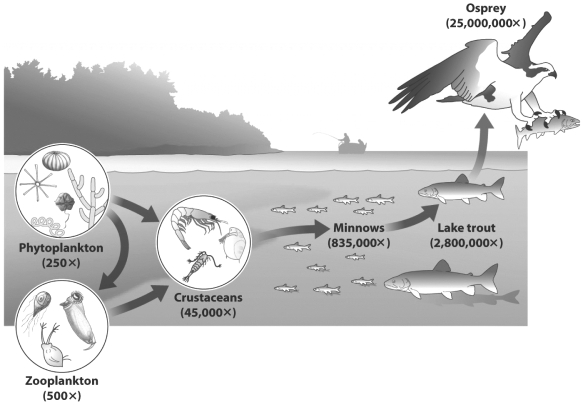 Although the lake trout and minnow are both fish, the lake trout is more contaminated. Why?
 (Multiple Choice)
4.9/5 (85)
(85) Humans have had little lasting impact on the physical appearance of Earth.
(True/False)
4.8/5 (95)
(95) Biodeisel fuel is produced from oils synthesized by and harvested from living plants. How does the use of biodeisel fuel compare to the use of fossil fuels with respect to the amount of carbon dioxide released to the atmosphere?
(Multiple Choice)
4.9/5 (90)
(90) Even without the melting of polar ice, sea level is anticipated to rise because warm water expands.
(True/False)
4.9/5 (84)
(84) Intentionally supplementing nitrogen into a monoculture like a corn field has predictable and desirable results. Is the same true when added to a system as complex as a community?
(Multiple Choice)
4.9/5 (86)
(86) Humans now utilize approximately 30-35 percent of the terrestrial net primary productivity (NPP). A result of this is that
(Multiple Choice)
5.0/5 (91)
(91) The amount of nitrogen that cycles among organisms is _______ than the amount that is in the atmosphere.
(Short Answer)
4.7/5 (84)
(84) Factual
The cutting and burning of forests has led to an increase in global _______ _______ levels.
(Short Answer)
4.8/5 (81)
(81) In comparison to past estimates extinction rates are currently high. Which of the following is the most plausible explanation?
(Multiple Choice)
5.0/5 (69)
(69) 
Filters
- Essay(0)
- Multiple Choice(0)
- Short Answer(0)
- True False(0)
- Matching(0)