



 Chat with AI
Exam 25: The Nervous System

Exam 1: The Nature of Science and the Characteristics of Life75 Questions
Exam 2: Organizing the Diversity of Life75 Questions
Exam 3: Major Groups of Living Organisms74 Questions
Exam 4: Chemical Building Blocks77 Questions
Exam 5: Cell Structure and Internal Compartments76 Questions
Exam 6: Cell Membranes, Transport, and Communication73 Questions
Exam 7: Energy and Enzymes68 Questions
Exam 8: Photosynthesis and Cellular Respiration70 Questions
Exam 9: Cell Division77 Questions
Exam 10: Patterns of Inheritance65 Questions
Exam 11: Chromosomes and Human Genetics70 Questions
Exam 12: DNA62 Questions
Exam 13: From Gene to Protein73 Questions
Exam 14: Control of Gene Expression66 Questions
Exam 15: DNA Technology64 Questions
Exam 16: How Evolution Works65 Questions
Exam 17: Evolution of Populations64 Questions
Exam 18: Adaptation and Speciation66 Questions
Exam 19: The Evolutionary History of Life69 Questions
Exam 20: Maintaining the Internal Environment66 Questions
Exam 21: Animal Nutrition and Digestion68 Questions
Exam 22: Gas Exchange68 Questions
Exam 23: The Circulatory System68 Questions
Exam 24: Animal Hormones69 Questions
Exam 25: The Nervous System69 Questions
Exam 26: Sensing the Environment66 Questions
Exam 27: Skeletons, Muscles, and Movement65 Questions
Exam 28: Defenses against Disease67 Questions
Exam 29: Reproduction and Development68 Questions
Exam 30: Animal Behavior61 Questions
Exam 31: Plant Structure, Nutrition, and Transport63 Questions
Exam 32: Plant Growth and Reproduction67 Questions
Exam 33: The Biosphere67 Questions
Exam 34: Growth of Populations65 Questions
Exam 35: Interactions among Organisms70 Questions
Exam 36: Communities of Organisms65 Questions
Exam 37: Ecosystems68 Questions
Exam 38: Global Change65 Questions
Exam 39: Biodiversity and People72 Questions
Exam 40: Cancer: Cell Division Out of Control69 Questions
Exam 41: Harnessing the Human Genome62 Questions
Exam 42: Humans and Evolution60 Questions
Exam 43: Smoking--Beyond Lung Cancer63 Questions
Exam 44: Feeding a Hungry Planet55 Questions
Exam 45: Building a Sustainable Society47 Questions
Select questions type


The figure below illustrates how a neuron with myelinated axon transmits signals. 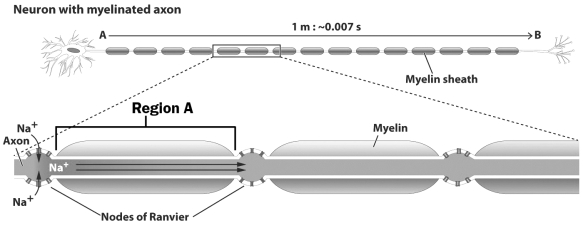 What is happening in Region A of this figure?
 (Multiple Choice)
4.9/5  (95)
(95) In vertebrates, special cells produce an insulating sheath of _______ that wraps around the axon of a neuron.
(Short Answer)
5.0/5 (87)
(87) The __________ nervous system ferries signals to and from the central nervous system.
(Short Answer)
4.9/5 (85)
(85) You bite into a juicy peach. What region of the cerebrum interprets the flavors in your mouth?
(Multiple Choice)
4.9/5 (72)
(72) Where would you expect to see an absence of neurotransmitters?
(Multiple Choice)
4.8/5 (85)
(85) When a signal causes sodium ions to flow into a neuron it becomes ___________.
(Short Answer)
4.8/5 (80)
(80) After a long hard workout, you feel thirsty. What part of the brain stimulated your thirst?
(Multiple Choice)
4.9/5 (86)
(86) One reason that the human race will probably not evolve larger brains is that it takes a lot of energy to run such a thinking machine.
(True/False)
4.7/5 (74)
(74) The flow of ions across an axon's plasma membrane generates an electrical impulse known as the _____________.
(Short Answer)
4.8/5 (82)
(82) _________ neurons receive information from the environment whereas ________ neurons carry out the orders of the central nervous system.
(Short Answer)
4.9/5 (77)
(77) After a signal has been transmitted to a receiving cell, neurotransmitters are rapidly removed from the synaptic cleft because
(Multiple Choice)
4.7/5 (77)
(77) In order to respond to an incoming signal, such as your fingertip being burned by a candle's flame, the signal must be transmitted to the brain before your muscles can be told to respond and pull away.
(True/False)
4.8/5 (75)
(75) Which of the following statements about a reflex arc is false?
(Multiple Choice)
4.7/5 (84)
(84) Which of the following best describes the flow of signals in our nervous system?
(Multiple Choice)
4.8/5 (70)
(70) The cerebral cortex of the human brain is much more highly and intricately folded than the same region in other animals. Why might this be the case?
(Multiple Choice)
4.8/5 (85)
(85) As a whole, the nervous system converts stimuli into _______ input-action potentials that convey information about stimuli.
(Short Answer)
4.7/5 (77)
(77) 
Filters
- Essay(0)
- Multiple Choice(0)
- Short Answer(0)
- True False(0)
- Matching(0)