



 Chat with AI
Exam 21: Animal Nutrition and Digestion

Exam 1: The Nature of Science and the Characteristics of Life75 Questions
Exam 2: Organizing the Diversity of Life75 Questions
Exam 3: Major Groups of Living Organisms74 Questions
Exam 4: Chemical Building Blocks77 Questions
Exam 5: Cell Structure and Internal Compartments76 Questions
Exam 6: Cell Membranes, Transport, and Communication73 Questions
Exam 7: Energy and Enzymes68 Questions
Exam 8: Photosynthesis and Cellular Respiration70 Questions
Exam 9: Cell Division77 Questions
Exam 10: Patterns of Inheritance65 Questions
Exam 11: Chromosomes and Human Genetics70 Questions
Exam 12: DNA62 Questions
Exam 13: From Gene to Protein73 Questions
Exam 14: Control of Gene Expression66 Questions
Exam 15: DNA Technology64 Questions
Exam 16: How Evolution Works65 Questions
Exam 17: Evolution of Populations64 Questions
Exam 18: Adaptation and Speciation66 Questions
Exam 19: The Evolutionary History of Life69 Questions
Exam 20: Maintaining the Internal Environment66 Questions
Exam 21: Animal Nutrition and Digestion68 Questions
Exam 22: Gas Exchange68 Questions
Exam 23: The Circulatory System68 Questions
Exam 24: Animal Hormones69 Questions
Exam 25: The Nervous System69 Questions
Exam 26: Sensing the Environment66 Questions
Exam 27: Skeletons, Muscles, and Movement65 Questions
Exam 28: Defenses against Disease67 Questions
Exam 29: Reproduction and Development68 Questions
Exam 30: Animal Behavior61 Questions
Exam 31: Plant Structure, Nutrition, and Transport63 Questions
Exam 32: Plant Growth and Reproduction67 Questions
Exam 33: The Biosphere67 Questions
Exam 34: Growth of Populations65 Questions
Exam 35: Interactions among Organisms70 Questions
Exam 36: Communities of Organisms65 Questions
Exam 37: Ecosystems68 Questions
Exam 38: Global Change65 Questions
Exam 39: Biodiversity and People72 Questions
Exam 40: Cancer: Cell Division Out of Control69 Questions
Exam 41: Harnessing the Human Genome62 Questions
Exam 42: Humans and Evolution60 Questions
Exam 43: Smoking--Beyond Lung Cancer63 Questions
Exam 44: Feeding a Hungry Planet55 Questions
Exam 45: Building a Sustainable Society47 Questions
Select questions type


The natural production and absorption of many vitamins is regulated by negative feedback loops.
(True/False)
4.8/5  (80)
(80) Describe how the structure of the small intestine aids in its role in nutrient absorption.
(Essay)
4.9/5 (70)
(70) Many ___________, small inorganic compounds that are needed in trace amounts, are essential to the proper function of proteins.
(Short Answer)
4.8/5 (79)
(79) The colon contains bacteria that produce _____________, a small organic compound that is involved in blood clotting.
(Short Answer)
4.8/5 (82)
(82) The lower region of the small intestine is structured to create large amounts of surface area so that it can more efficiently
(Multiple Choice)
4.8/5 (87)
(87) Only guinea pigs, bats, the great apes, and humans must get vitamin C from their diets rather than synthesizing it themselves.
(True/False)
4.8/5 (78)
(78) As nutrients move across an intestinal villus, capillaries absorb
(Multiple Choice)
4.9/5 (73)
(73) Which of the following is not one of the three elements that provide the framework for the complex organic compounds that characterize life?
(Multiple Choice)
4.8/5 (87)
(87) How rapidly an organism can absorb nutrients generally depends on
(Multiple Choice)
4.9/5 (71)
(71) Why do sheep have a much longer small intestine relative to their size than dogs do?
(Multiple Choice)
4.8/5 (64)
(64) The figure below shows four types of nutrients that are absorbable by animal cells.  Which of the above molecules could be absorbed by the digestive tract without further digestion by enzymes?
 (Multiple Choice)
4.8/5 (82)
(82) Chemical digestion occurs inside of the organ indicated by the arrow in the figure below.
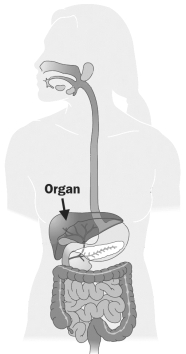
(True/False)
4.9/5 (79)
(79) Organisms need energy to carry out life processes, but they also must use energy simply to gather nutrients. Which of the following statements must be true in order for an organism to live?
(Multiple Choice)
4.8/5 (79)
(79) When humans who lack a particular enzyme consume products made from cow's milk they suffer digestive problems. The enzyme is
(Multiple Choice)
4.9/5 (80)
(80) Some animals have part of their guts modified into a muscular area that grinds food against small pebbles or sand grains collected from the environment. Which of the following statements about this area is false?
(Multiple Choice)
4.8/5 (71)
(71) Which of the following steps of digestion does not occur in the mouth?
(Multiple Choice)
4.8/5 (81)
(81) Which one of the following food sources would be eaten by carnivores?
(Multiple Choice)
4.7/5 (65)
(65) 
Filters
- Essay(0)
- Multiple Choice(0)
- Short Answer(0)
- True False(0)
- Matching(0)