



 Chat with AI
Exam 7: Energy and Enzymes

Exam 1: The Nature of Science and the Characteristics of Life75 Questions
Exam 2: Organizing the Diversity of Life75 Questions
Exam 3: Major Groups of Living Organisms74 Questions
Exam 4: Chemical Building Blocks77 Questions
Exam 5: Cell Structure and Internal Compartments76 Questions
Exam 6: Cell Membranes, Transport, and Communication73 Questions
Exam 7: Energy and Enzymes68 Questions
Exam 8: Photosynthesis and Cellular Respiration70 Questions
Exam 9: Cell Division77 Questions
Exam 10: Patterns of Inheritance65 Questions
Exam 11: Chromosomes and Human Genetics70 Questions
Exam 12: DNA62 Questions
Exam 13: From Gene to Protein73 Questions
Exam 14: Control of Gene Expression66 Questions
Exam 15: DNA Technology64 Questions
Exam 16: How Evolution Works65 Questions
Exam 17: Evolution of Populations64 Questions
Exam 18: Adaptation and Speciation66 Questions
Exam 19: The Evolutionary History of Life69 Questions
Exam 20: Maintaining the Internal Environment66 Questions
Exam 21: Animal Nutrition and Digestion68 Questions
Exam 22: Gas Exchange68 Questions
Exam 23: The Circulatory System68 Questions
Exam 24: Animal Hormones69 Questions
Exam 25: The Nervous System69 Questions
Exam 26: Sensing the Environment66 Questions
Exam 27: Skeletons, Muscles, and Movement65 Questions
Exam 28: Defenses against Disease67 Questions
Exam 29: Reproduction and Development68 Questions
Exam 30: Animal Behavior61 Questions
Exam 31: Plant Structure, Nutrition, and Transport63 Questions
Exam 32: Plant Growth and Reproduction67 Questions
Exam 33: The Biosphere67 Questions
Exam 34: Growth of Populations65 Questions
Exam 35: Interactions among Organisms70 Questions
Exam 36: Communities of Organisms65 Questions
Exam 37: Ecosystems68 Questions
Exam 38: Global Change65 Questions
Exam 39: Biodiversity and People72 Questions
Exam 40: Cancer: Cell Division Out of Control69 Questions
Exam 41: Harnessing the Human Genome62 Questions
Exam 42: Humans and Evolution60 Questions
Exam 43: Smoking--Beyond Lung Cancer63 Questions
Exam 44: Feeding a Hungry Planet55 Questions
Exam 45: Building a Sustainable Society47 Questions
Select questions type


The gain of electrons by one atom from another atom is referred to as _______.
(Short Answer)
4.9/5  (85)
(85) According to the _____ ______ model, the active site of an enzyme adjusts its shape to mold around a substrate after binding.
(Short Answer)
4.8/5 (83)
(83) Photosynthesis creates energy and cellular respiration destroys energy.
(True/False)
4.9/5 (87)
(87) All of the chemical energy in ATP is used during a chemical reaction
(True/False)
5.0/5 (85)
(85) A spherical rock rests at the top of a steep hill. The rock has
(Multiple Choice)
4.8/5 (82)
(82) When humans cut down trees for lumber to build permanent structures, what aspect of metabolic cycling is disrupted?
(Multiple Choice)
4.9/5 (71)
(71) A catalyst affects the _______ at which a chemical reaction occurs, but it is not itself changed during the reaction.
(Short Answer)
4.9/5 (80)
(80) Exposing many proteins to high heat causes their three-dimensional shape to change. How might heat affect the function of an enzyme?
(Essay)
4.8/5 (70)
(70) This image diagrams the action of an enzyme. 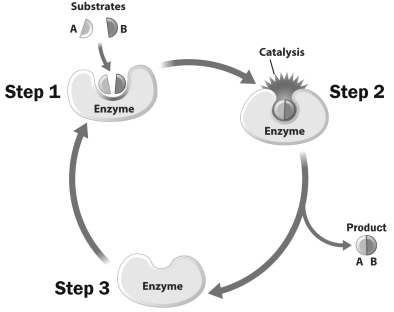 Notice that the enzyme is depicted as being more tightly wrapped around the substrates in step 2 than it is in step 1. Why is this?
 (Multiple Choice)
4.9/5 (71)
(71) COX-2 inhibitors like Vioxx control inflammation without affecting COX-1, but patients taking these drugs are more susceptible to heart attack and stroke. Which of the following is a possible explanation of this side effect?
(Multiple Choice)
4.9/5 (71)
(71) An insect devouring a leaf is an example of the second law of thermodynamics in action.
(True/False)
4.9/5 (76)
(76) The heat given off by living systems can increase the likelihood of a given chemical reaction's taking place. Why is this true?
(Multiple Choice)
4.9/5 (95)
(95) Carbon dioxide is the product of the metabolic process called ____________ that occurs in both plants and animals.
(Short Answer)
4.8/5 (83)
(83) _______ are the organelles where the breakdown products of food are oxidized, thereby generating most of a cell's ATP.
(Short Answer)
5.0/5 (71)
(71) Living systems must work to remain ordered. They pass off their disorder in the form of
(Multiple Choice)
4.7/5 (76)
(76) 
Filters
- Essay(0)
- Multiple Choice(0)
- Short Answer(0)
- True False(0)
- Matching(0)