



 Chat with AI
Exam 43: The Immune System

Exam 1: Introduction: Evolution and Themes of Biology77 Questions
Exam 2: The Chemical Context of Life98 Questions
Exam 3: Water and Life92 Questions
Exam 4: Carbon and the Molecular Diversity of Life86 Questions
Exam 5: The Structure and Function of Large Biological Molecules131 Questions
Exam 6: A Tour of the Cell111 Questions
Exam 7: Membrane Structure and Function88 Questions
Exam 8: An Introduction to Metabolism92 Questions
Exam 9: Cellular Respiration and Fermentation128 Questions
Exam 10: Photosynthesis103 Questions
Exam 11: Cell Communication85 Questions
Exam 12: The Cell Cycle98 Questions
Exam 13: Meiosis and Sexual Life Cycles90 Questions
Exam 14: Mendel and the Gene Idea92 Questions
Exam 15: The Chromosomal Basis of Inheritance75 Questions
Exam 16: The Molecular Basis of Inheritance84 Questions
Exam 17: From Gene to Protein106 Questions
Exam 18: Regulation of Gene Expression116 Questions
Exam 19: Viruses71 Questions
Exam 20: DNA Tools and Biotechnology78 Questions
Exam 21: Genomes and Their Evolution64 Questions
Exam 22: Descent with Modification: A Darwinian View of Life68 Questions
Exam 23: The Evolution of Populations92 Questions
Exam 24: The Origin of Species76 Questions
Exam 25: The History of Life on Earth89 Questions
Exam 26: Phylogeny and the Tree of Life91 Questions
Exam 27: Bacteria and Archaea96 Questions
Exam 28: Protists82 Questions
Exam 29: Plant Diversity I: How Plants Colonized Land93 Questions
Exam 30: Plant Diversity II: The Evolution of Seed Plants119 Questions
Exam 31: Fungi105 Questions
Exam 32: An Overview of Animal Diversity93 Questions
Exam 33: An Introduction to Invertebrates111 Questions
Exam 34: The Origin and Evolution of Vertebrates126 Questions
Exam 35: Plant Structure,Growth,and Development82 Questions
Exam 36: Resource Acquisition and Transport in Vascular Plants100 Questions
Exam 37: Soil and Plant Nutrition99 Questions
Exam 38: Angiosperm Reproduction and Biotechnology107 Questions
Exam 39: Plant Responses to Internal and External Signals137 Questions
Exam 40: Basic Principles of Animal Form and Function98 Questions
Exam 41: Animal Nutrition87 Questions
Exam 42: Circulation and Gas Exchange112 Questions
Exam 43: The Immune System123 Questions
Exam 44: Osmoregulation and Excretion91 Questions
Exam 45: Hormones and the Endocrine System92 Questions
Exam 46: Animal Reproduction104 Questions
Exam 47: Animal Development106 Questions
Exam 48: Neurons,Synapses,and Signalling93 Questions
Exam 49: Nervous Systems85 Questions
Exam 50: Sensory and Motor Mechanisms106 Questions
Exam 51: Animal Behaviour91 Questions
Exam 52: An Introduction to Ecology and the Biosphere90 Questions
Exam 53: Population Ecology89 Questions
Exam 54: Community Ecology97 Questions
Exam 55: Ecosystems and Restoration Ecology98 Questions
Exam 56: Conservation Biology and Global Change90 Questions
Select questions type


The ability of some viruses to remain inactive (latent)for a period of time is exemplified by
(Multiple Choice)
4.9/5  (81)
(81) Preventing the appearance of the symptoms of an allergy attack would be the likely result of
(Multiple Choice)
4.9/5 (73)
(73) Antibodies of the different classes IgM,IgG,IgA,IgD,and IgE differ from each other
(Multiple Choice)
4.9/5 (87)
(87) The cells involved in innate immunity,whose absence increases the chances of developing malignant tumours,are
(Multiple Choice)
5.0/5 (81)
(81) In the human disease known as lupus,there is an immune reaction against a patient's own DNA from broken or dying cells,which categorizes lupus as
(Multiple Choice)
4.9/5 (85)
(85) An inflammation-causing signal released by mast cells at the site of an infection is
(Multiple Choice)
4.9/5 (87)
(87) An example of a pathogen that undergoes rapid changes resulting in antigenic variation is
(Multiple Choice)
4.7/5 (67)
(67) You and a friend were in line for a movie when you noticed the woman in front of you sneezing and coughing.Both of you were equally exposed to the woman's virus,but over the next few days,only your friend acquired flu-like symptoms and was ill for almost a week before recovering.Which one of the following is a logical explanation for this?
(Multiple Choice)
5.0/5 (86)
(86) Mucus occurs in both the respiratory and digestive tracts.What is its main immunological function?
(Multiple Choice)
4.8/5 (67)
(67) Ancient peoples sought to identify the indicators of inflammation because
(Multiple Choice)
4.8/5 (73)
(73) The ability of one person to produce over a million different antibody molecules does not require over a million different genes; rather,this wide range of antibody production is due to
(Multiple Choice)
5.0/5 (72)
(72) If a patient is missing B and T cells,what would be absent from the immune response?
(Multiple Choice)
4.9/5 (78)
(78) Use the following information to answer the next few questions.
In a famous study,women were asked to smell and rate the attractiveness of axillary odours on t-shirts worn by different men.Results showed that ovulating women preferred the odour of the t-shirts worn by MHC (major histocompatibility complex)dissimilar men.This indicates that dissimilarity in MHC may play a role in mate selection.
-The purpose of an MHC molecule is to
(Multiple Choice)
4.9/5 (90)
(90) Mammals have Toll-like receptors (TLRs)that can recognize a kind of macromolecule that is absent from vertebrates but present in/on certain groups of pathogens,including viral
(Multiple Choice)
4.8/5 (73)
(73) What major advantage is conveyed by having a system of adaptive immunity?
(Multiple Choice)
4.8/5 (77)
(77) Mutant fruit flies that make only one antimicrobial peptide were tested for survival after infection with Neurospora crassa fungi or with Micrococcus luteus bacteria.
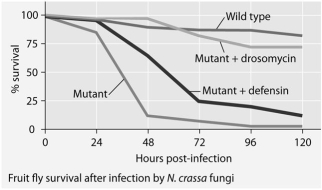
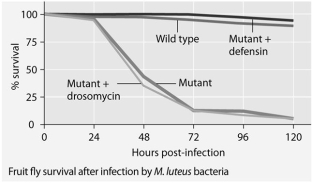 -The results shown in the graphs support the hypothesis that
 (Multiple Choice)
4.8/5 (85)
(85) Septic shock,a systemic response including high fever and low blood pressure,is a response to
(Multiple Choice)
5.0/5 (87)
(87) Jenner's successful use of cowpox virus as a vaccine against the smallpox virus is due to the fact that
(Multiple Choice)
4.7/5 (93)
(93) 
Filters
- Essay(0)
- Multiple Choice(0)
- Short Answer(0)
- True False(0)
- Matching(0)