



 Chat with AI
Exam 54: Community Ecology

Exam 1: Introduction: Evolution and Themes of Biology77 Questions
Exam 2: The Chemical Context of Life98 Questions
Exam 3: Water and Life92 Questions
Exam 4: Carbon and the Molecular Diversity of Life86 Questions
Exam 5: The Structure and Function of Large Biological Molecules131 Questions
Exam 6: A Tour of the Cell111 Questions
Exam 7: Membrane Structure and Function88 Questions
Exam 8: An Introduction to Metabolism92 Questions
Exam 9: Cellular Respiration and Fermentation128 Questions
Exam 10: Photosynthesis103 Questions
Exam 11: Cell Communication85 Questions
Exam 12: The Cell Cycle98 Questions
Exam 13: Meiosis and Sexual Life Cycles90 Questions
Exam 14: Mendel and the Gene Idea92 Questions
Exam 15: The Chromosomal Basis of Inheritance75 Questions
Exam 16: The Molecular Basis of Inheritance84 Questions
Exam 17: From Gene to Protein106 Questions
Exam 18: Regulation of Gene Expression116 Questions
Exam 19: Viruses71 Questions
Exam 20: DNA Tools and Biotechnology78 Questions
Exam 21: Genomes and Their Evolution64 Questions
Exam 22: Descent with Modification: A Darwinian View of Life68 Questions
Exam 23: The Evolution of Populations92 Questions
Exam 24: The Origin of Species76 Questions
Exam 25: The History of Life on Earth89 Questions
Exam 26: Phylogeny and the Tree of Life91 Questions
Exam 27: Bacteria and Archaea96 Questions
Exam 28: Protists82 Questions
Exam 29: Plant Diversity I: How Plants Colonized Land93 Questions
Exam 30: Plant Diversity II: The Evolution of Seed Plants119 Questions
Exam 31: Fungi105 Questions
Exam 32: An Overview of Animal Diversity93 Questions
Exam 33: An Introduction to Invertebrates111 Questions
Exam 34: The Origin and Evolution of Vertebrates126 Questions
Exam 35: Plant Structure,Growth,and Development82 Questions
Exam 36: Resource Acquisition and Transport in Vascular Plants100 Questions
Exam 37: Soil and Plant Nutrition99 Questions
Exam 38: Angiosperm Reproduction and Biotechnology107 Questions
Exam 39: Plant Responses to Internal and External Signals137 Questions
Exam 40: Basic Principles of Animal Form and Function98 Questions
Exam 41: Animal Nutrition87 Questions
Exam 42: Circulation and Gas Exchange112 Questions
Exam 43: The Immune System123 Questions
Exam 44: Osmoregulation and Excretion91 Questions
Exam 45: Hormones and the Endocrine System92 Questions
Exam 46: Animal Reproduction104 Questions
Exam 47: Animal Development106 Questions
Exam 48: Neurons,Synapses,and Signalling93 Questions
Exam 49: Nervous Systems85 Questions
Exam 50: Sensory and Motor Mechanisms106 Questions
Exam 51: Animal Behaviour91 Questions
Exam 52: An Introduction to Ecology and the Biosphere90 Questions
Exam 53: Population Ecology89 Questions
Exam 54: Community Ecology97 Questions
Exam 55: Ecosystems and Restoration Ecology98 Questions
Exam 56: Conservation Biology and Global Change90 Questions
Select questions type


Which of the following is an example of cryptic colouration?

Free
(Multiple Choice)
4.8/5  (95)
(95) Correct Answer: Verified
E
According to the nonequilibrium model
Free
(Multiple Choice)
4.7/5 (75)
(75) Correct Answer:Verified
VerifiedE
The 1988 Yellowstone National Park lodgepole pine forest fires were likely the result of
Free
(Multiple Choice)
4.8/5 (80)
(80) Correct Answer:Verified
VerifiedC
Which of the following would be most significant in understanding the structure of an ecological community?
I. determining how many species are present overall
II. determining which particular species are present
III.determining the kinds of interactions that occur among organisms of different species
IV.determining the relative abundance of species
(Multiple Choice)
4.7/5 (79)
(79) The following statements about community structure and interactions are correct,with the exception of which one?
(Multiple Choice)
5.0/5 (85)
(85) Which of the following is a correct statement about the MacArthur/Wilson Island Equilibrium Model?
(Multiple Choice)
4.7/5 (79)
(79) In terms of community ecology,why are pathogens more virulent now than ever before?
(Multiple Choice)
5.0/5 (77)
(77) Scientists interested in how populations interact within communities are attempting to determine the species diversity of an island under study.What kind of data would be most helpful to the scientists in determining diversity?
(Multiple Choice)
4.7/5 (86)
(86) Based on the intermediate disturbance hypothesis,a community's species diversity is increased by
(Multiple Choice)
4.8/5 (73)
(73) The symbols +,-,and o are to be used to show the results of interactions between individuals and groups of individuals in the examples that follow.The symbol + denotes a positive interaction,- denotes a negative interaction,and o denotes where individuals are not affected by interacting.The first symbol refers to the first organism mentioned.
-What interactions exist between a bee and a flower?
(Multiple Choice)
4.9/5 (77)
(77) The symbols +,-,and o are to be used to show the results of interactions between individuals and groups of individuals in the examples that follow.The symbol + denotes a positive interaction,- denotes a negative interaction,and o denotes where individuals are not affected by interacting.The first symbol refers to the first organism mentioned.
-What interactions exist between a tick on a dog and the dog?
(Multiple Choice)
4.9/5 (79)
(79) Approximately how many kg of carnivore biomass can be supported by a field plot containing 1000 kg of plant material?
(Multiple Choice)
4.9/5 (74)
(74) Primary succession differs from secondary succession in what way?
(Multiple Choice)
4.7/5 (80)
(80) Please refer to the art below to answer the following question.
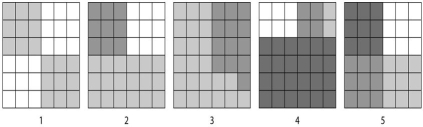 -According to the Shannon Diversity Index,which block would show the greatest diversity?
 (Multiple Choice)
4.9/5 (71)
(71) The symbols +,-,and o are to be used to show the results of interactions between individuals and groups of individuals in the examples that follow.The symbol + denotes a positive interaction,- denotes a negative interaction,and o denotes where individuals are not affected by interacting.The first symbol refers to the first organism mentioned.
-What interactions exist between a lion pride and a hyena pack?
(Multiple Choice)
4.7/5 (101)
(101) Which of the following statements is consistent with the principle of competitive exclusion?
(Multiple Choice)
4.8/5 (75)
(75) Which of the following is an example of aposematic colouration?
(Multiple Choice)
4.7/5 (77)
(77) Elephants are not the most dominant species in African grasslands,yet they influence community structure.The grasslands contain scattered woody plants,but they are kept in check by the uprooting activities of the elephants.Take away the elephants,and the grasslands convert to forests or to shrublands.The newly growing forests support fewer species than the previous grasslands.Which of the following describes why elephants are the keystone species in this scenario?
(Multiple Choice)
4.9/5 (75)
(75) 
Filters
- Essay(0)
- Multiple Choice(0)
- Short Answer(0)
- True False(0)
- Matching(0)