



 Chat with AI
Exam 14: Mendel and the Gene Idea

Exam 1: Introduction: Evolution and Themes of Biology77 Questions
Exam 2: The Chemical Context of Life98 Questions
Exam 3: Water and Life92 Questions
Exam 4: Carbon and the Molecular Diversity of Life86 Questions
Exam 5: The Structure and Function of Large Biological Molecules131 Questions
Exam 6: A Tour of the Cell111 Questions
Exam 7: Membrane Structure and Function88 Questions
Exam 8: An Introduction to Metabolism92 Questions
Exam 9: Cellular Respiration and Fermentation128 Questions
Exam 10: Photosynthesis103 Questions
Exam 11: Cell Communication85 Questions
Exam 12: The Cell Cycle98 Questions
Exam 13: Meiosis and Sexual Life Cycles90 Questions
Exam 14: Mendel and the Gene Idea92 Questions
Exam 15: The Chromosomal Basis of Inheritance75 Questions
Exam 16: The Molecular Basis of Inheritance84 Questions
Exam 17: From Gene to Protein106 Questions
Exam 18: Regulation of Gene Expression116 Questions
Exam 19: Viruses71 Questions
Exam 20: DNA Tools and Biotechnology78 Questions
Exam 21: Genomes and Their Evolution64 Questions
Exam 22: Descent with Modification: A Darwinian View of Life68 Questions
Exam 23: The Evolution of Populations92 Questions
Exam 24: The Origin of Species76 Questions
Exam 25: The History of Life on Earth89 Questions
Exam 26: Phylogeny and the Tree of Life91 Questions
Exam 27: Bacteria and Archaea96 Questions
Exam 28: Protists82 Questions
Exam 29: Plant Diversity I: How Plants Colonized Land93 Questions
Exam 30: Plant Diversity II: The Evolution of Seed Plants119 Questions
Exam 31: Fungi105 Questions
Exam 32: An Overview of Animal Diversity93 Questions
Exam 33: An Introduction to Invertebrates111 Questions
Exam 34: The Origin and Evolution of Vertebrates126 Questions
Exam 35: Plant Structure,Growth,and Development82 Questions
Exam 36: Resource Acquisition and Transport in Vascular Plants100 Questions
Exam 37: Soil and Plant Nutrition99 Questions
Exam 38: Angiosperm Reproduction and Biotechnology107 Questions
Exam 39: Plant Responses to Internal and External Signals137 Questions
Exam 40: Basic Principles of Animal Form and Function98 Questions
Exam 41: Animal Nutrition87 Questions
Exam 42: Circulation and Gas Exchange112 Questions
Exam 43: The Immune System123 Questions
Exam 44: Osmoregulation and Excretion91 Questions
Exam 45: Hormones and the Endocrine System92 Questions
Exam 46: Animal Reproduction104 Questions
Exam 47: Animal Development106 Questions
Exam 48: Neurons,Synapses,and Signalling93 Questions
Exam 49: Nervous Systems85 Questions
Exam 50: Sensory and Motor Mechanisms106 Questions
Exam 51: Animal Behaviour91 Questions
Exam 52: An Introduction to Ecology and the Biosphere90 Questions
Exam 53: Population Ecology89 Questions
Exam 54: Community Ecology97 Questions
Exam 55: Ecosystems and Restoration Ecology98 Questions
Exam 56: Conservation Biology and Global Change90 Questions
Select questions type


An obstetrician knows that one of her patients is a pregnant woman whose fetus is at risk for a serious disorder that is detectable biochemically in fetal cells.The obstetrician would most reasonably offer which of the following procedures to her patient?

Free
(Multiple Choice)
4.8/5  (90)
(90) Correct Answer: Verified
C
Albinism is an autosomal (not sex-linked)recessive trait.A man and woman are both of normal pigmentation,but both have one parent who is albino (without melanin pigmentation).What is the probability that their first child will be an albino?
Free
(Multiple Choice)
4.8/5 (85)
(85) Correct Answer:Verified
VerifiedB
The following questions refer to the pedigree chart in the figure below for a family,some of whose members exhibit the dominant trait,W.Affected individuals are indicated by a dark square or circle.
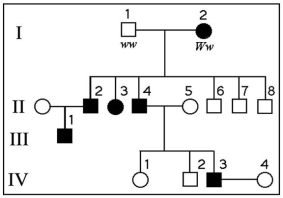 -What is the genotype of individual II-5?
Free
(Multiple Choice)
4.7/5 (89)
(89) Correct Answer:Verified
VerifiedC
Use the following information to answer the questions below.
Skin colour in a certain species of fish is inherited via a single gene with four different alleles.
-One fish of this type has alleles 1 and 3 (S₁S₃)and its mate has alleles 2 and 4 (S₂S₄).If each allele confers a unit of colour darkness such that S₁ has one unit,S₂ has two units,and so on,then what proportion of their offspring would be expected to have five units of colour?
(Multiple Choice)
4.9/5 (78)
(78) When crossing an organism that is homozygous recessive for a single trait with a heterozygote,what is the chance of producing an offspring with the homozygous recessive phenotype?
(Multiple Choice)
4.8/5 (77)
(77) Use the following pedigree shown below for a family in which dark-shaded symbols represent individuals with one of the two major types of colon cancer.Numbers under the symbols are the individual's age at the time of diagnosis.
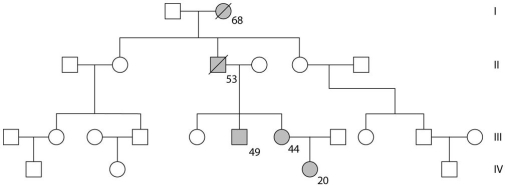 -The affected woman in generation IV is thinking about her future and asks her oncologist (cancer specialist)whether she can know whether any or all of her children will have a high risk of the same cancer.The doctor would be expected to advise which of the following?
I.genetic counselling
II.prenatal diagnosis when/if she becomes pregnant
III.testing to see whether she has the allele
IV.testing to see whether her future spouse or partner has the allele
-The affected woman in generation IV is thinking about her future and asks her oncologist (cancer specialist)whether she can know whether any or all of her children will have a high risk of the same cancer.The doctor would be expected to advise which of the following?
I.genetic counselling
II.prenatal diagnosis when/if she becomes pregnant
III.testing to see whether she has the allele
IV.testing to see whether her future spouse or partner has the allele (Multiple Choice)
4.8/5 (81)
(81) Use the following information to answer the questions below.
A woman who has blood type A positive has a daughter who is type O positive and a son who is type B negative.Rh positive is a trait that shows simple dominance over Rh negative and is designated by the alleles R and r,respectively.A third gene for the MN blood group has codominant alleles M and N.
-Which of the following is a possible genotype for the mother?
(Multiple Choice)
4.8/5 (66)
(66) When both traits are exhibited in the phenotype,it is said that the alleles display
(Multiple Choice)
4.9/5 (76)
(76) Use the following information to answer the questions below.
Tay-Sachs disease is an inherited genetic disorder in which the gene sequence codes for an enzyme involved in lipid metabolism.Accumulation of lipids in the brain leads to seizures,blindness,loss of neural function,and early death.People can be carriers of this disease and only homozygotic offspring will die from this disorder.
-When the enzyme structure of a heterozygote carrier is examined,there is an equal number of functioning and non-functioning enzymes produced.This is an example of
(Multiple Choice)
4.8/5 (78)
(78) What do we mean when we use the terms monohybrid cross and dihybrid cross?
(Multiple Choice)
4.8/5 (72)
(72) Use the following information to answer the questions below.
Two true-breeding stocks of pea plants are crossed.One parent has red,axial flowers and the other has white,terminal flowers; all F₁ individuals have red,axial flowers.The genes for flower colour and location assort independently.
-Among the F₂ offspring,what is the probability of plants with white axial flowers?
(Multiple Choice)
4.8/5 (75)
(75) Which of the following statements is a correct explanation for the observation that all offspring exhibit a phenotype for a particular trait that appears to be a blend of the two parental varieties?
(Multiple Choice)
4.8/5 (80)
(80) Refer to the following information to answer the questions below.
Gene S controls the sharpness of spines in a type of cactus.Cacti with the dominant allele,S,have sharp spines,whereas homozygous recessive ss cacti have dull spines.At the same time,a second gene,N,determines whether or not cacti have spines.Homozygous recessive nn cacti have no spines at all.
-If doubly heterozygous SsNn cacti were allowed to self-pollinate,the F₂ would segregate in which of the following ratios?
(Multiple Choice)
4.8/5 (74)
(74) Use the following information to answer the questions below.
A certain (hypothetical)organism is diploid,has either blue or orange wings as the consequence of one of its genes on chromosome 12,and has either long or short antennae as the result of a second gene on chromosome 19,as shown in this figure.
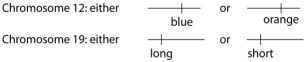 -A certain female's number 12 chromosomes both have the blue gene and number 19 chromosomes both have the long gene.As cells in her ovaries undergo meiosis,her resulting eggs (ova)may have which of the following?
 (Multiple Choice)
4.9/5 (90)
(90) Visitors at Algonquin Park in Northern Ontario may miss out on the brilliant red colouration of Acer sacchrum in autumn because
(Multiple Choice)
4.8/5 (86)
(86) Mendel crossed yellow-seeded and green-seeded pea plants and then allowed the offspring to self-pollinate to produce an F₂ generation.The results were as follows: 6022 yellow and 2001 green (8023 total).The allele for green seeds has what relationship to the allele for yellow seeds?
(Multiple Choice)
4.9/5 (76)
(76) Cystic fibrosis affects the lungs,the pancreas,the digestive system,and other organs,resulting in symptoms ranging from breathing difficulties to recurrent infections.Which of the following terms best describes this?
(Multiple Choice)
4.8/5 (85)
(85) Hutchinson-Gilford progeria is an exceedingly rare human genetic disorder in which there is very early senility and death,usually from coronary artery disease,at an average age of approximately 13.Patients,who look very old even as children,do not live to reproduce.Which of the following represents the most likely assumption?
(Multiple Choice)
4.9/5 (72)
(72) Which of the following calculations requires that you utilize the addition rule?
(Multiple Choice)
4.8/5 (80)
(80) When Mendel crossed yellow-seeded and green-seeded pea plants,all the offspring were yellow seeded.When he took these F₁ yellow-seeded plants and crossed them to green-seeded plants,what genotypic ratio was expected?
(Multiple Choice)
5.0/5 (86)
(86) 
Filters
- Essay(0)
- Multiple Choice(0)
- Short Answer(0)
- True False(0)
- Matching(0)