



 Chat with AI
Exam 18: Regulation of Gene Expression

Exam 1: Introduction: Evolution and Themes of Biology77 Questions
Exam 2: The Chemical Context of Life98 Questions
Exam 3: Water and Life92 Questions
Exam 4: Carbon and the Molecular Diversity of Life86 Questions
Exam 5: The Structure and Function of Large Biological Molecules131 Questions
Exam 6: A Tour of the Cell111 Questions
Exam 7: Membrane Structure and Function88 Questions
Exam 8: An Introduction to Metabolism92 Questions
Exam 9: Cellular Respiration and Fermentation128 Questions
Exam 10: Photosynthesis103 Questions
Exam 11: Cell Communication85 Questions
Exam 12: The Cell Cycle98 Questions
Exam 13: Meiosis and Sexual Life Cycles90 Questions
Exam 14: Mendel and the Gene Idea92 Questions
Exam 15: The Chromosomal Basis of Inheritance75 Questions
Exam 16: The Molecular Basis of Inheritance84 Questions
Exam 17: From Gene to Protein106 Questions
Exam 18: Regulation of Gene Expression116 Questions
Exam 19: Viruses71 Questions
Exam 20: DNA Tools and Biotechnology78 Questions
Exam 21: Genomes and Their Evolution64 Questions
Exam 22: Descent with Modification: A Darwinian View of Life68 Questions
Exam 23: The Evolution of Populations92 Questions
Exam 24: The Origin of Species76 Questions
Exam 25: The History of Life on Earth89 Questions
Exam 26: Phylogeny and the Tree of Life91 Questions
Exam 27: Bacteria and Archaea96 Questions
Exam 28: Protists82 Questions
Exam 29: Plant Diversity I: How Plants Colonized Land93 Questions
Exam 30: Plant Diversity II: The Evolution of Seed Plants119 Questions
Exam 31: Fungi105 Questions
Exam 32: An Overview of Animal Diversity93 Questions
Exam 33: An Introduction to Invertebrates111 Questions
Exam 34: The Origin and Evolution of Vertebrates126 Questions
Exam 35: Plant Structure,Growth,and Development82 Questions
Exam 36: Resource Acquisition and Transport in Vascular Plants100 Questions
Exam 37: Soil and Plant Nutrition99 Questions
Exam 38: Angiosperm Reproduction and Biotechnology107 Questions
Exam 39: Plant Responses to Internal and External Signals137 Questions
Exam 40: Basic Principles of Animal Form and Function98 Questions
Exam 41: Animal Nutrition87 Questions
Exam 42: Circulation and Gas Exchange112 Questions
Exam 43: The Immune System123 Questions
Exam 44: Osmoregulation and Excretion91 Questions
Exam 45: Hormones and the Endocrine System92 Questions
Exam 46: Animal Reproduction104 Questions
Exam 47: Animal Development106 Questions
Exam 48: Neurons,Synapses,and Signalling93 Questions
Exam 49: Nervous Systems85 Questions
Exam 50: Sensory and Motor Mechanisms106 Questions
Exam 51: Animal Behaviour91 Questions
Exam 52: An Introduction to Ecology and the Biosphere90 Questions
Exam 53: Population Ecology89 Questions
Exam 54: Community Ecology97 Questions
Exam 55: Ecosystems and Restoration Ecology98 Questions
Exam 56: Conservation Biology and Global Change90 Questions
Select questions type


Forms of the Ras protein found in tumours usually cause which of the following?

Free
(Multiple Choice)
4.8/5  (87)
(87) Correct Answer: Verified
E
Which of the following is a protein produced by a regulatory gene?
Free
(Multiple Choice)
4.9/5 (73)
(73) Correct Answer:Verified
VerifiedD
When does the trp repressor block transcription of the trp operon?
Free
(Multiple Choice)
4.8/5 (88)
(88) Correct Answer:Verified
VerifiedB
What is the primary difference between enhancers and promoter-proximal elements?
(Multiple Choice)
4.9/5 (72)
(72) What would occur if the repressor of an inducible operon were mutated so it could not bind the operator?
(Multiple Choice)
4.8/5 (88)
(88) Use the following information to answer the questions below.
A few decades ago,Knudsen and colleagues proposed a theory that,for a normal cell to become a cancer cell,a minimum of two genetic changes had to occur in that cell.Knudsen was studying retinoblastoma,a childhood cancer of the eye.
-Which of the following types of mutation would convert a proto-oncogene into an oncogene?
(Multiple Choice)
4.7/5 (83)
(83) Altering patterns of gene expression in prokaryotes would most likely serve the organism's survival in which of the following ways?
(Multiple Choice)
4.8/5 (78)
(78) 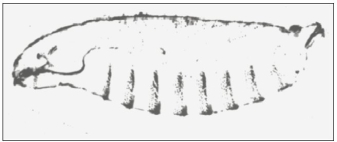 Drosophila larvae (wt)showing segmentation and anterior-posterior axis.
Refer to the image above to answer the following questions.
-When is a cell considered to be differentiated?
Drosophila larvae (wt)showing segmentation and anterior-posterior axis.
Refer to the image above to answer the following questions.
-When is a cell considered to be differentiated? (Multiple Choice)
4.9/5 (70)
(70) Which processes contribute to this dynamic compacting and decompacting of DNA?
(Multiple Choice)
5.0/5 (68)
(68) Why is CAP said to be responsible for positive regulation of the lac operon?
(Multiple Choice)
4.9/5 (71)
(71) Use the following information to answer the questions below.
A researcher found a method she could use to manipulate and quantify phosphorylation and methylation in embryonic cells in culture.
-In one set of experiments using this procedure in Drosophila,she was readily successful in increasing phosphorylation of amino acids adjacent to methylated amino acids in histone tails.Which of the following results would she most likely see?
(Multiple Choice)
4.8/5 (81)
(81) The fact that plants can be cloned from somatic cells demonstrates that
(Multiple Choice)
4.8/5 (78)
(78) A lack of which molecule would result in the cell's inability to "turn off" genes?
(Multiple Choice)
4.8/5 (77)
(77) Which of the following statements describes proto-oncogenes?
(Multiple Choice)
4.9/5 (96)
(96) The transformation from a zygote to a full-formed organism involves three interrelated processes.In order of occurrence,they are
(Multiple Choice)
4.8/5 (79)
(79) Mutations in which of the following genes lead to transformations in the identity of entire body parts?
(Multiple Choice)
4.7/5 (82)
(82) Use the following information to answer the questions below.
Suppose an experimenter becomes proficient with a technique that allows her to move DNA sequences within a prokaryotic genome.
-If she moves the operator to the far end of the operon (past the transacetylase gene),which of the following would likely occur when the cell is exposed to lactose?
(Multiple Choice)
4.7/5 (87)
(87) Proto-oncogenes can change into oncogenes that cause cancer.Which of the following best explains the presence of these potential time bombs in eukaryotic cells?
(Multiple Choice)
4.7/5 (81)
(81) Your brother has just purchased a new plastic model airplane.He places all the parts on the table in approximately the positions in which they will be located when the model is complete.His actions are analogous to which process in development?
(Multiple Choice)
4.8/5 (84)
(84) 
Filters
- Essay(0)
- Multiple Choice(0)
- Short Answer(0)
- True False(0)
- Matching(0)