



 Chat with AI
Exam 18: Regulation of Gene Expression

Exam 1: Introduction: Evolution and Themes of Biology77 Questions
Exam 2: The Chemical Context of Life98 Questions
Exam 3: Water and Life92 Questions
Exam 4: Carbon and the Molecular Diversity of Life86 Questions
Exam 5: The Structure and Function of Large Biological Molecules131 Questions
Exam 6: A Tour of the Cell111 Questions
Exam 7: Membrane Structure and Function88 Questions
Exam 8: An Introduction to Metabolism92 Questions
Exam 9: Cellular Respiration and Fermentation128 Questions
Exam 10: Photosynthesis103 Questions
Exam 11: Cell Communication85 Questions
Exam 12: The Cell Cycle98 Questions
Exam 13: Meiosis and Sexual Life Cycles90 Questions
Exam 14: Mendel and the Gene Idea92 Questions
Exam 15: The Chromosomal Basis of Inheritance75 Questions
Exam 16: The Molecular Basis of Inheritance84 Questions
Exam 17: From Gene to Protein106 Questions
Exam 18: Regulation of Gene Expression116 Questions
Exam 19: Viruses71 Questions
Exam 20: DNA Tools and Biotechnology78 Questions
Exam 21: Genomes and Their Evolution64 Questions
Exam 22: Descent with Modification: A Darwinian View of Life68 Questions
Exam 23: The Evolution of Populations92 Questions
Exam 24: The Origin of Species76 Questions
Exam 25: The History of Life on Earth89 Questions
Exam 26: Phylogeny and the Tree of Life91 Questions
Exam 27: Bacteria and Archaea96 Questions
Exam 28: Protists82 Questions
Exam 29: Plant Diversity I: How Plants Colonized Land93 Questions
Exam 30: Plant Diversity II: The Evolution of Seed Plants119 Questions
Exam 31: Fungi105 Questions
Exam 32: An Overview of Animal Diversity93 Questions
Exam 33: An Introduction to Invertebrates111 Questions
Exam 34: The Origin and Evolution of Vertebrates126 Questions
Exam 35: Plant Structure,Growth,and Development82 Questions
Exam 36: Resource Acquisition and Transport in Vascular Plants100 Questions
Exam 37: Soil and Plant Nutrition99 Questions
Exam 38: Angiosperm Reproduction and Biotechnology107 Questions
Exam 39: Plant Responses to Internal and External Signals137 Questions
Exam 40: Basic Principles of Animal Form and Function98 Questions
Exam 41: Animal Nutrition87 Questions
Exam 42: Circulation and Gas Exchange112 Questions
Exam 43: The Immune System123 Questions
Exam 44: Osmoregulation and Excretion91 Questions
Exam 45: Hormones and the Endocrine System92 Questions
Exam 46: Animal Reproduction104 Questions
Exam 47: Animal Development106 Questions
Exam 48: Neurons,Synapses,and Signalling93 Questions
Exam 49: Nervous Systems85 Questions
Exam 50: Sensory and Motor Mechanisms106 Questions
Exam 51: Animal Behaviour91 Questions
Exam 52: An Introduction to Ecology and the Biosphere90 Questions
Exam 53: Population Ecology89 Questions
Exam 54: Community Ecology97 Questions
Exam 55: Ecosystems and Restoration Ecology98 Questions
Exam 56: Conservation Biology and Global Change90 Questions
Select questions type


Use the following figure to answer the questions below.
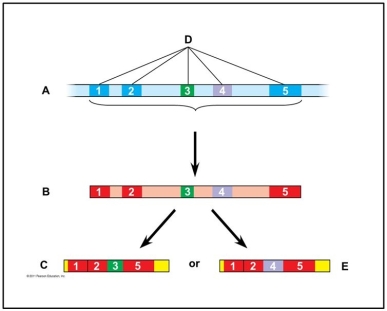 -What has happened to make the products C and D?
 (Multiple Choice)
4.9/5  (81)
(81) Use the following figure to answer the questions below.
-What is the significance of C and D?
-What is the significance of C and D? (Multiple Choice)
4.8/5 (74)
(74) Which of the following seems to account for most of the non-protein-coding DNA?
(Multiple Choice)
4.8/5 (81)
(81) Use the following information to answer the questions below.
A researcher introduces double-stranded RNA into a culture of mammalian cells,and can identify its location or that of its smaller subsections experimentally,using a fluorescent probe.
-Some time later,she finds that the introduced strand separates into single-stranded RNAs,one of which is degraded.What does this enable the remaining strand to do?
(Multiple Choice)
4.9/5 (75)
(75) Which of the following is an example of post-transcriptional control of gene expression?
(Multiple Choice)
4.9/5 (90)
(90) The role of a metabolite that controls a repressible operon is to
(Multiple Choice)
4.9/5 (87)
(87) Use the following information to answer the questions below.
A researcher introduces double-stranded RNA into a culture of mammalian cells,and can identify its location or that of its smaller subsections experimentally,using a fluorescent probe.
-Within the first quarter hour,the researcher sees that the intact RNA is found in the cells.After 3 hours,she is not surprised to find that
(Multiple Choice)
5.0/5 (88)
(88) Which of the following genes map out the basic subdivisions along the anterior-posterior axis of the Drosophila embryo?
(Multiple Choice)
4.9/5 (75)
(75) A mutation that inactivates the regulatory gene of a repressible operon in an E.coli cell would result in
(Multiple Choice)
4.9/5 (86)
(86) The cancer-causing forms of the Ras protein are involved in which of the following processes?
(Multiple Choice)
4.9/5 (66)
(66) Genomic imprinting,DNA methylation,and histone acetylation are all examples of
(Multiple Choice)
4.8/5 (91)
(91) Use the following information to answer the questions below.
A researcher has arrived at a method to prevent gene expression from Drosophila embryonic genes.The following questions assume that he is using this method.
-The researcher continues to study the reactions of the embryo to these new proteins and you hypothesize that he is most likely to see which of the following (while embryonic genes are still not being expressed)?
(Multiple Choice)
4.8/5 (81)
(81) A genetic test to detect predisposition to cancer would likely examine the APC gene for involvement in which type(s)of cancer?
(Multiple Choice)
4.9/5 (80)
(80) In response to chemical signals,prokaryotes can do which of the following?
(Multiple Choice)
4.8/5 (92)
(92) What causes different sets of proteins to be expressed in a nerve and a pancreatic cell of the same individual?
(Multiple Choice)
4.8/5 (79)
(79) 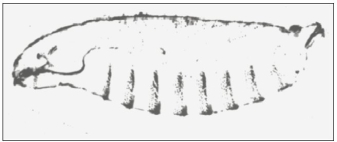 Drosophila larvae (wt)showing segmentation and anterior-posterior axis.
Refer to the image above to answer the following questions.
-The product of the gene responsible for anterior-posterior axis is concentrated more in the anterior end.This supports the
Drosophila larvae (wt)showing segmentation and anterior-posterior axis.
Refer to the image above to answer the following questions.
-The product of the gene responsible for anterior-posterior axis is concentrated more in the anterior end.This supports the (Multiple Choice)
4.8/5 (81)
(81) How can one detect alternative splicing of transcripts from a given gene?
(Multiple Choice)
4.9/5 (79)
(79) Of the following scenarios for future research,from which would you expect to gain most medical benefit from noncoding RNAs?
(Multiple Choice)
4.7/5 (68)
(68) 
Filters
- Essay(0)
- Multiple Choice(0)
- Short Answer(0)
- True False(0)
- Matching(0)