



 Chat with AI
Exam 29: Plant Diversity I: How Plants Colonized Land

Exam 1: Introduction: Evolution and Themes of Biology77 Questions
Exam 2: The Chemical Context of Life98 Questions
Exam 3: Water and Life92 Questions
Exam 4: Carbon and the Molecular Diversity of Life86 Questions
Exam 5: The Structure and Function of Large Biological Molecules131 Questions
Exam 6: A Tour of the Cell111 Questions
Exam 7: Membrane Structure and Function88 Questions
Exam 8: An Introduction to Metabolism92 Questions
Exam 9: Cellular Respiration and Fermentation128 Questions
Exam 10: Photosynthesis103 Questions
Exam 11: Cell Communication85 Questions
Exam 12: The Cell Cycle98 Questions
Exam 13: Meiosis and Sexual Life Cycles90 Questions
Exam 14: Mendel and the Gene Idea92 Questions
Exam 15: The Chromosomal Basis of Inheritance75 Questions
Exam 16: The Molecular Basis of Inheritance84 Questions
Exam 17: From Gene to Protein106 Questions
Exam 18: Regulation of Gene Expression116 Questions
Exam 19: Viruses71 Questions
Exam 20: DNA Tools and Biotechnology78 Questions
Exam 21: Genomes and Their Evolution64 Questions
Exam 22: Descent with Modification: A Darwinian View of Life68 Questions
Exam 23: The Evolution of Populations92 Questions
Exam 24: The Origin of Species76 Questions
Exam 25: The History of Life on Earth89 Questions
Exam 26: Phylogeny and the Tree of Life91 Questions
Exam 27: Bacteria and Archaea96 Questions
Exam 28: Protists82 Questions
Exam 29: Plant Diversity I: How Plants Colonized Land93 Questions
Exam 30: Plant Diversity II: The Evolution of Seed Plants119 Questions
Exam 31: Fungi105 Questions
Exam 32: An Overview of Animal Diversity93 Questions
Exam 33: An Introduction to Invertebrates111 Questions
Exam 34: The Origin and Evolution of Vertebrates126 Questions
Exam 35: Plant Structure,Growth,and Development82 Questions
Exam 36: Resource Acquisition and Transport in Vascular Plants100 Questions
Exam 37: Soil and Plant Nutrition99 Questions
Exam 38: Angiosperm Reproduction and Biotechnology107 Questions
Exam 39: Plant Responses to Internal and External Signals137 Questions
Exam 40: Basic Principles of Animal Form and Function98 Questions
Exam 41: Animal Nutrition87 Questions
Exam 42: Circulation and Gas Exchange112 Questions
Exam 43: The Immune System123 Questions
Exam 44: Osmoregulation and Excretion91 Questions
Exam 45: Hormones and the Endocrine System92 Questions
Exam 46: Animal Reproduction104 Questions
Exam 47: Animal Development106 Questions
Exam 48: Neurons,Synapses,and Signalling93 Questions
Exam 49: Nervous Systems85 Questions
Exam 50: Sensory and Motor Mechanisms106 Questions
Exam 51: Animal Behaviour91 Questions
Exam 52: An Introduction to Ecology and the Biosphere90 Questions
Exam 53: Population Ecology89 Questions
Exam 54: Community Ecology97 Questions
Exam 55: Ecosystems and Restoration Ecology98 Questions
Exam 56: Conservation Biology and Global Change90 Questions
Select questions type


Which of the following were probably factors that permitted early plants to successfully colonize land?
1)the relative number of potential predators (herbivores)
2)the relative number of competitors
3)the relative availability of symbiotic partners
4)air's relative lack of support,compared to water's support

Free
(Multiple Choice)
4.9/5  (69)
(69) Correct Answer: Verified
D
During glacial periods in the early evolution of land plants,which of the following would have been a beneficial adaptation regarding the number of stomata per unit surface area,and what accounts for it?
Free
(Multiple Choice)
4.8/5 (82)
(82) Correct Answer:Verified
VerifiedB
Increasing the number of stomata per unit surface area of a leaf when atmospheric CO₂ levels decline is most analogous to a human
Free
(Multiple Choice)
4.7/5 (81)
(81) Correct Answer:Verified
VerifiedB
Liverworts,hornworts,and mosses are grouped together as the Bryophytes.Besides not having vascular tissue,what do they all have in common?
(Multiple Choice)
4.9/5 (84)
(84) As is true of the gametophytes of all land plants,the gametophytes of true mosses lack stomata.Yet,the feather moss Pleurozium harbors nitrogen-fixing cyanobacteria.Which of the following is a feature of moss gametophytes that is most important for the continued survival of these cyanobacteria in the tissues of the feather moss gametophyte?
(Multiple Choice)
4.9/5 (82)
(82) All of the following are common to both charophytes and land plants except
(Multiple Choice)
4.9/5 (72)
(72) The next few questions are based on the following description.
A biology student hiking in a forest happens upon an erect,15-cm-tall plant that bears microphylls and a strobilus at its tallest point.When disturbed,the cone emits a dense cloud of brownish dust.A pocket magnifying glass reveals the dust to be composed of tiny spheres with a high oil content.
-A dissection of the interior of this organism's stem should reveal
(Multiple Choice)
4.9/5 (72)
(72) Which taxon is essentially equivalent to the "embryophytes"?
(Multiple Choice)
4.9/5 (87)
(87) You are hiking in a forest and happen upon a plant featuring a central stemlike structure from which sprout many,tiny,leaflike structures.Which of the following would be the most certain means of distinguishing whether it was a true moss or a club moss?
(Multiple Choice)
4.9/5 (77)
(77) Which of these time intervals,based on plant fossils,came last (most recently)?
(Multiple Choice)
4.7/5 (88)
(88) If intelligent extraterrestrials visited Earth 475 million years ago,and then again 300 million years ago (at the close of the Carboniferous period),what trends would they have noticed in Earth's terrestrial vegetation over this period?
1)a trend from dominant gametophytes to dominant sporophytes
2)a trend from sporangia borne on modified leaves (sporophylls)to sporangia borne on stalks (seta)
3)a trend from no true leaves,to microphylls,to megaphylls
4)a trend from soil-surface-hugging plants to "overtopping" plants
5)a trend toward increased lignification of conducting systems
(Multiple Choice)
4.9/5 (97)
(97) Which of the following structures are in the gametophyte generation of a moss?
(Multiple Choice)
4.9/5 (77)
(77) In terms of evolutionary time,which phyla are the oldest and which are the most recent (respectively)?
(Multiple Choice)
4.8/5 (75)
(75) Use the following figure to answer the questions below.
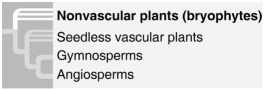 -What is true of the phylogenetic tree in the figure above?
1)It depicts uncertainty about whether the bryophytes or the vascular plants evolved first.
2)It is hypothetical.
3)It includes polytomies.
4)It shows that ferns (phylum Pterophyta)are the closest living relatives to the seed plants.
5)It indicates that seeds are a shared ancestral character of all vascular plants.
-What is true of the phylogenetic tree in the figure above?
1)It depicts uncertainty about whether the bryophytes or the vascular plants evolved first.
2)It is hypothetical.
3)It includes polytomies.
4)It shows that ferns (phylum Pterophyta)are the closest living relatives to the seed plants.
5)It indicates that seeds are a shared ancestral character of all vascular plants. (Multiple Choice)
4.8/5 (82)
(82) A student encounters a pondweed which,judging from its appearance,seems to be a charophyte.She brings a sample back to her biology lab.Using only a compound light microscope to study the sample,which of the following features should help her to determine whether the sample comes from a charophyte or from some other type of green alga?
1)molecular structure of enzymes inside peroxisomes
2)structure of sperm cells
3)presence of phragmoplasts
4)rings of cellulose-synthesizing complexes
(Multiple Choice)
4.9/5 (78)
(78) Evidence indicates that plants increase the number of stomata in their leaves as atmospheric CO₂ levels decline.Increasing the number of stomata per unit surface area should have the effect of doing which of the following?
1)increase dehydration of leaf tissues
2)decrease dehydration of leaf tissues
3)counter the effect of declining CO₂ on photosynthesis
4)reinforce the effect of declining CO₂ on photosynthesis
5)decrease the O₂ content of air next to the leaves to a level lower than it would otherwise be
6)increase the O₂ content of air next to the leaves to a level higher than it would otherwise be
(Multiple Choice)
4.7/5 (79)
(79) 
Filters
- Essay(0)
- Multiple Choice(0)
- Short Answer(0)
- True False(0)
- Matching(0)