



 Chat with AI
Exam 6: A Tour of the Cell

Exam 1: Introduction: Evolution and Themes of Biology77 Questions
Exam 2: The Chemical Context of Life98 Questions
Exam 3: Water and Life92 Questions
Exam 4: Carbon and the Molecular Diversity of Life86 Questions
Exam 5: The Structure and Function of Large Biological Molecules131 Questions
Exam 6: A Tour of the Cell111 Questions
Exam 7: Membrane Structure and Function88 Questions
Exam 8: An Introduction to Metabolism92 Questions
Exam 9: Cellular Respiration and Fermentation128 Questions
Exam 10: Photosynthesis103 Questions
Exam 11: Cell Communication85 Questions
Exam 12: The Cell Cycle98 Questions
Exam 13: Meiosis and Sexual Life Cycles90 Questions
Exam 14: Mendel and the Gene Idea92 Questions
Exam 15: The Chromosomal Basis of Inheritance75 Questions
Exam 16: The Molecular Basis of Inheritance84 Questions
Exam 17: From Gene to Protein106 Questions
Exam 18: Regulation of Gene Expression116 Questions
Exam 19: Viruses71 Questions
Exam 20: DNA Tools and Biotechnology78 Questions
Exam 21: Genomes and Their Evolution64 Questions
Exam 22: Descent with Modification: A Darwinian View of Life68 Questions
Exam 23: The Evolution of Populations92 Questions
Exam 24: The Origin of Species76 Questions
Exam 25: The History of Life on Earth89 Questions
Exam 26: Phylogeny and the Tree of Life91 Questions
Exam 27: Bacteria and Archaea96 Questions
Exam 28: Protists82 Questions
Exam 29: Plant Diversity I: How Plants Colonized Land93 Questions
Exam 30: Plant Diversity II: The Evolution of Seed Plants119 Questions
Exam 31: Fungi105 Questions
Exam 32: An Overview of Animal Diversity93 Questions
Exam 33: An Introduction to Invertebrates111 Questions
Exam 34: The Origin and Evolution of Vertebrates126 Questions
Exam 35: Plant Structure,Growth,and Development82 Questions
Exam 36: Resource Acquisition and Transport in Vascular Plants100 Questions
Exam 37: Soil and Plant Nutrition99 Questions
Exam 38: Angiosperm Reproduction and Biotechnology107 Questions
Exam 39: Plant Responses to Internal and External Signals137 Questions
Exam 40: Basic Principles of Animal Form and Function98 Questions
Exam 41: Animal Nutrition87 Questions
Exam 42: Circulation and Gas Exchange112 Questions
Exam 43: The Immune System123 Questions
Exam 44: Osmoregulation and Excretion91 Questions
Exam 45: Hormones and the Endocrine System92 Questions
Exam 46: Animal Reproduction104 Questions
Exam 47: Animal Development106 Questions
Exam 48: Neurons,Synapses,and Signalling93 Questions
Exam 49: Nervous Systems85 Questions
Exam 50: Sensory and Motor Mechanisms106 Questions
Exam 51: Animal Behaviour91 Questions
Exam 52: An Introduction to Ecology and the Biosphere90 Questions
Exam 53: Population Ecology89 Questions
Exam 54: Community Ecology97 Questions
Exam 55: Ecosystems and Restoration Ecology98 Questions
Exam 56: Conservation Biology and Global Change90 Questions
Select questions type


The cell walls of bacteria,fungi,and plant cells and the extracellular matrix of animal cells are all external to the plasma membrane.Which of the following is a characteristic common to all of these extracellular structures?

Free
(Multiple Choice)
4.9/5  (79)
(79) Correct Answer: Verified
D
A mutation that disrupts the ability of an animal cell to add polysaccharide modifications to proteins would most likely cause defects in its
Free
(Multiple Choice)
4.9/5 (86)
(86) Correct Answer:Verified
VerifiedD
Which structure is not part of the endomembrane system?
Free
(Multiple Choice)
5.0/5 (74)
(74) Correct Answer:Verified
VerifiedB
Which type of organelle is found in plant cells but not in animal cells?
(Multiple Choice)
4.8/5 (85)
(85) A biologist wants specifically to examine the surfaces of different types of cells in kidney tubules of small mammals.The cells in question can be distinguished by external shape,size,and 3-D characteristics.Which of the following would be the optimum method for her study?
(Multiple Choice)
4.7/5 (84)
(84) Researchers tried to explain how vesicular transport occurs in cells by attempting to assemble the transport components.They set up microtubular tracks along which vesicles could be transported,and they added vesicles and ATP (because they knew the transport process requires energy).Yet,when they put everything together,there was no movement or transport of vesicles.What were they missing?
(Multiple Choice)
4.9/5 (89)
(89) Which of the following statements about the cytoskeleton is true?
(Multiple Choice)
5.0/5 (74)
(74) Thylakoids,DNA,and ribosomes are all components found in which organelle?
(Multiple Choice)
4.7/5 (93)
(93) The nuclear lamina is an array of filaments on the inner side of the nuclear membrane.If a method were found that could cause the lamina to fall into disarray,what would you expect to be the most likely consequence?
(Multiple Choice)
4.8/5 (82)
(82) Cyanide binds with at least one molecule involved in producing ATP.If a cell is exposed to cyanide,most of the cyanide will be found within the
(Multiple Choice)
4.8/5 (70)
(70) The smallest cell structure that would most likely be visible with a standard (not super-resolution)research-grade light microscope is
(Multiple Choice)
4.9/5 (90)
(90) Which of the following statements correctly describes some aspect of protein secretion from prokaryotic cells?
(Multiple Choice)
4.8/5 (80)
(80) If an individual has abnormal microtubules due to a hereditary condition,in which organs or tissues would you expect dysfunction?
(Multiple Choice)
4.8/5 (78)
(78) Use the following figure to answer the questions below.
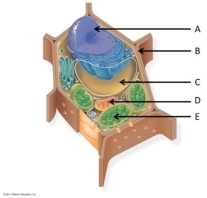 -What type of cell is pictured above?
 (Multiple Choice)
4.9/5 (80)
(80) Large numbers of ribosomes are present in cells that specialize in producing which of the following molecules?
(Multiple Choice)
4.9/5 (89)
(89) When biologists wish to study the internal ultrastructure of cells,they can achieve the finest resolution by using
(Multiple Choice)
4.8/5 (81)
(81) Gaucher disease is the most common of lipid storage diseases in humans.It is caused
By a deficiency of an enzyme necessary for lipid metabolism.This leads to a collection of
Fatty material in organs of the body including the spleen,liver,kidneys,lungs,brain,and
Bone marrow.Using your knowledge of the structure of eukaryotic cells,identify the statement below that best explains how internal membranes and the organelles of cells would be involved
In Gaucher disease.
(Multiple Choice)
4.7/5 (75)
(75) One of the key innovations in the evolution of eukaryotes from a prokaryotic ancestor is the endomembrane system.What eukaryotic organelles or features might have evolved as a part of,or as an elaboration of,the endomembrane system?
(Multiple Choice)
4.8/5 (76)
(76) In a liver cell detoxifying alcohol and some other poisons,the enzymes of the peroxisome remove hydrogen from these molecules and
(Multiple Choice)
5.0/5 (79)
(79) 
Filters
- Essay(0)
- Multiple Choice(0)
- Short Answer(0)
- True False(0)
- Matching(0)