



 Chat with AI
Exam 3: Water and Life

Exam 1: Introduction: Evolution and Themes of Biology77 Questions
Exam 2: The Chemical Context of Life98 Questions
Exam 3: Water and Life92 Questions
Exam 4: Carbon and the Molecular Diversity of Life86 Questions
Exam 5: The Structure and Function of Large Biological Molecules131 Questions
Exam 6: A Tour of the Cell111 Questions
Exam 7: Membrane Structure and Function88 Questions
Exam 8: An Introduction to Metabolism92 Questions
Exam 9: Cellular Respiration and Fermentation128 Questions
Exam 10: Photosynthesis103 Questions
Exam 11: Cell Communication85 Questions
Exam 12: The Cell Cycle98 Questions
Exam 13: Meiosis and Sexual Life Cycles90 Questions
Exam 14: Mendel and the Gene Idea92 Questions
Exam 15: The Chromosomal Basis of Inheritance75 Questions
Exam 16: The Molecular Basis of Inheritance84 Questions
Exam 17: From Gene to Protein106 Questions
Exam 18: Regulation of Gene Expression116 Questions
Exam 19: Viruses71 Questions
Exam 20: DNA Tools and Biotechnology78 Questions
Exam 21: Genomes and Their Evolution64 Questions
Exam 22: Descent with Modification: A Darwinian View of Life68 Questions
Exam 23: The Evolution of Populations92 Questions
Exam 24: The Origin of Species76 Questions
Exam 25: The History of Life on Earth89 Questions
Exam 26: Phylogeny and the Tree of Life91 Questions
Exam 27: Bacteria and Archaea96 Questions
Exam 28: Protists82 Questions
Exam 29: Plant Diversity I: How Plants Colonized Land93 Questions
Exam 30: Plant Diversity II: The Evolution of Seed Plants119 Questions
Exam 31: Fungi105 Questions
Exam 32: An Overview of Animal Diversity93 Questions
Exam 33: An Introduction to Invertebrates111 Questions
Exam 34: The Origin and Evolution of Vertebrates126 Questions
Exam 35: Plant Structure,Growth,and Development82 Questions
Exam 36: Resource Acquisition and Transport in Vascular Plants100 Questions
Exam 37: Soil and Plant Nutrition99 Questions
Exam 38: Angiosperm Reproduction and Biotechnology107 Questions
Exam 39: Plant Responses to Internal and External Signals137 Questions
Exam 40: Basic Principles of Animal Form and Function98 Questions
Exam 41: Animal Nutrition87 Questions
Exam 42: Circulation and Gas Exchange112 Questions
Exam 43: The Immune System123 Questions
Exam 44: Osmoregulation and Excretion91 Questions
Exam 45: Hormones and the Endocrine System92 Questions
Exam 46: Animal Reproduction104 Questions
Exam 47: Animal Development106 Questions
Exam 48: Neurons,Synapses,and Signalling93 Questions
Exam 49: Nervous Systems85 Questions
Exam 50: Sensory and Motor Mechanisms106 Questions
Exam 51: Animal Behaviour91 Questions
Exam 52: An Introduction to Ecology and the Biosphere90 Questions
Exam 53: Population Ecology89 Questions
Exam 54: Community Ecology97 Questions
Exam 55: Ecosystems and Restoration Ecology98 Questions
Exam 56: Conservation Biology and Global Change90 Questions
Select questions type


You have two beakers.One contains a solution of HCl at pH = 1.0.The other contains a solution of NaOH at pH = 13.Into a third beaker,you slowly and cautiously pour 20 mL of the HCl and 20 mL of the NaOH.After complete stirring,the pH of the mixture will be

Free
(Multiple Choice)
4.9/5  (74)
(74) Correct Answer: Verified
C
How many molecules of glucose (C₆H₁₂O₆ molecular mass = 180 daltons)would be present in 90 grams of glucose?
Free
(Multiple Choice)
4.9/5 (70)
(70) Correct Answer:Verified
VerifiedE
Use the following figure to answer the questions below.
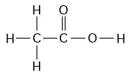 -How many grams of the compound in the figure above would be required to make 2.5 L of a 1 M solution?
(carbon = 12,oxygen = 16,hydrogen = 1)
-How many grams of the compound in the figure above would be required to make 2.5 L of a 1 M solution?
(carbon = 12,oxygen = 16,hydrogen = 1)Free
(Multiple Choice)
4.8/5 (82)
(82) Correct Answer:Verified
VerifiedD
Which of the following is a property of liquid water? Liquid water ________.
(Multiple Choice)
5.0/5 (73)
(73) Which of the following ionizes completely in solution and is considered to be a strong base (alkali)?
(Multiple Choice)
4.7/5 (68)
(68) Use the following figure to answer the questions below.
-How many grams of the compound in the figure above would be required to make 1 L of a 0.5 M solution?
(carbon = 12,oxygen = 16,hydrogen = 1)
-How many grams of the compound in the figure above would be required to make 1 L of a 0.5 M solution?
(carbon = 12,oxygen = 16,hydrogen = 1) (Multiple Choice)
4.8/5 (88)
(88) Identical heat lamps are arranged to shine on identical containers of water and methanol (wood alcohol),so that each liquid absorbs the same amount of energy minute by minute.The covalent bonds of methanol molecules are nonpolar,so there are no hydrogen bonds among methanol molecules.Which of the following graphs correctly describes what will happen to the temperature of the water and the methanol?
(Multiple Choice)
4.8/5 (77)
(77) If the cytoplasm of a cell is at pH 7,and the mitochondrial matrix is at pH 8,this means that
(Multiple Choice)
4.8/5 (98)
(98) Many mammals control their body temperature by sweating.Which property of water is most directly responsible for the ability of sweat to lower body temperature?
(Multiple Choice)
4.8/5 (79)
(79) You have a freshly prepared 1 M solution of glucose in water.You carefully pour out a 100 mL sample of that solution.How many glucose molecules are included in that 100 mL sample?
(Multiple Choice)
4.7/5 (90)
(90) To act as an effective coolant in a car's radiator,a substance has to have the capacity to absorb a great deal of heat.You have a reference book with tables listing the physical properties of many liquids.In choosing a coolant for your car,which table would you check first?
(Multiple Choice)
4.8/5 (75)
(75) The molecular weight of water is 18 daltons.What is the molarity of 1 litre of pure water? (Hint: What is the mass of 1 litre of pure water?)
(Multiple Choice)
4.9/5 (79)
(79) Consider the following reaction at equilibrium: What would be the effect of adding additional H₂CO₃?
(Multiple Choice)
4.9/5 (91)
(91) You have two beakers.One contains pure water; the other contains pure methanol (wood alcohol).The covalent bonds of methanol molecules are nonpolar,so there are no hydrogen bonds among methanol molecules.You pour crystals of table salt (NaCl)into each beaker.Predict what will happen.
(Multiple Choice)
5.0/5 (83)
(83) Consider two solutions: solution X has a pH of 4; solution Y has a pH of 7.From this information,we can reasonably conclude that
(Multiple Choice)
4.8/5 (83)
(83) 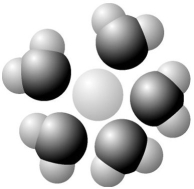 -Based on your knowledge of the polarity of water molecules,the solute molecule depicted here is most likely
 (Multiple Choice)
4.7/5 (83)
(83) 
Filters
- Essay(0)
- Multiple Choice(0)
- Short Answer(0)
- True False(0)
- Matching(0)