



 Chat with AI
Exam 3: Water and Life

Exam 1: Introduction: Evolution and Themes of Biology77 Questions
Exam 2: The Chemical Context of Life98 Questions
Exam 3: Water and Life92 Questions
Exam 4: Carbon and the Molecular Diversity of Life86 Questions
Exam 5: The Structure and Function of Large Biological Molecules131 Questions
Exam 6: A Tour of the Cell111 Questions
Exam 7: Membrane Structure and Function88 Questions
Exam 8: An Introduction to Metabolism92 Questions
Exam 9: Cellular Respiration and Fermentation128 Questions
Exam 10: Photosynthesis103 Questions
Exam 11: Cell Communication85 Questions
Exam 12: The Cell Cycle98 Questions
Exam 13: Meiosis and Sexual Life Cycles90 Questions
Exam 14: Mendel and the Gene Idea92 Questions
Exam 15: The Chromosomal Basis of Inheritance75 Questions
Exam 16: The Molecular Basis of Inheritance84 Questions
Exam 17: From Gene to Protein106 Questions
Exam 18: Regulation of Gene Expression116 Questions
Exam 19: Viruses71 Questions
Exam 20: DNA Tools and Biotechnology78 Questions
Exam 21: Genomes and Their Evolution64 Questions
Exam 22: Descent with Modification: A Darwinian View of Life68 Questions
Exam 23: The Evolution of Populations92 Questions
Exam 24: The Origin of Species76 Questions
Exam 25: The History of Life on Earth89 Questions
Exam 26: Phylogeny and the Tree of Life91 Questions
Exam 27: Bacteria and Archaea96 Questions
Exam 28: Protists82 Questions
Exam 29: Plant Diversity I: How Plants Colonized Land93 Questions
Exam 30: Plant Diversity II: The Evolution of Seed Plants119 Questions
Exam 31: Fungi105 Questions
Exam 32: An Overview of Animal Diversity93 Questions
Exam 33: An Introduction to Invertebrates111 Questions
Exam 34: The Origin and Evolution of Vertebrates126 Questions
Exam 35: Plant Structure,Growth,and Development82 Questions
Exam 36: Resource Acquisition and Transport in Vascular Plants100 Questions
Exam 37: Soil and Plant Nutrition99 Questions
Exam 38: Angiosperm Reproduction and Biotechnology107 Questions
Exam 39: Plant Responses to Internal and External Signals137 Questions
Exam 40: Basic Principles of Animal Form and Function98 Questions
Exam 41: Animal Nutrition87 Questions
Exam 42: Circulation and Gas Exchange112 Questions
Exam 43: The Immune System123 Questions
Exam 44: Osmoregulation and Excretion91 Questions
Exam 45: Hormones and the Endocrine System92 Questions
Exam 46: Animal Reproduction104 Questions
Exam 47: Animal Development106 Questions
Exam 48: Neurons,Synapses,and Signalling93 Questions
Exam 49: Nervous Systems85 Questions
Exam 50: Sensory and Motor Mechanisms106 Questions
Exam 51: Animal Behaviour91 Questions
Exam 52: An Introduction to Ecology and the Biosphere90 Questions
Exam 53: Population Ecology89 Questions
Exam 54: Community Ecology97 Questions
Exam 55: Ecosystems and Restoration Ecology98 Questions
Exam 56: Conservation Biology and Global Change90 Questions
Select questions type


The partial negative charge in a molecule of water occurs because
(Multiple Choice)
4.8/5  (80)
(80) The slight negative charge at one end of one water molecule is attracted to the slight positive charge of another water molecule.What is this attraction called?
(Multiple Choice)
4.9/5 (73)
(73) One idea to mitigate the effects of burning fossil fuels on atmospheric CO₂ concentrations is to pipe liquid CO₂ into the ocean at depths of 2500 feet or greater.At the high pressures at such depths,CO₂ is heavier than water.What potential effects might result from implementing such a scheme?
(Multiple Choice)
4.8/5 (83)
(83) The cities of Vancouver,Canada,and Regina,Saskatchewan,are at about the same latitude,but Regina has much hotter summers and much colder winters than Vancouver.Why?
(Multiple Choice)
4.9/5 (74)
(74) A solution contains 0.0000001 (10⁻⁷)moles of hydroxyl ions [OH⁻] per litre.Which of the following best describes this solution?
(Multiple Choice)
4.9/5 (74)
(74) Use the following information to answer the questions below.
You live in Atlantic Canada and you are Skyping a friend in Manitoba.You are both complaining about the weather as both regions are being subjected to the same arctic air mass.As you discuss it,however,it becomes clear that she is experiencing a bitter cold that you are not.You realize that you had pretty much the same conversation last summer when it was much hotter in Manitoba than at home.
-The best explanation for this difference is that
(Multiple Choice)
4.9/5 (87)
(87) When an ionic compound such as sodium chloride (NaCl)is placed in water,the component atoms of the NaCl crystal dissociate into individual sodium ions (Na⁺)and chloride ions (Cl⁻).In contrast,the atoms of covalently bonded molecules (e.g.,glucose,sucrose,glycerol)do not generally dissociate when placed in aqueous solution.Which of the following solutions would be expected to contain the greatest number of solute particles (molecules or ions)?
(Multiple Choice)
4.8/5 (80)
(80) Rank,from low to high,the pH of blood,stomach acid,and urine.
(Multiple Choice)
4.9/5 (76)
(76) Carbon dioxide (CO₂)is readily soluble in water,according to the equation CO₂ + H₂O ↔ H₂CO₃.Carbonic acid (H₂CO₃)is a weak acid.If CO₂ is bubbled into a beaker containing pure,freshly distilled water,which of the following graphs correctly describes the results?
(Multiple Choice)
4.9/5 (74)
(74) If the pH of a solution is decreased from 9 to 8,it means that the
(Multiple Choice)
4.9/5 (98)
(98) Plants transport water through their vascular system utilizing what property of water?
(Multiple Choice)
4.8/5 (74)
(74) A solution with a pH of 7 has how many more protons in it than a solution with a pH of 9?
(Multiple Choice)
4.7/5 (88)
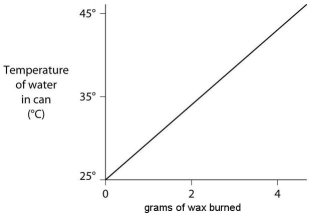
(88) A small birthday candle is weighed,then lighted and placed beneath a metal can containing 100 mL of water.Careful records are kept as the temperature of the water rises.Data from this experiment are shown on the graph.What amount of heat energy is released in the burning of candle wax?
(Multiple Choice)
4.8/5 (77)
(77) Assume that acid rain has lowered the pH of a particular lake to pH 4.0.What is the hydroxyl ion concentration of this lake?
(Multiple Choice)
5.0/5 (83)
(83) One litre of a solution of pH 9 has how many more hydroxyl ions (OH⁻)than 1 L of a solution of pH 4?
(Multiple Choice)
4.9/5 (72)
(72) Use the following information to answer the questions below.
You live in Atlantic Canada and you are Skyping a friend in Manitoba.You are both complaining about the weather as both regions are being subjected to the same arctic air mass.As you discuss it,however,it becomes clear that she is experiencing a bitter cold that you are not.You realize that you had pretty much the same conversation last summer when it was much hotter in Manitoba than at home.
-This phenomenon is due to
(Multiple Choice)
4.8/5 (59)
(59) 
Filters
- Essay(0)
- Multiple Choice(0)
- Short Answer(0)
- True False(0)
- Matching(0)