



 Chat with AI
Exam 31: Fungi

Exam 1: Introduction: Evolution and Themes of Biology77 Questions
Exam 2: The Chemical Context of Life98 Questions
Exam 3: Water and Life92 Questions
Exam 4: Carbon and the Molecular Diversity of Life86 Questions
Exam 5: The Structure and Function of Large Biological Molecules131 Questions
Exam 6: A Tour of the Cell111 Questions
Exam 7: Membrane Structure and Function88 Questions
Exam 8: An Introduction to Metabolism92 Questions
Exam 9: Cellular Respiration and Fermentation128 Questions
Exam 10: Photosynthesis103 Questions
Exam 11: Cell Communication85 Questions
Exam 12: The Cell Cycle98 Questions
Exam 13: Meiosis and Sexual Life Cycles90 Questions
Exam 14: Mendel and the Gene Idea92 Questions
Exam 15: The Chromosomal Basis of Inheritance75 Questions
Exam 16: The Molecular Basis of Inheritance84 Questions
Exam 17: From Gene to Protein106 Questions
Exam 18: Regulation of Gene Expression116 Questions
Exam 19: Viruses71 Questions
Exam 20: DNA Tools and Biotechnology78 Questions
Exam 21: Genomes and Their Evolution64 Questions
Exam 22: Descent with Modification: A Darwinian View of Life68 Questions
Exam 23: The Evolution of Populations92 Questions
Exam 24: The Origin of Species76 Questions
Exam 25: The History of Life on Earth89 Questions
Exam 26: Phylogeny and the Tree of Life91 Questions
Exam 27: Bacteria and Archaea96 Questions
Exam 28: Protists82 Questions
Exam 29: Plant Diversity I: How Plants Colonized Land93 Questions
Exam 30: Plant Diversity II: The Evolution of Seed Plants119 Questions
Exam 31: Fungi105 Questions
Exam 32: An Overview of Animal Diversity93 Questions
Exam 33: An Introduction to Invertebrates111 Questions
Exam 34: The Origin and Evolution of Vertebrates126 Questions
Exam 35: Plant Structure,Growth,and Development82 Questions
Exam 36: Resource Acquisition and Transport in Vascular Plants100 Questions
Exam 37: Soil and Plant Nutrition99 Questions
Exam 38: Angiosperm Reproduction and Biotechnology107 Questions
Exam 39: Plant Responses to Internal and External Signals137 Questions
Exam 40: Basic Principles of Animal Form and Function98 Questions
Exam 41: Animal Nutrition87 Questions
Exam 42: Circulation and Gas Exchange112 Questions
Exam 43: The Immune System123 Questions
Exam 44: Osmoregulation and Excretion91 Questions
Exam 45: Hormones and the Endocrine System92 Questions
Exam 46: Animal Reproduction104 Questions
Exam 47: Animal Development106 Questions
Exam 48: Neurons,Synapses,and Signalling93 Questions
Exam 49: Nervous Systems85 Questions
Exam 50: Sensory and Motor Mechanisms106 Questions
Exam 51: Animal Behaviour91 Questions
Exam 52: An Introduction to Ecology and the Biosphere90 Questions
Exam 53: Population Ecology89 Questions
Exam 54: Community Ecology97 Questions
Exam 55: Ecosystems and Restoration Ecology98 Questions
Exam 56: Conservation Biology and Global Change90 Questions
Select questions type


Plasmogamy can directly result in which of the following?
1)cells with a single haploid nucleus
2)heterokaryotic cells
3)dikaryotic cells
4)cells with two diploid nuclei

Free
(Multiple Choice)
4.7/5  (95)
(95) Correct Answer: Verified
C
Which of the following cells or structures are associated with asexual reproduction in fungi?
Free
(Multiple Choice)
4.8/5 (71)
(71) Correct Answer:Verified
VerifiedD
Lichens are older than plants.Is it possible that lichens were an important component in aiding the colonization of land by plants?
Free
(Multiple Choice)
4.8/5 (70)
(70) Correct Answer:Verified
VerifiedB
The following figure depicts the outline of a large fairy ring that has appeared overnight in an open meadow,as viewed from above.The fairy ring represents the furthest advance of this mycelium through the soil.Locations A-D are all 0.5 metres below the soil surface.Responses may be used once,more than once,or not at all.
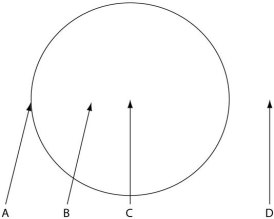 -If the fungus that produced the fairy ring can also produce arbuscules,then which of the following is most likely to be buried at location "C"?
 (Multiple Choice)
4.9/5 (76)
(76) Which of the following conditions is caused by a fungus that is accidentally consumed along with rye flour?
(Multiple Choice)
4.8/5 (73)
(73) When pathogenic fungi are found growing on the roots of grape vines,grape farmers sometimes respond by covering the ground around their vines with plastic sheeting and pumping a gaseous fungicide into the soil.The most important concern of grape farmers who engage in this practice should be that the
(Multiple Choice)
5.0/5 (78)
(78) Which process occurs in fungi and has the opposite effect on a cell's chromosome number than does meiosis I?
(Multiple Choice)
4.8/5 (79)
(79) Fungi have an extremely high surface-area-to-volume ratio.What is the advantage of this to an organism that gets most of its nutrition through absorption?
(Multiple Choice)
4.9/5 (76)
(76) The next few questions refer to the following phylogenetic trees.
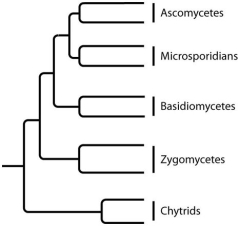 I.
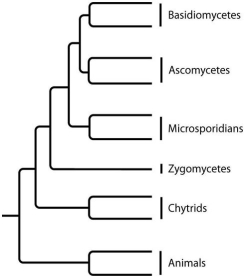 II.
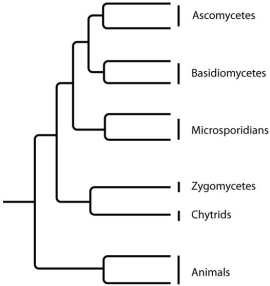 III.
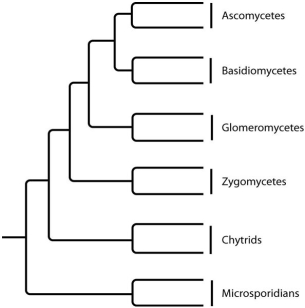 IV.
-Which tree depicts the microsporidians as a sister group of the fungi,rather than as a fungus?
I.
II.
III.
IV.
-Which tree depicts the microsporidians as a sister group of the fungi,rather than as a fungus? (Multiple Choice)
4.8/5 (97)
(97) The following figure depicts the outline of a large fairy ring that has appeared overnight in an open meadow,as viewed from above.The fairy ring represents the furthest advance of this mycelium through the soil.Locations A-D are all 0.5 metres below the soil surface.Responses may be used once,more than once,or not at all.
-What is the most probable location of the oldest portion of this mycelium?
-What is the most probable location of the oldest portion of this mycelium? (Multiple Choice)
4.9/5 (85)
(85) If infection primarily involves the outermost layers of adult amphibian skin,and if the chytrids use the skin as their sole source of nutrition,then which term best applies to the chytrids?
(Multiple Choice)
4.9/5 (81)
(81) The hydrolytic digestion of which of the following should produce monomers that are aminated (i.e.,have an amine group attached)molecules of β-glucose?
(Multiple Choice)
4.8/5 (71)
(71) Some fungal species can kill herbivores while feeding off of sugars from its plant host.What type of relationship does this fungus have with its host?
(Multiple Choice)
4.8/5 (89)
(89) The following figure depicts the outline of a large fairy ring that has appeared overnight in an open meadow,as viewed from above.The fairy ring represents the furthest advance of this mycelium through the soil.Locations A-D are all 0.5 metres below the soil surface.Responses may be used once,more than once,or not at all.
-At which location is the mycelium currently absorbing the most nutrients per unit surface area,per unit time?
-At which location is the mycelium currently absorbing the most nutrients per unit surface area,per unit time? (Multiple Choice)
4.8/5 (79)
(79) Among sac fungi,which of these correctly distinguishes ascospores from conidia?
(Multiple Choice)
4.7/5 (94)
(94) What is the importance of a high surface area to volume ratio of mycelia?
(Multiple Choice)
4.9/5 (85)
(85) Sexual reproduction has not been observed in Bd.If its morphology and genetics did not identify it as a chytridiomycete,then to which fungal group would Bd be assigned?
(Multiple Choice)
4.8/5 (76)
(76) The adaptive advantage associated with the filamentous nature of fungal mycelia is primarily related to
(Multiple Choice)
4.8/5 (85)
(85) Which of the following has the least affiliation with all of the others?
(Multiple Choice)
4.8/5 (90)
(90) 
Filters
- Essay(0)
- Multiple Choice(0)
- Short Answer(0)
- True False(0)
- Matching(0)