



 Chat with AI
Exam 31: Fungi

Exam 1: Introduction: Evolution and Themes of Biology77 Questions
Exam 2: The Chemical Context of Life98 Questions
Exam 3: Water and Life92 Questions
Exam 4: Carbon and the Molecular Diversity of Life86 Questions
Exam 5: The Structure and Function of Large Biological Molecules131 Questions
Exam 6: A Tour of the Cell111 Questions
Exam 7: Membrane Structure and Function88 Questions
Exam 8: An Introduction to Metabolism92 Questions
Exam 9: Cellular Respiration and Fermentation128 Questions
Exam 10: Photosynthesis103 Questions
Exam 11: Cell Communication85 Questions
Exam 12: The Cell Cycle98 Questions
Exam 13: Meiosis and Sexual Life Cycles90 Questions
Exam 14: Mendel and the Gene Idea92 Questions
Exam 15: The Chromosomal Basis of Inheritance75 Questions
Exam 16: The Molecular Basis of Inheritance84 Questions
Exam 17: From Gene to Protein106 Questions
Exam 18: Regulation of Gene Expression116 Questions
Exam 19: Viruses71 Questions
Exam 20: DNA Tools and Biotechnology78 Questions
Exam 21: Genomes and Their Evolution64 Questions
Exam 22: Descent with Modification: A Darwinian View of Life68 Questions
Exam 23: The Evolution of Populations92 Questions
Exam 24: The Origin of Species76 Questions
Exam 25: The History of Life on Earth89 Questions
Exam 26: Phylogeny and the Tree of Life91 Questions
Exam 27: Bacteria and Archaea96 Questions
Exam 28: Protists82 Questions
Exam 29: Plant Diversity I: How Plants Colonized Land93 Questions
Exam 30: Plant Diversity II: The Evolution of Seed Plants119 Questions
Exam 31: Fungi105 Questions
Exam 32: An Overview of Animal Diversity93 Questions
Exam 33: An Introduction to Invertebrates111 Questions
Exam 34: The Origin and Evolution of Vertebrates126 Questions
Exam 35: Plant Structure,Growth,and Development82 Questions
Exam 36: Resource Acquisition and Transport in Vascular Plants100 Questions
Exam 37: Soil and Plant Nutrition99 Questions
Exam 38: Angiosperm Reproduction and Biotechnology107 Questions
Exam 39: Plant Responses to Internal and External Signals137 Questions
Exam 40: Basic Principles of Animal Form and Function98 Questions
Exam 41: Animal Nutrition87 Questions
Exam 42: Circulation and Gas Exchange112 Questions
Exam 43: The Immune System123 Questions
Exam 44: Osmoregulation and Excretion91 Questions
Exam 45: Hormones and the Endocrine System92 Questions
Exam 46: Animal Reproduction104 Questions
Exam 47: Animal Development106 Questions
Exam 48: Neurons,Synapses,and Signalling93 Questions
Exam 49: Nervous Systems85 Questions
Exam 50: Sensory and Motor Mechanisms106 Questions
Exam 51: Animal Behaviour91 Questions
Exam 52: An Introduction to Ecology and the Biosphere90 Questions
Exam 53: Population Ecology89 Questions
Exam 54: Community Ecology97 Questions
Exam 55: Ecosystems and Restoration Ecology98 Questions
Exam 56: Conservation Biology and Global Change90 Questions
Select questions type


Use the following information to answer the questions below.
Recent genetic studies of the structure of microsporidian genomes,as well as the sequences of their tubulin genes and the gene for RNA polymerase II,indicate that microsporidians are closely related to the fungi.Microsporidians lack flagella,centrioles,peroxisomes,and mitochondria (although they do have degenerate mitochondria,called mitosomes).They have the smallest genome of any eukaryote,and it is a genome that changes quickly.The genome is contained within two haploid nuclei.All microsporidians are obligate intracellular parasites.They use a unique organelle called a polar filament to gain access to the cells of their hosts.One species causes chronic diarrhea in AIDS patients.Another parasitizes Anopheles gambiae,the mosquito that transmits a fatal form of malaria to humans.
-The lifestyle of microsporidians is most similar to that of
(Multiple Choice)
4.8/5  (78)
(78) Asexual reproduction in yeasts occurs by budding.Due to unequal cytokinesis,the "bud" cell receives less cytoplasm than the parent cell.Which of the following should be true of the smaller cell until it reaches the size of the larger cell?
(Multiple Choice)
4.8/5 (79)
(79) Please refer to the following information to answer the next few questions.
Diploid nuclei of the ascomycete,Neurospora crassa,contain 14 chromosomes.A single diploid cell in an ascus will undergo one round of meiosis,followed in each of the daughter cells by one round of mitosis,producing a total of eight ascospores.
-If a single,diploid G₂ nucleus in an ascus contains 400 nanograms (ng)of DNA,then a single ascospore nucleus of this species should contain how much DNA (ng),carried on how many chromosomes?
(Multiple Choice)
4.9/5 (81)
(81) In what structures do both Penicillium and Aspergillus produce asexual spores?
(Multiple Choice)
4.9/5 (89)
(89) A fungal spore germinates,giving rise to a mycelium that grows outward into the soil surrounding the site where the spore originally landed.Which of the following accounts for the fungal movement,as described here?
(Multiple Choice)
4.9/5 (78)
(78) Which of the following terms refers to symbiotic relationships that involve fungi living between the cells in plant leaves?
(Multiple Choice)
4.8/5 (76)
(76) Which of the following is a characteristic of hyphate fungi (fungi featuring hyphae)?
(Multiple Choice)
4.9/5 (66)
(66) Sexual reproduction has never been observed among the fungi that produce the blue-green marbling of blue cheeses.What is true of these fungi and others that do not have a sexual stage?
(Multiple Choice)
4.9/5 (86)
(86) Fossil fungi date back to the origin and early evolution of plants.What combination of environmental and morphological change is similar in the evolution of both fungi and plants?
(Multiple Choice)
4.9/5 (89)
(89) The next few questions refer to the following phylogenetic trees.
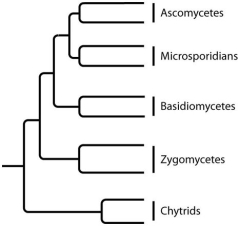 I.
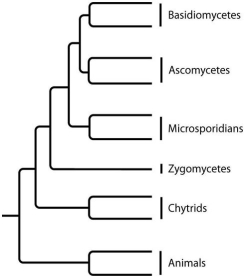 II.
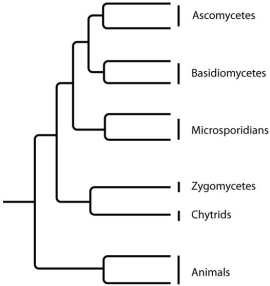 III.
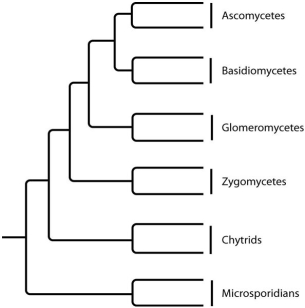 IV.
-Which tree depicts the microsporidians as a sister group of the ascomycetes?
I.
II.
III.
IV.
-Which tree depicts the microsporidians as a sister group of the ascomycetes? (Multiple Choice)
4.8/5 (74)
(74) In most fungi,karyogamy does not immediately follow plasmogamy,which consequently
(Multiple Choice)
4.8/5 (77)
(77) You observe the gametes of a fungal species under the microscope and realize that they resemble animal sperm.To which of the following group does the fungus belong?
(Multiple Choice)
4.9/5 (91)
(91) After cytokinesis occurs in budding yeasts,the daughter cell has a
(Multiple Choice)
4.9/5 (80)
(80) Which feature seen in chytrids supports the hypothesis that they diverged earliest in fungal evolution?
(Multiple Choice)
4.8/5 (89)
(89) The multicellular condition of animals and fungi seems to have arisen
(Multiple Choice)
4.9/5 (81)
(81) In the United States and Canada,bats use one of two strategies to survive winter: They either migrate south,or they hibernate.Recently,those that hibernate seem to have come under attack by a fungus,Geomyces destructans (Gd),an attack that is occurring from Missouri to southern Canada.Many infected bats have a delicate,white filamentous mat on their muzzles,which is referred to as white-nose syndrome (WNS).The fungus invades the bat tissues,causes discomfort,and awakens the bat from its hibernation.The bat fidgets and wastes calories,using up its stored fat.The bat then behaves abnormally,leaving its cave during daytime in winter to search for food.Their food,primarily insects,is scarce during the winter,and the bats ultimately starve to death.Since 2007,it is estimated that up to one million bats have perished from WNS.
The Gd mat on the fur of the bats should be expected to consist of ________.
(Multiple Choice)
4.9/5 (80)
(80) Both fungus-farming ants and their fungi can synthesize the same structural polysaccharide from the β-glucose.What is this polysaccharide?
(Multiple Choice)
4.9/5 (72)
(72) A researcher took water in which a Jl population had been thriving,filtered the water to remove all bacterial cells,and then applied the water to the skins of adult amphibians to see if there would subsequently be a reduced infection rate by Bd when frog skins were inoculated with Bd.For which of the following hypotheses is the procedure described a potential test?
(Multiple Choice)
4.8/5 (74)
(74) Use the following information to answer the questions below.
Unicellular yeasts can be represented as spheres,whereas filamentous hyphae more closely resemble cylinders.As these two geometric figures increase in size,their surface area-to-volume ratios change.The following tables demonstrate how this ratio changes,first for spheres,and second for cylinders.For the cylinder,girth (i.e.,radius,r)will remain constant,whereas length,L,will increase.Note the formulas below the respective tables.
A sphere's change in surface area and volume with increasing radius,r
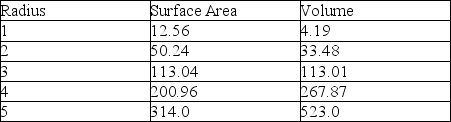 Area of a Sphere = 4r² Volume of a Sphere = 4/3r³
A cylinder's change in surface area and volume with increasing length,L
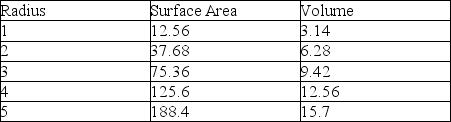 Area of a Cylinder = 2(r²)+ 2rL Volume of a Cylinder = r²ᴸ
-As a direct result of increasing surface area in both yeasts and filamentous hyphae,which cell structures/materials must also increase?
1)amount of chitin
2)number of nuclei
3)amount of plasma membrane
4)number of mitochondria
5)amount of peptidoglycan
Area of a Sphere = 4r² Volume of a Sphere = 4/3r³
A cylinder's change in surface area and volume with increasing length,L
Area of a Cylinder = 2(r²)+ 2rL Volume of a Cylinder = r²ᴸ
-As a direct result of increasing surface area in both yeasts and filamentous hyphae,which cell structures/materials must also increase?
1)amount of chitin
2)number of nuclei
3)amount of plasma membrane
4)number of mitochondria
5)amount of peptidoglycan (Multiple Choice)
4.8/5 (88)
(88) The fact that infection by Bd causes lethargy in many infected amphibians can have what effect on efforts to accurately census the numbers of dead or dying amphibians at a particular time,in a particular habitat?
(Multiple Choice)
4.8/5 (79)
(79) 
Filters
- Essay(0)
- Multiple Choice(0)
- Short Answer(0)
- True False(0)
- Matching(0)