



 Chat with AI
Exam 49: Nervous Systems

Exam 1: Introduction: Evolution and Themes of Biology77 Questions
Exam 2: The Chemical Context of Life98 Questions
Exam 3: Water and Life92 Questions
Exam 4: Carbon and the Molecular Diversity of Life86 Questions
Exam 5: The Structure and Function of Large Biological Molecules131 Questions
Exam 6: A Tour of the Cell111 Questions
Exam 7: Membrane Structure and Function88 Questions
Exam 8: An Introduction to Metabolism92 Questions
Exam 9: Cellular Respiration and Fermentation128 Questions
Exam 10: Photosynthesis103 Questions
Exam 11: Cell Communication85 Questions
Exam 12: The Cell Cycle98 Questions
Exam 13: Meiosis and Sexual Life Cycles90 Questions
Exam 14: Mendel and the Gene Idea92 Questions
Exam 15: The Chromosomal Basis of Inheritance75 Questions
Exam 16: The Molecular Basis of Inheritance84 Questions
Exam 17: From Gene to Protein106 Questions
Exam 18: Regulation of Gene Expression116 Questions
Exam 19: Viruses71 Questions
Exam 20: DNA Tools and Biotechnology78 Questions
Exam 21: Genomes and Their Evolution64 Questions
Exam 22: Descent with Modification: A Darwinian View of Life68 Questions
Exam 23: The Evolution of Populations92 Questions
Exam 24: The Origin of Species76 Questions
Exam 25: The History of Life on Earth89 Questions
Exam 26: Phylogeny and the Tree of Life91 Questions
Exam 27: Bacteria and Archaea96 Questions
Exam 28: Protists82 Questions
Exam 29: Plant Diversity I: How Plants Colonized Land93 Questions
Exam 30: Plant Diversity II: The Evolution of Seed Plants119 Questions
Exam 31: Fungi105 Questions
Exam 32: An Overview of Animal Diversity93 Questions
Exam 33: An Introduction to Invertebrates111 Questions
Exam 34: The Origin and Evolution of Vertebrates126 Questions
Exam 35: Plant Structure,Growth,and Development82 Questions
Exam 36: Resource Acquisition and Transport in Vascular Plants100 Questions
Exam 37: Soil and Plant Nutrition99 Questions
Exam 38: Angiosperm Reproduction and Biotechnology107 Questions
Exam 39: Plant Responses to Internal and External Signals137 Questions
Exam 40: Basic Principles of Animal Form and Function98 Questions
Exam 41: Animal Nutrition87 Questions
Exam 42: Circulation and Gas Exchange112 Questions
Exam 43: The Immune System123 Questions
Exam 44: Osmoregulation and Excretion91 Questions
Exam 45: Hormones and the Endocrine System92 Questions
Exam 46: Animal Reproduction104 Questions
Exam 47: Animal Development106 Questions
Exam 48: Neurons,Synapses,and Signalling93 Questions
Exam 49: Nervous Systems85 Questions
Exam 50: Sensory and Motor Mechanisms106 Questions
Exam 51: Animal Behaviour91 Questions
Exam 52: An Introduction to Ecology and the Biosphere90 Questions
Exam 53: Population Ecology89 Questions
Exam 54: Community Ecology97 Questions
Exam 55: Ecosystems and Restoration Ecology98 Questions
Exam 56: Conservation Biology and Global Change90 Questions
Select questions type


Which of the following correctly describes the how memories are stored and learning takes place?

Free
(Multiple Choice)
4.9/5  (90)
(90) Correct Answer: Verified
D
Preparation for the fight-or-flight response includes activation of the ________ nervous system.
Free
(Multiple Choice)
4.7/5 (89)
(89) Correct Answer:Verified
VerifiedA
The system that modulates excitation and inhibition of smooth and cardiac muscles of the digestive,cardiovascular,and excretory systems is the
Free
(Multiple Choice)
4.8/5 (80)
(80) Correct Answer:Verified
VerifiedC
The activation of the parasympathetic branch of the autonomic nervous system is associated with
(Multiple Choice)
4.9/5 (76)
(76) Bottlenose dolphins breathe air but can sleep in the ocean because
(Multiple Choice)
4.8/5 (91)
(91) Cephalization,the clustering of neurons and interneurons in the anterior part of the animal,is apparent in
(Multiple Choice)
4.9/5 (71)
(71) Our understanding of mental illness has been most advanced by discoveries involving
(Multiple Choice)
4.8/5 (85)
(85) Increased activity in the sympathetic nervous system leads to
(Multiple Choice)
4.9/5 (95)
(95) The endogenous nature of biological rhythms is based on the observations that animals isolated from light and dark cues
(Multiple Choice)
4.8/5 (67)
(67) Which of the following correctly describes the brain reward system?
(Multiple Choice)
4.9/5 (84)
(84) Refer to the following illustration of the limbic system to help answer the next few questions.
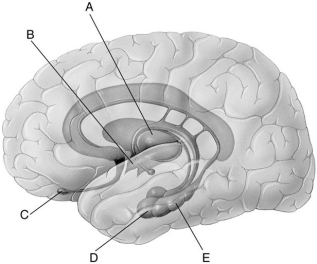 -In the figure,which letter points to the hypothalamus?
 (Multiple Choice)
4.8/5 (80)
(80) After suffering a stroke,a patient can see objects anywhere in front of him but pays attention only to objects in his right field of vision.When asked to describe these objects,he has difficulty judging their size and distance.What part of the brain was likely damaged by the stroke?
(Multiple Choice)
4.8/5 (84)
(84) Hormones that are secreted by the posterior pituitary gland are made in the
(Multiple Choice)
4.8/5 (79)
(79) In mammals,advanced cognition is usually correlated with a large and very convoluted neocortex,but birds are capable of sophisticated cognition because they have
(Multiple Choice)
5.0/5 (85)
(85) Use the following information to answer the next few questions.
While deployed to Afghanistan,a soldier steps on a landmine and loses the lower portion of his right leg and also sustains a substantial brain injury.In time,doctors observe that the soldier is not acquiring new long-term memories since the explosion occurred; however,his recollection of times previous to the explosion is impeccable.Sometimes the soldier can feel a tingling sensation in his missing limb.
-Over time,the soldier's phantom limb syndrome subsides and he rarely "feels" his missing limb.This is an example of
(Multiple Choice)
4.9/5 (74)
(74) If an individual did not possess the NMDA or AMPA receptors,this would inhibit
(Multiple Choice)
4.9/5 (73)
(73) Central coordination of vertebrate biological rhythms in physiology and behaviour reside in the
(Multiple Choice)
4.8/5 (80)
(80) 
Filters
- Essay(0)
- Multiple Choice(0)
- Short Answer(0)
- True False(0)
- Matching(0)