



 Chat with AI
Exam 49: Nervous Systems

Exam 1: Introduction: Evolution and Themes of Biology77 Questions
Exam 2: The Chemical Context of Life98 Questions
Exam 3: Water and Life92 Questions
Exam 4: Carbon and the Molecular Diversity of Life86 Questions
Exam 5: The Structure and Function of Large Biological Molecules131 Questions
Exam 6: A Tour of the Cell111 Questions
Exam 7: Membrane Structure and Function88 Questions
Exam 8: An Introduction to Metabolism92 Questions
Exam 9: Cellular Respiration and Fermentation128 Questions
Exam 10: Photosynthesis103 Questions
Exam 11: Cell Communication85 Questions
Exam 12: The Cell Cycle98 Questions
Exam 13: Meiosis and Sexual Life Cycles90 Questions
Exam 14: Mendel and the Gene Idea92 Questions
Exam 15: The Chromosomal Basis of Inheritance75 Questions
Exam 16: The Molecular Basis of Inheritance84 Questions
Exam 17: From Gene to Protein106 Questions
Exam 18: Regulation of Gene Expression116 Questions
Exam 19: Viruses71 Questions
Exam 20: DNA Tools and Biotechnology78 Questions
Exam 21: Genomes and Their Evolution64 Questions
Exam 22: Descent with Modification: A Darwinian View of Life68 Questions
Exam 23: The Evolution of Populations92 Questions
Exam 24: The Origin of Species76 Questions
Exam 25: The History of Life on Earth89 Questions
Exam 26: Phylogeny and the Tree of Life91 Questions
Exam 27: Bacteria and Archaea96 Questions
Exam 28: Protists82 Questions
Exam 29: Plant Diversity I: How Plants Colonized Land93 Questions
Exam 30: Plant Diversity II: The Evolution of Seed Plants119 Questions
Exam 31: Fungi105 Questions
Exam 32: An Overview of Animal Diversity93 Questions
Exam 33: An Introduction to Invertebrates111 Questions
Exam 34: The Origin and Evolution of Vertebrates126 Questions
Exam 35: Plant Structure,Growth,and Development82 Questions
Exam 36: Resource Acquisition and Transport in Vascular Plants100 Questions
Exam 37: Soil and Plant Nutrition99 Questions
Exam 38: Angiosperm Reproduction and Biotechnology107 Questions
Exam 39: Plant Responses to Internal and External Signals137 Questions
Exam 40: Basic Principles of Animal Form and Function98 Questions
Exam 41: Animal Nutrition87 Questions
Exam 42: Circulation and Gas Exchange112 Questions
Exam 43: The Immune System123 Questions
Exam 44: Osmoregulation and Excretion91 Questions
Exam 45: Hormones and the Endocrine System92 Questions
Exam 46: Animal Reproduction104 Questions
Exam 47: Animal Development106 Questions
Exam 48: Neurons,Synapses,and Signalling93 Questions
Exam 49: Nervous Systems85 Questions
Exam 50: Sensory and Motor Mechanisms106 Questions
Exam 51: Animal Behaviour91 Questions
Exam 52: An Introduction to Ecology and the Biosphere90 Questions
Exam 53: Population Ecology89 Questions
Exam 54: Community Ecology97 Questions
Exam 55: Ecosystems and Restoration Ecology98 Questions
Exam 56: Conservation Biology and Global Change90 Questions
Select questions type


Food and water appetites are under the regulatory influence of the
(Multiple Choice)
4.7/5  (87)
(87) If a patient has an injury in the brain stem,which of the following would be observed?
(Multiple Choice)
4.8/5 (80)
(80) Refer to the following illustration of the limbic system to help answer the next few questions.
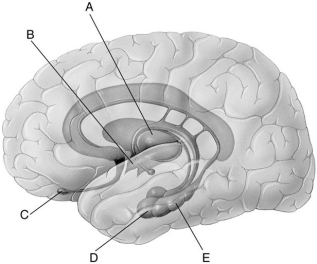 -In the figure,which letter points to the hippocampus?
 (Multiple Choice)
4.9/5 (81)
(81) Upon witnessing a robber hold up a convenience store at gunpoint,which of the following reactions would your nervous system initiate?
(Multiple Choice)
5.0/5 (78)
(78) Which of the following shows a brain structure correctly paired with one of its primary functions?
(Multiple Choice)
5.0/5 (98)
(98) The limbic system in the central nervous system sustains many vegetative functions in mammals and is closely associated with structures that process cues about
(Multiple Choice)
4.8/5 (80)
(80) Refer to the following illustration of the limbic system to help answer the next few questions.
-In the figure,which letter points to the thalamus?
-In the figure,which letter points to the thalamus? (Multiple Choice)
4.9/5 (78)
(78) In a cephalized invertebrate,the system that transmits "efferent" impulses from the anterior ganglion to distal segments is the
(Multiple Choice)
4.9/5 (91)
(91) Use the following information to answer the next few questions.
While walking your dog one night,you notice that there are few animals making noise compared to the day.This piques your interest and you decide to perform a literature search.You discover that the 24-hour biological clock is a conserved evolutionary adaptation across many taxa,and is typically synchronized with periods of light and dark,where the animals are alert in the light periods and sleeping during the dark periods.The group of neurons that links the biological clock to environmental cues of light and dark is called the suprachiasmatic nucleus (SCN).
-In birds and mammals,the hormone that affects the sleep/wake cycle is
(Multiple Choice)
4.8/5 (83)
(83) Which brain region would be involved in information retention if you were to take a nap after studying?
(Multiple Choice)
4.8/5 (77)
(77) An adolescent decides to take a risky jump from the roof into a shallow pool.This poorly assessed decision is indicative of a(n)
(Multiple Choice)
4.8/5 (89)
(89) The regulation of body temperature derives from the activity of the
(Multiple Choice)
4.9/5 (86)
(86) In a simple synapse,where are neurotransmitter chemicals released?
(Multiple Choice)
4.9/5 (64)
(64) In the human knee-jerk reflex,as the calf is raised from the vertical toward the horizontal,the muscles of the quadriceps (flexors on the ventral side of the thighs)and the muscles of the hamstring (extensors on the dorsal side of the thighs)are
(Multiple Choice)
5.0/5 (78)
(78) Increases and decreases of the heart rate result from changes in the activity of the
(Multiple Choice)
4.9/5 (85)
(85) One of the complications of Alzheimer's disease is an interference with learning and memory.This disease would most likely involve which of the following?
(Multiple Choice)
4.7/5 (88)
(88) If you were writing an essay,the part of your brain that would be actively involved in this task would be the
(Multiple Choice)
4.9/5 (78)
(78) Which animal would you expect to have the most sophisticated nervous system organization?
(Multiple Choice)
4.9/5 (83)
(83) Use the following information to answer the next few questions.
While walking your dog one night,you notice that there are few animals making noise compared to the day.This piques your interest and you decide to perform a literature search.You discover that the 24-hour biological clock is a conserved evolutionary adaptation across many taxa,and is typically synchronized with periods of light and dark,where the animals are alert in the light periods and sleeping during the dark periods.The group of neurons that links the biological clock to environmental cues of light and dark is called the suprachiasmatic nucleus (SCN).
-What would happen if the SCN were removed?
(Multiple Choice)
4.8/5 (85)
(85) 
Filters
- Essay(0)
- Multiple Choice(0)
- Short Answer(0)
- True False(0)
- Matching(0)