



 Chat with AI
Exam 28: Protists

Exam 1: Introduction: Evolution and Themes of Biology77 Questions
Exam 2: The Chemical Context of Life98 Questions
Exam 3: Water and Life92 Questions
Exam 4: Carbon and the Molecular Diversity of Life86 Questions
Exam 5: The Structure and Function of Large Biological Molecules131 Questions
Exam 6: A Tour of the Cell111 Questions
Exam 7: Membrane Structure and Function88 Questions
Exam 8: An Introduction to Metabolism92 Questions
Exam 9: Cellular Respiration and Fermentation128 Questions
Exam 10: Photosynthesis103 Questions
Exam 11: Cell Communication85 Questions
Exam 12: The Cell Cycle98 Questions
Exam 13: Meiosis and Sexual Life Cycles90 Questions
Exam 14: Mendel and the Gene Idea92 Questions
Exam 15: The Chromosomal Basis of Inheritance75 Questions
Exam 16: The Molecular Basis of Inheritance84 Questions
Exam 17: From Gene to Protein106 Questions
Exam 18: Regulation of Gene Expression116 Questions
Exam 19: Viruses71 Questions
Exam 20: DNA Tools and Biotechnology78 Questions
Exam 21: Genomes and Their Evolution64 Questions
Exam 22: Descent with Modification: A Darwinian View of Life68 Questions
Exam 23: The Evolution of Populations92 Questions
Exam 24: The Origin of Species76 Questions
Exam 25: The History of Life on Earth89 Questions
Exam 26: Phylogeny and the Tree of Life91 Questions
Exam 27: Bacteria and Archaea96 Questions
Exam 28: Protists82 Questions
Exam 29: Plant Diversity I: How Plants Colonized Land93 Questions
Exam 30: Plant Diversity II: The Evolution of Seed Plants119 Questions
Exam 31: Fungi105 Questions
Exam 32: An Overview of Animal Diversity93 Questions
Exam 33: An Introduction to Invertebrates111 Questions
Exam 34: The Origin and Evolution of Vertebrates126 Questions
Exam 35: Plant Structure,Growth,and Development82 Questions
Exam 36: Resource Acquisition and Transport in Vascular Plants100 Questions
Exam 37: Soil and Plant Nutrition99 Questions
Exam 38: Angiosperm Reproduction and Biotechnology107 Questions
Exam 39: Plant Responses to Internal and External Signals137 Questions
Exam 40: Basic Principles of Animal Form and Function98 Questions
Exam 41: Animal Nutrition87 Questions
Exam 42: Circulation and Gas Exchange112 Questions
Exam 43: The Immune System123 Questions
Exam 44: Osmoregulation and Excretion91 Questions
Exam 45: Hormones and the Endocrine System92 Questions
Exam 46: Animal Reproduction104 Questions
Exam 47: Animal Development106 Questions
Exam 48: Neurons,Synapses,and Signalling93 Questions
Exam 49: Nervous Systems85 Questions
Exam 50: Sensory and Motor Mechanisms106 Questions
Exam 51: Animal Behaviour91 Questions
Exam 52: An Introduction to Ecology and the Biosphere90 Questions
Exam 53: Population Ecology89 Questions
Exam 54: Community Ecology97 Questions
Exam 55: Ecosystems and Restoration Ecology98 Questions
Exam 56: Conservation Biology and Global Change90 Questions
Select questions type


Diplomonads,such as Giardia,contain two haploid nuclei per trophozoite.Thus,during the G₁ phase of the cell cycle,there should be a total of how many unreplicated chromosomes per trophozoite,and during the G₂ phase,how many replicated chromosomes per trophozoite?

Free
(Multiple Choice)
4.8/5  (78)
(78) Correct Answer: Verified
C
A large seaweed that floats freely on the surface of deep bodies of water would be expected to lack which of the following?
Free
(Multiple Choice)
4.9/5 (72)
(72) Correct Answer:Verified
VerifiedC
Biologists have long been aware that the defunct kingdom Protista is polyphyletic.Which of these statements is most consistent with this conclusion?
Free
(Multiple Choice)
4.8/5 (78)
(78) Correct Answer:Verified
VerifiedC
If we were to apply the most recent technique used to fight potato late blight to the fight against the malarial infection of humans,then we would
(Multiple Choice)
4.7/5 (90)
(90) The next few questions refer to the following description and table.
Diatoms are encased in Petri-platelike cases (valves)made of translucent hydrated silica whose thickness can be varied.The material used to store excess calories can also be varied.At certain times,diatoms store excess calories in the form of the liquid polysaccharide,laminarin,and at other times as oil.The following are data concerning the density (specific gravity)of various components of diatoms,and of their environment.
Specific Gravities of Materials Relevant to Diatoms
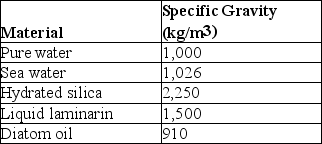 -Judging from the table and given that water's density and,consequently,its buoyancy decrease at warmer temperatures,in which environment should diatoms (and other suspended particles)sink most slowly?
 (Multiple Choice)
4.9/5 (76)
(76) Which process could have allowed the nucleomorphs of chlorarachniophytes to be reduced,without the net loss of any genetic information?
(Multiple Choice)
4.9/5 (83)
(83) The mitosome of Giardia has no DNA within it.If it did contain DNA,then what predictions should we be able to make about its DNA?
1)It is linear.
2)It is circular.
3)It has many introns.
4)It has few introns.
5)It is not associated with histone proteins.
6)It is complexed with histone proteins.
(Multiple Choice)
4.7/5 (68)
(68) Use the following information to answer the questions below.
Paulinella chromatophora is one of the few cercozoans that is autotrophic,carrying out aerobic photosynthesis with its two elongated "cyanelles." The cyanelles are contained within vesicles of the host cell,and each is derived from a cyanobacterium,though not the same type of cyanobacterium that gave rise to the chloroplasts of algae and plants.
-The closest living relative of P.chromatophora is the heterotroph,P.ovalis.P.ovalis uses threadlike pseudopods to capture its prey,which it digests internally.Which of the following,if observed,would be the best reason for relabelling P.chromatophora as a mixotroph?
(Multiple Choice)
4.7/5 (77)
(77) According to the endosymbiotic theory of the origin of eukaryotic cells,how did mitochondria originate?
(Multiple Choice)
4.9/5 (71)
(71) P.chromatophora secretes around itself a test,or case,of plates made of silica.Which of the following is another rhizarian that would be in competition with P.chromatophora for the silica needed to make these plates,assuming limited quantities of silica in the environment?
(Multiple Choice)
4.9/5 (81)
(81) Why do photosynthetic protists play a critical role in aquatic ecosystems?
(Multiple Choice)
4.8/5 (79)
(79) Which pair of alternatives is highlighted by the life cycle of the cellular slime moulds,such as Dictyostelium?
(Multiple Choice)
4.9/5 (80)
(80) A gelatinous seaweed that grows in shallow,cold water and undergoes heteromorphic alternation of generations is most probably what type of alga?
(Multiple Choice)
4.9/5 (84)
(84) Reinforced,threadlike pseudopods that can perform phagocytosis are generally characteristic of which group?
(Multiple Choice)
4.8/5 (86)
(86) The genome of modern chloroplasts is roughly 50% the size of the genome of the cyanobacterium from which it is thought to have been derived.In comparison,the genome of P.chromatophora's cyanelle is only slightly reduced relative to the size of the genome of the cyanobacterium from which it is thought to have been derived.What is a valid conclusion that can be drawn from this comparison?
(Multiple Choice)
4.9/5 (78)
(78) Which two genera have members that can evade the human immune system by frequently changing their surface proteins?
1)Plasmodium
2)Trichomonas
3)Paramecium
4)Trypanosoma
5)Entamoeba
(Multiple Choice)
4.8/5 (80)
(80) You are given the task of designing an aerobic,mixotrophic protist that can perform photosynthesis in fairly deep water (for example,250 m deep),and can also crawl about and engulf small particles.With which two of the following structures would you provide your protist?
1)hydrogenosome
2)apicoplast
3)pseudopods
4)chloroplast from red alga
5)chloroplast from green alga
(Multiple Choice)
4.8/5 (71)
(71) The chloroplasts of all of the following are thought to be derived from ancestral red algae,except those of
(Multiple Choice)
4.7/5 (73)
(73) 
Filters
- Essay(0)
- Multiple Choice(0)
- Short Answer(0)
- True False(0)
- Matching(0)