



 Chat with AI
Exam 28: Protists

Exam 1: Introduction: Evolution and Themes of Biology77 Questions
Exam 2: The Chemical Context of Life98 Questions
Exam 3: Water and Life92 Questions
Exam 4: Carbon and the Molecular Diversity of Life86 Questions
Exam 5: The Structure and Function of Large Biological Molecules131 Questions
Exam 6: A Tour of the Cell111 Questions
Exam 7: Membrane Structure and Function88 Questions
Exam 8: An Introduction to Metabolism92 Questions
Exam 9: Cellular Respiration and Fermentation128 Questions
Exam 10: Photosynthesis103 Questions
Exam 11: Cell Communication85 Questions
Exam 12: The Cell Cycle98 Questions
Exam 13: Meiosis and Sexual Life Cycles90 Questions
Exam 14: Mendel and the Gene Idea92 Questions
Exam 15: The Chromosomal Basis of Inheritance75 Questions
Exam 16: The Molecular Basis of Inheritance84 Questions
Exam 17: From Gene to Protein106 Questions
Exam 18: Regulation of Gene Expression116 Questions
Exam 19: Viruses71 Questions
Exam 20: DNA Tools and Biotechnology78 Questions
Exam 21: Genomes and Their Evolution64 Questions
Exam 22: Descent with Modification: A Darwinian View of Life68 Questions
Exam 23: The Evolution of Populations92 Questions
Exam 24: The Origin of Species76 Questions
Exam 25: The History of Life on Earth89 Questions
Exam 26: Phylogeny and the Tree of Life91 Questions
Exam 27: Bacteria and Archaea96 Questions
Exam 28: Protists82 Questions
Exam 29: Plant Diversity I: How Plants Colonized Land93 Questions
Exam 30: Plant Diversity II: The Evolution of Seed Plants119 Questions
Exam 31: Fungi105 Questions
Exam 32: An Overview of Animal Diversity93 Questions
Exam 33: An Introduction to Invertebrates111 Questions
Exam 34: The Origin and Evolution of Vertebrates126 Questions
Exam 35: Plant Structure,Growth,and Development82 Questions
Exam 36: Resource Acquisition and Transport in Vascular Plants100 Questions
Exam 37: Soil and Plant Nutrition99 Questions
Exam 38: Angiosperm Reproduction and Biotechnology107 Questions
Exam 39: Plant Responses to Internal and External Signals137 Questions
Exam 40: Basic Principles of Animal Form and Function98 Questions
Exam 41: Animal Nutrition87 Questions
Exam 42: Circulation and Gas Exchange112 Questions
Exam 43: The Immune System123 Questions
Exam 44: Osmoregulation and Excretion91 Questions
Exam 45: Hormones and the Endocrine System92 Questions
Exam 46: Animal Reproduction104 Questions
Exam 47: Animal Development106 Questions
Exam 48: Neurons,Synapses,and Signalling93 Questions
Exam 49: Nervous Systems85 Questions
Exam 50: Sensory and Motor Mechanisms106 Questions
Exam 51: Animal Behaviour91 Questions
Exam 52: An Introduction to Ecology and the Biosphere90 Questions
Exam 53: Population Ecology89 Questions
Exam 54: Community Ecology97 Questions
Exam 55: Ecosystems and Restoration Ecology98 Questions
Exam 56: Conservation Biology and Global Change90 Questions
Select questions type


A P.bursaria cell that has lost its zoochlorellae is aposymbiotic.If aposymbiotic cells have population growth rates the same as those of healthy,zoochlorella-containing P.bursaria in well-lit environments with plenty of prey items,then such an observation would be consistent with which type of relationship?
(Multiple Choice)
5.0/5  (78)
(78) The following questions refer to the description below.
Malaria is a global health problem in over 100 countries,killing about one million people every year.The protist,Plasmodium,that causes malaria lives in 2 hosts,mosquitoes and humans.Malaria is transmitted to humans by the Anopholes mosquito.
-A friend of yours has just returned from central Africa and has told you that she is sick with malaria.You know your friend took an anti-malaria medication before she left on her trip.How can you explain why your friend contracted malaria?
(Multiple Choice)
4.9/5 (95)
(95) If true,which of the following would be most important in determining whether P.chromatophora's cyanelle is still an endosymbiont,or is an organelle,as the term cyanelle implies?
(Multiple Choice)
4.8/5 (71)
(71) Which protists are in the same eukaryotic supergroup as land plants?
(Multiple Choice)
4.8/5 (77)
(77) Living diatoms contain brownish plastids.If global warming causes blooms of diatoms in the surface waters of Earth's oceans,how might this be harmful to the animals that build coral reefs?
(Multiple Choice)
4.9/5 (62)
(62) Which of the following groups is matched with a correct anatomical feature?
(Multiple Choice)
4.8/5 (73)
(73) A biologist discovers an alga that is marine,multicellular,and lives at a depth reached only by blue light.This alga probably belongs to which group?
(Multiple Choice)
4.8/5 (78)
(78) Unikonta is a supergroup that includes all of the following except ________.
(Multiple Choice)
4.8/5 (78)
(78) The next few questions refer to the following description and table.
Diatoms are encased in Petri-platelike cases (valves)made of translucent hydrated silica whose thickness can be varied.The material used to store excess calories can also be varied.At certain times,diatoms store excess calories in the form of the liquid polysaccharide,laminarin,and at other times as oil.The following are data concerning the density (specific gravity)of various components of diatoms,and of their environment.
Specific Gravities of Materials Relevant to Diatoms
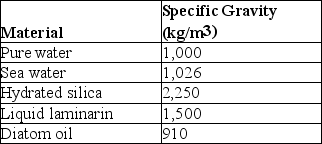 -Using dead diatoms to "pump" CO₂ to the seafloor is feasible only if dead diatoms sink quickly.Consequently,application of mineral fertilizers,such as iron,should be most effective at times when diatom valves
 (Multiple Choice)
4.9/5 (90)
(90) Which process results in genetic recombination,but is separate from the process by which the population size of Paramecium increases?
(Multiple Choice)
4.9/5 (89)
(89) If the mitosomes of Giardia contain no DNA,yet are descendants of what were once free-living organisms,then where are we likely to find the genes that encode their structures,and what accounts for their current location there?
(Multiple Choice)
4.9/5 (91)
(91) Unlike most excavates,Giardia trophozoites have no oral groove and are unable to form food vacuoles.Thus,we should expect its nutrition (mostly glucose)to come from
(Multiple Choice)
4.9/5 (84)
(84) The chloroplasts of land plants are thought to have been derived according to which evolutionary sequence?
(Multiple Choice)
4.7/5 (80)
(80) Which term best describes the symbiotic relationship of well-fed P.bursaria to their zoochlorellae?
(Multiple Choice)
4.9/5 (77)
(77) Diatoms are mostly asexual members of the phytoplankton.Diatoms lack any organelles that might have the 9 + 2 pattern.They obtain their nutrition from functional chloroplasts,and each diatom is encased within two porous,glasslike valves.Which question would be most important for one interested in the day-to-day survival of individual diatoms?
(Multiple Choice)
4.9/5 (78)
(78) Which of the following statements about dinoflagellates is true?
(Multiple Choice)
4.9/5 (80)
(80) The following questions refer to the description below.
Malaria is a global health problem in over 100 countries,killing about one million people every year.The protist,Plasmodium,that causes malaria lives in 2 hosts,mosquitoes and humans.Malaria is transmitted to humans by the Anopholes mosquito.
-The use of DDT greatly decreased numbers of Anopholes mosquitoes in the 1960s,and drugs killed the Plasmodium.Now doctors tend to prescribe a combination of drugs against malaria.Why don't doctors prescribe a vaccine to combat malaria?
(Multiple Choice)
4.8/5 (69)
(69) Given its mode of reproduction and internal structures,which of the following should be expected to occur in Giardia at some stage of its life cycle?
1)separation (segregation)of daughter chromosomes
2)crossing over
3)meiosis
(Multiple Choice)
4.8/5 (82)
(82) The motility that permits P.bursaria to move toward a light source is provided by
(Multiple Choice)
4.8/5 (96)
(96) 
Filters
- Essay(0)
- Multiple Choice(0)
- Short Answer(0)
- True False(0)
- Matching(0)