



 Chat with AI
Exam 28: Protists

Exam 1: Introduction: Evolution and Themes of Biology77 Questions
Exam 2: The Chemical Context of Life98 Questions
Exam 3: Water and Life92 Questions
Exam 4: Carbon and the Molecular Diversity of Life86 Questions
Exam 5: The Structure and Function of Large Biological Molecules131 Questions
Exam 6: A Tour of the Cell111 Questions
Exam 7: Membrane Structure and Function88 Questions
Exam 8: An Introduction to Metabolism92 Questions
Exam 9: Cellular Respiration and Fermentation128 Questions
Exam 10: Photosynthesis103 Questions
Exam 11: Cell Communication85 Questions
Exam 12: The Cell Cycle98 Questions
Exam 13: Meiosis and Sexual Life Cycles90 Questions
Exam 14: Mendel and the Gene Idea92 Questions
Exam 15: The Chromosomal Basis of Inheritance75 Questions
Exam 16: The Molecular Basis of Inheritance84 Questions
Exam 17: From Gene to Protein106 Questions
Exam 18: Regulation of Gene Expression116 Questions
Exam 19: Viruses71 Questions
Exam 20: DNA Tools and Biotechnology78 Questions
Exam 21: Genomes and Their Evolution64 Questions
Exam 22: Descent with Modification: A Darwinian View of Life68 Questions
Exam 23: The Evolution of Populations92 Questions
Exam 24: The Origin of Species76 Questions
Exam 25: The History of Life on Earth89 Questions
Exam 26: Phylogeny and the Tree of Life91 Questions
Exam 27: Bacteria and Archaea96 Questions
Exam 28: Protists82 Questions
Exam 29: Plant Diversity I: How Plants Colonized Land93 Questions
Exam 30: Plant Diversity II: The Evolution of Seed Plants119 Questions
Exam 31: Fungi105 Questions
Exam 32: An Overview of Animal Diversity93 Questions
Exam 33: An Introduction to Invertebrates111 Questions
Exam 34: The Origin and Evolution of Vertebrates126 Questions
Exam 35: Plant Structure,Growth,and Development82 Questions
Exam 36: Resource Acquisition and Transport in Vascular Plants100 Questions
Exam 37: Soil and Plant Nutrition99 Questions
Exam 38: Angiosperm Reproduction and Biotechnology107 Questions
Exam 39: Plant Responses to Internal and External Signals137 Questions
Exam 40: Basic Principles of Animal Form and Function98 Questions
Exam 41: Animal Nutrition87 Questions
Exam 42: Circulation and Gas Exchange112 Questions
Exam 43: The Immune System123 Questions
Exam 44: Osmoregulation and Excretion91 Questions
Exam 45: Hormones and the Endocrine System92 Questions
Exam 46: Animal Reproduction104 Questions
Exam 47: Animal Development106 Questions
Exam 48: Neurons,Synapses,and Signalling93 Questions
Exam 49: Nervous Systems85 Questions
Exam 50: Sensory and Motor Mechanisms106 Questions
Exam 51: Animal Behaviour91 Questions
Exam 52: An Introduction to Ecology and the Biosphere90 Questions
Exam 53: Population Ecology89 Questions
Exam 54: Community Ecology97 Questions
Exam 55: Ecosystems and Restoration Ecology98 Questions
Exam 56: Conservation Biology and Global Change90 Questions
Select questions type


Biologists suspect that endosymbiosis gave rise to mitochondria before plastids partly because
(Multiple Choice)
4.7/5  (76)
(76) A snail-like,coiled,porous test (shell)of calcium carbonate is characteristic of which group?
(Multiple Choice)
4.9/5 (79)
(79) You are given the task of designing an aquatic protist that is a primary producer.It cannot swim on its own,yet must stay in well-lit surface waters.It must be resistant to physical damage from wave action.It should be most similar to a(n)
(Multiple Choice)
4.7/5 (82)
(82) Which of the following is correctly described as a primary producer?
(Multiple Choice)
4.8/5 (79)
(79) Including the membrane of the surrounding vesicle,how many phospholipid (NOT lipopolysaccharide)bilayers should be found around each cyanelle,and which one of these bilayers should have photosystems embedded in it?
(Multiple Choice)
4.9/5 (79)
(79) A P.bursaria cell that has lost its zoochlorellae is said to be aposymbiotic.It might be able to replenish its contingent of zoochlorellae by ingesting them without subsequently digesting them.Which of the following situations would be most favourable to the reestablishment of resident zoochlorellae,assuming compatible Chlorella are present in P.bursaria's habitat?
(Multiple Choice)
4.8/5 (79)
(79) Which process in Paramecium results in genetic recombination but no increase in population size?
(Multiple Choice)
4.9/5 (67)
(67) Green algae differ from land plants in that many green algae
(Multiple Choice)
4.9/5 (68)
(68) Which of the following pairs of protists and their characteristics is mismatched?
(Multiple Choice)
4.8/5 (88)
(88) The primary treatment for giardiasis (infection with Giardia),as well as for trichomoniasis (infection with Trichomonas vaginalis)and for amoebic dysentery (infection with Entamoeba histolytica),is a drug marketed as Flagyl (generic name is metronidazole).The drug also kills anaerobic gut bacteria.Consequently,which of these are cues that Flagyl's mode of action has nothing to do with attacking or disabling the parasites' flagella,as the drug's name might imply?
1)It would also harm the flagellated lining of the human intestine.
2)Entamoeba possesses pseudopods,not flagella,yet it is killed by Flagyl.
3)Prokaryotic flagella and eukaryotic flagella are radically different from each other and unlikely to be harmed by the same chemical.
4)Not all anaerobic gut bacteria possess flagella,yet it kills these bacteria.
(Multiple Choice)
4.9/5 (94)
(94) A crucial photosynthetic gene of the cyanobacterium that gave rise to the cyanelle is called psaE.This gene is present in the nuclear genome of the cercozoan,but is not in the genome of the cyanelle.This is evidence of
(Multiple Choice)
4.7/5 (76)
(76) In alternation of generation in brown algae,which pair is incorrectly matched?
(Multiple Choice)
4.8/5 (72)
(72) Given that Flagyl produces only minor side effects (if any)in humans,and given the set of parasites that it kills,Flagyl's mode of action probably involves
(Multiple Choice)
4.9/5 (84)
(84) Given the putative ancestry of Giardia's mitosome,what should we predict is true of the mitosome?
(Multiple Choice)
4.9/5 (77)
(77) The following questions refer to the description below.
You are given four test tubes,each containing an unknown protist,and your task is to read the following description and match these four protists to the correct test tube.
When light,especially red and blue light,is shone on the tubes,oxygen bubbles accumulate on the inside of test tubes 1 and 2.Chemical analysis of test tube 1 indicates the presence of a chemical that is toxic to fish and humans.Chemical analysis of test tube 2 indicates the presence of substantial amounts of silica.Microscopic analysis of organisms in test tubes 1,3,and 4 reveals the presence of permanent,membrane-bounded sacs just under the plasma membrane.Microscopic analysis of organisms in test tube 3 reveals the presence of an apicoplast in each.Microscopic analysis of the contents in test tube 4 reveals the presence of one large nucleus and one small nucleus in each organism.
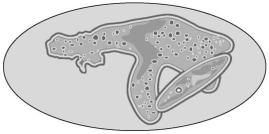 -Test tube 3 contains ________.
 (Multiple Choice)
4.9/5 (75)
(75) Plastids that are surrounded by more than two membranes are evidence of
(Multiple Choice)
4.8/5 (82)
(82) During passage through the large intestine,a trophozoite will often secrete a case around itself,forming a cyst.Cysts contain four haploid nuclei.When cysts "hatch" within a new host,two trophozoites are released.Thus,which of the following must happen within the cyst,prior to hatching?
1)meiosis
2)nuclear division
3)S phase
4)binary fission
(Multiple Choice)
5.0/5 (68)
(68) Use the following information to answer the questions below.
Paulinella chromatophora is one of the few cercozoans that is autotrophic,carrying out aerobic photosynthesis with its two elongated "cyanelles." The cyanelles are contained within vesicles of the host cell,and each is derived from a cyanobacterium,though not the same type of cyanobacterium that gave rise to the chloroplasts of algae and plants.
-The closest living relative of P.chromatophora is the heterotroph,P.ovalis.What type of evidence permits biologists to make this claim about relatedness?
(Multiple Choice)
4.8/5 (75)
(75) The next few questions refer to the following description.
Healthy individuals of Paramecium bursaria contain photosynthetic algal endosymbionts of the genus Chlorella.When within their hosts,the algae are referred to as zoochlorellae.In aquaria with light coming from only one side,P.bursaria gathers at the well-lit side,whereas other species of Paramecium gather at the opposite side.The zoochlorellae provide their hosts with glucose and oxygen,and P.bursaria provides its zoochlorellae with protection and motility.P.bursaria can lose its zoochlorellae in two ways: (1)if kept in darkness,the algae will die; and (2)if prey items (mostly bacteria)are absent from its habitat,P.bursaria will digest its zoochlorellae.
-Which term accurately describes the behaviour of Paramecium species that lack zoochlorellae in an aquarium with light coming from one side only?
(Multiple Choice)
4.8/5 (89)
(89) 
Filters
- Essay(0)
- Multiple Choice(0)
- Short Answer(0)
- True False(0)
- Matching(0)