



 Chat with AI
Exam 28: Protists

Exam 1: Introduction: Evolution and Themes of Biology77 Questions
Exam 2: The Chemical Context of Life98 Questions
Exam 3: Water and Life92 Questions
Exam 4: Carbon and the Molecular Diversity of Life86 Questions
Exam 5: The Structure and Function of Large Biological Molecules131 Questions
Exam 6: A Tour of the Cell111 Questions
Exam 7: Membrane Structure and Function88 Questions
Exam 8: An Introduction to Metabolism92 Questions
Exam 9: Cellular Respiration and Fermentation128 Questions
Exam 10: Photosynthesis103 Questions
Exam 11: Cell Communication85 Questions
Exam 12: The Cell Cycle98 Questions
Exam 13: Meiosis and Sexual Life Cycles90 Questions
Exam 14: Mendel and the Gene Idea92 Questions
Exam 15: The Chromosomal Basis of Inheritance75 Questions
Exam 16: The Molecular Basis of Inheritance84 Questions
Exam 17: From Gene to Protein106 Questions
Exam 18: Regulation of Gene Expression116 Questions
Exam 19: Viruses71 Questions
Exam 20: DNA Tools and Biotechnology78 Questions
Exam 21: Genomes and Their Evolution64 Questions
Exam 22: Descent with Modification: A Darwinian View of Life68 Questions
Exam 23: The Evolution of Populations92 Questions
Exam 24: The Origin of Species76 Questions
Exam 25: The History of Life on Earth89 Questions
Exam 26: Phylogeny and the Tree of Life91 Questions
Exam 27: Bacteria and Archaea96 Questions
Exam 28: Protists82 Questions
Exam 29: Plant Diversity I: How Plants Colonized Land93 Questions
Exam 30: Plant Diversity II: The Evolution of Seed Plants119 Questions
Exam 31: Fungi105 Questions
Exam 32: An Overview of Animal Diversity93 Questions
Exam 33: An Introduction to Invertebrates111 Questions
Exam 34: The Origin and Evolution of Vertebrates126 Questions
Exam 35: Plant Structure,Growth,and Development82 Questions
Exam 36: Resource Acquisition and Transport in Vascular Plants100 Questions
Exam 37: Soil and Plant Nutrition99 Questions
Exam 38: Angiosperm Reproduction and Biotechnology107 Questions
Exam 39: Plant Responses to Internal and External Signals137 Questions
Exam 40: Basic Principles of Animal Form and Function98 Questions
Exam 41: Animal Nutrition87 Questions
Exam 42: Circulation and Gas Exchange112 Questions
Exam 43: The Immune System123 Questions
Exam 44: Osmoregulation and Excretion91 Questions
Exam 45: Hormones and the Endocrine System92 Questions
Exam 46: Animal Reproduction104 Questions
Exam 47: Animal Development106 Questions
Exam 48: Neurons,Synapses,and Signalling93 Questions
Exam 49: Nervous Systems85 Questions
Exam 50: Sensory and Motor Mechanisms106 Questions
Exam 51: Animal Behaviour91 Questions
Exam 52: An Introduction to Ecology and the Biosphere90 Questions
Exam 53: Population Ecology89 Questions
Exam 54: Community Ecology97 Questions
Exam 55: Ecosystems and Restoration Ecology98 Questions
Exam 56: Conservation Biology and Global Change90 Questions
Select questions type


Which of the following statements concerning protists is true?
(Multiple Choice)
4.8/5  (94)
(94) Previously understood similarities that seemed to connect slime molds and fungi are now considered to be ________.
(Multiple Choice)
4.9/5 (87)
(87) You are given an unknown organism to identify.It is unicellular and heterotrophic.It is motile,using many short extensions of the cytoplasm,each featuring the 9 + 2 filament pattern.It has well-developed organelles and three nuclei,one large and two small.This organism is most likely to be a member of which group?
(Multiple Choice)
4.8/5 (93)
(93) You are designing an artificial drug-delivery "cell" that can penetrate animal cells.Which of these protist structures should provide the most likely avenue for research along these lines?
(Multiple Choice)
4.8/5 (70)
(70) What must occur for asexual reproduction to be successful in P.chromatophora?
1)mitosis
2)S phase
3)meiosis
4)equal distribution of cyanelles during cytokinesis
(Multiple Choice)
4.9/5 (74)
(74) In life cycles with an alternation of generations,multicellular haploid forms alternate with
(Multiple Choice)
4.9/5 (83)
(83) Which of the following are actual mutualistic partnerships that involve a protist and a host organism?
(Multiple Choice)
4.8/5 (74)
(74) The following questions refer to the description below.
You are given four test tubes,each containing an unknown protist,and your task is to read the following description and match these four protists to the correct test tube.
When light,especially red and blue light,is shone on the tubes,oxygen bubbles accumulate on the inside of test tubes 1 and 2.Chemical analysis of test tube 1 indicates the presence of a chemical that is toxic to fish and humans.Chemical analysis of test tube 2 indicates the presence of substantial amounts of silica.Microscopic analysis of organisms in test tubes 1,3,and 4 reveals the presence of permanent,membrane-bounded sacs just under the plasma membrane.Microscopic analysis of organisms in test tube 3 reveals the presence of an apicoplast in each.Microscopic analysis of the contents in test tube 4 reveals the presence of one large nucleus and one small nucleus in each organism.
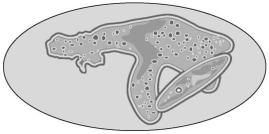 -Test tube 4 contains ________.
 (Multiple Choice)
4.8/5 (76)
(76) An individual mixotroph loses its plastids,yet continues to survive.Which of the following most likely accounts for its continued survival?
(Multiple Choice)
4.9/5 (84)
(84) Theoretically,P.bursaria can obtain zoochlorella either vertically (via the asexual reproduction of its mother cell)or horizontally (by ingesting free-living Chlorella from its habitat).Consider a P.bursaria cell containing zoochlorellae,but whose habitat lacks free-living Chlorella.If this cell subsequently undergoes many generations of asexual reproduction,if all of its daughter cells contain roughly the same number of zoochlorellae as it had originally contained,and if the zoochlorellae are all haploid and identical in appearance,then what is true?
(Multiple Choice)
5.0/5 (88)
(88) The best evidence for not classifying the slime moulds as fungi comes from slime moulds'
(Multiple Choice)
4.8/5 (79)
(79) Which of the following represents the true significance of the finding that the cyanelles of P.chromatophora stem from a different type of cyanobacterium than gave rise to chloroplasts?
(Multiple Choice)
4.9/5 (71)
(71) If true,which of the following is the best evidence that the cyanelles are providing nutrition (in other words,calories)to the surrounding cercozoan?
(Multiple Choice)
4.9/5 (87)
(87) Use the following information to answer the questions below.
Giardia lamblia is an intestinal parasite of humans and other mammals that causes intestinal ailments in most people who ingest the cysts.Upon ingestion,each cyst releases two motile cells,called trophozoites.These attach to the small intestine's lining via a ventral adhesive disk.The trophozoites anaerobically metabolize glucose from the host's intestinal contents to produce ATP.Reproduction is completely asexual,occurring by longitudinal binary fission of trophozoites,with each daughter cell receiving two haploid nuclei (n = 5).A trophozoite will often encyst as it passes into the large intestine by secreting around itself a case that is resistant to cold,heat,and dehydration.Infection usually occurs by drinking untreated water that contains cysts.
-Giardia's mitosome can be said to be "doubly degenerate," because it is a degenerate form of a ________,an organelle that is itself a degenerate form of a(n)________.
(Multiple Choice)
4.8/5 (70)
(70) Similar to most amoebozoans,the forams and the radiolarians also have pseudopods,as do some of the white blood cells of animals (monocytes).If one were to erect a taxon that included all organisms that have cells with pseudopods,what would be true of such a taxon?
(Multiple Choice)
4.7/5 (80)
(80) Use the following information to answer the questions below.
Giardia lamblia is an intestinal parasite of humans and other mammals that causes intestinal ailments in most people who ingest the cysts.Upon ingestion,each cyst releases two motile cells,called trophozoites.These attach to the small intestine's lining via a ventral adhesive disk.The trophozoites anaerobically metabolize glucose from the host's intestinal contents to produce ATP.Reproduction is completely asexual,occurring by longitudinal binary fission of trophozoites,with each daughter cell receiving two haploid nuclei (n = 5).A trophozoite will often encyst as it passes into the large intestine by secreting around itself a case that is resistant to cold,heat,and dehydration.Infection usually occurs by drinking untreated water that contains cysts.
-The trophozoites of Giardia were first observed in 1681 in the diarrhea stools of the first known person to view protists with a microscope,a person named
(Multiple Choice)
4.8/5 (86)
(86) The next few questions refer to the following description and table.
Diatoms are encased in Petri-platelike cases (valves)made of translucent hydrated silica whose thickness can be varied.The material used to store excess calories can also be varied.At certain times,diatoms store excess calories in the form of the liquid polysaccharide,laminarin,and at other times as oil.The following are data concerning the density (specific gravity)of various components of diatoms,and of their environment.
Specific Gravities of Materials Relevant to Diatoms
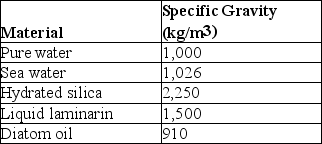 -Water's density and,consequently,its buoyancy decrease at warmer temperatures.Based on this consideration and using data from the table,at which time of year should one expect diatoms to be storing excess calories mostly as oil?
 (Multiple Choice)
4.9/5 (79)
(79) The next few questions refer to the following description.
Healthy individuals of Paramecium bursaria contain photosynthetic algal endosymbionts of the genus Chlorella.When within their hosts,the algae are referred to as zoochlorellae.In aquaria with light coming from only one side,P.bursaria gathers at the well-lit side,whereas other species of Paramecium gather at the opposite side.The zoochlorellae provide their hosts with glucose and oxygen,and P.bursaria provides its zoochlorellae with protection and motility.P.bursaria can lose its zoochlorellae in two ways: (1)if kept in darkness,the algae will die; and (2)if prey items (mostly bacteria)are absent from its habitat,P.bursaria will digest its zoochlorellae.
-Which term most accurately describes the nutritional mode of healthy P.bursaria?
(Multiple Choice)
4.9/5 (80)
(80) 
Filters
- Essay(0)
- Multiple Choice(0)
- Short Answer(0)
- True False(0)
- Matching(0)