



 Chat with AI
Exam 53: Population Ecology

Exam 1: Introduction: Evolution and Themes of Biology77 Questions
Exam 2: The Chemical Context of Life98 Questions
Exam 3: Water and Life92 Questions
Exam 4: Carbon and the Molecular Diversity of Life86 Questions
Exam 5: The Structure and Function of Large Biological Molecules131 Questions
Exam 6: A Tour of the Cell111 Questions
Exam 7: Membrane Structure and Function88 Questions
Exam 8: An Introduction to Metabolism92 Questions
Exam 9: Cellular Respiration and Fermentation128 Questions
Exam 10: Photosynthesis103 Questions
Exam 11: Cell Communication85 Questions
Exam 12: The Cell Cycle98 Questions
Exam 13: Meiosis and Sexual Life Cycles90 Questions
Exam 14: Mendel and the Gene Idea92 Questions
Exam 15: The Chromosomal Basis of Inheritance75 Questions
Exam 16: The Molecular Basis of Inheritance84 Questions
Exam 17: From Gene to Protein106 Questions
Exam 18: Regulation of Gene Expression116 Questions
Exam 19: Viruses71 Questions
Exam 20: DNA Tools and Biotechnology78 Questions
Exam 21: Genomes and Their Evolution64 Questions
Exam 22: Descent with Modification: A Darwinian View of Life68 Questions
Exam 23: The Evolution of Populations92 Questions
Exam 24: The Origin of Species76 Questions
Exam 25: The History of Life on Earth89 Questions
Exam 26: Phylogeny and the Tree of Life91 Questions
Exam 27: Bacteria and Archaea96 Questions
Exam 28: Protists82 Questions
Exam 29: Plant Diversity I: How Plants Colonized Land93 Questions
Exam 30: Plant Diversity II: The Evolution of Seed Plants119 Questions
Exam 31: Fungi105 Questions
Exam 32: An Overview of Animal Diversity93 Questions
Exam 33: An Introduction to Invertebrates111 Questions
Exam 34: The Origin and Evolution of Vertebrates126 Questions
Exam 35: Plant Structure,Growth,and Development82 Questions
Exam 36: Resource Acquisition and Transport in Vascular Plants100 Questions
Exam 37: Soil and Plant Nutrition99 Questions
Exam 38: Angiosperm Reproduction and Biotechnology107 Questions
Exam 39: Plant Responses to Internal and External Signals137 Questions
Exam 40: Basic Principles of Animal Form and Function98 Questions
Exam 41: Animal Nutrition87 Questions
Exam 42: Circulation and Gas Exchange112 Questions
Exam 43: The Immune System123 Questions
Exam 44: Osmoregulation and Excretion91 Questions
Exam 45: Hormones and the Endocrine System92 Questions
Exam 46: Animal Reproduction104 Questions
Exam 47: Animal Development106 Questions
Exam 48: Neurons,Synapses,and Signalling93 Questions
Exam 49: Nervous Systems85 Questions
Exam 50: Sensory and Motor Mechanisms106 Questions
Exam 51: Animal Behaviour91 Questions
Exam 52: An Introduction to Ecology and the Biosphere90 Questions
Exam 53: Population Ecology89 Questions
Exam 54: Community Ecology97 Questions
Exam 55: Ecosystems and Restoration Ecology98 Questions
Exam 56: Conservation Biology and Global Change90 Questions
Select questions type


Refer to the figure below to answer the following questions.
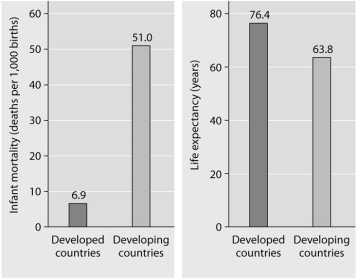 Infant mortality and life expectancy at birth in developed and developing countries (data as of 2005).
-In terms of demographics,which country is likely to experience the greatest population growth problem over the next ten years?
Infant mortality and life expectancy at birth in developed and developing countries (data as of 2005).
-In terms of demographics,which country is likely to experience the greatest population growth problem over the next ten years?
Free
(Multiple Choice)
5.0/5  (81)
(81) Correct Answer: Verified
E
Which pair of terms most accurately describes life history traits for a stable population of grizzly bears?
Free
(Multiple Choice)
4.8/5 (77)
(77) Correct Answer:Verified
VerifiedB
Which of the following pairs of reproductive strategies is consistent with energetic trade-off and reproductive success?
(Multiple Choice)
4.8/5 (82)
(82) Which of the following groups would be most likely to exhibit uniform dispersion?
(Multiple Choice)
5.0/5 (78)
(78) Which of the following choices would most likely promote random distribution?
(Multiple Choice)
4.9/5 (99)
(99) Which of the following scenarios would provide the most legitimate data on population density?
(Multiple Choice)
5.0/5 (73)
(73) Use the survivorship curves shown below to answer the following questions.
 -Which curve best describes survivorship in marine molluscs?
 (Multiple Choice)
4.8/5 (91)
(91) A population is correctly defined as having which of the following characteristics?
I.inhabiting the same general area
II.belonging to the same species
III.possessing a constant and uniform density and dispersion
(Multiple Choice)
4.8/5 (90)
(90) The following questions refer to the description below.
Theoretically,under ideal conditions,species can grow exponentially.In reality,however,species cannot maintain exponential growth indefinitely.Introducing species to habitats where conditions are optimal for that species often results in initial exponential growth.
-One example of exponential growth was seen with the introduction of European rabbits into Australia.Within a short period of time the rabbit population in Australia exploded.This invasive species efficiently grazed vegetation in all habitats it colonized and before long spread throughout most of Australia.Many factors can contribute to the exponential growth rate of the rabbit population; which of the these factors would likely slow down population growth?
(Multiple Choice)
4.9/5 (81)
(81) The three basic variables that make up the life history of an organism are
(Multiple Choice)
4.9/5 (90)
(90) Which of the following examples would most accurately measure the density of the population being studied?
(Multiple Choice)
4.9/5 (89)
(89) Why did the 2009 U.S.population continue to grow even though the United States had essentially established a zero population growth?
(Multiple Choice)
4.9/5 (97)
(97) Which of the following statements does not apply to the logistic growth model?
(Multiple Choice)
4.8/5 (70)
(70) Which of the following graphs illustrates the population growth curve of single bacterium growing in a flask of ideal medium at optimum temperature over a 24-hour period?
(Multiple Choice)
4.9/5 (75)
(75) The observation that members of a population are uniformly distributed suggests that
(Multiple Choice)
4.8/5 (65)
(65) Which of the following was the most significant limiting factor in human population growth in the 20th century?
(Multiple Choice)
4.9/5 (76)
(76) In July 2008,the United States had a population of approximately 302 000 000 people.How many Americans were there in July 2009,if the estimated 2008 growth rate was 0.88%?
(Multiple Choice)
4.9/5 (88)
(88) 
Filters
- Essay(0)
- Multiple Choice(0)
- Short Answer(0)
- True False(0)
- Matching(0)