



 Chat with AI
Exam 53: Population Ecology

Exam 1: Introduction: Evolution and Themes of Biology77 Questions
Exam 2: The Chemical Context of Life98 Questions
Exam 3: Water and Life92 Questions
Exam 4: Carbon and the Molecular Diversity of Life86 Questions
Exam 5: The Structure and Function of Large Biological Molecules131 Questions
Exam 6: A Tour of the Cell111 Questions
Exam 7: Membrane Structure and Function88 Questions
Exam 8: An Introduction to Metabolism92 Questions
Exam 9: Cellular Respiration and Fermentation128 Questions
Exam 10: Photosynthesis103 Questions
Exam 11: Cell Communication85 Questions
Exam 12: The Cell Cycle98 Questions
Exam 13: Meiosis and Sexual Life Cycles90 Questions
Exam 14: Mendel and the Gene Idea92 Questions
Exam 15: The Chromosomal Basis of Inheritance75 Questions
Exam 16: The Molecular Basis of Inheritance84 Questions
Exam 17: From Gene to Protein106 Questions
Exam 18: Regulation of Gene Expression116 Questions
Exam 19: Viruses71 Questions
Exam 20: DNA Tools and Biotechnology78 Questions
Exam 21: Genomes and Their Evolution64 Questions
Exam 22: Descent with Modification: A Darwinian View of Life68 Questions
Exam 23: The Evolution of Populations92 Questions
Exam 24: The Origin of Species76 Questions
Exam 25: The History of Life on Earth89 Questions
Exam 26: Phylogeny and the Tree of Life91 Questions
Exam 27: Bacteria and Archaea96 Questions
Exam 28: Protists82 Questions
Exam 29: Plant Diversity I: How Plants Colonized Land93 Questions
Exam 30: Plant Diversity II: The Evolution of Seed Plants119 Questions
Exam 31: Fungi105 Questions
Exam 32: An Overview of Animal Diversity93 Questions
Exam 33: An Introduction to Invertebrates111 Questions
Exam 34: The Origin and Evolution of Vertebrates126 Questions
Exam 35: Plant Structure,Growth,and Development82 Questions
Exam 36: Resource Acquisition and Transport in Vascular Plants100 Questions
Exam 37: Soil and Plant Nutrition99 Questions
Exam 38: Angiosperm Reproduction and Biotechnology107 Questions
Exam 39: Plant Responses to Internal and External Signals137 Questions
Exam 40: Basic Principles of Animal Form and Function98 Questions
Exam 41: Animal Nutrition87 Questions
Exam 42: Circulation and Gas Exchange112 Questions
Exam 43: The Immune System123 Questions
Exam 44: Osmoregulation and Excretion91 Questions
Exam 45: Hormones and the Endocrine System92 Questions
Exam 46: Animal Reproduction104 Questions
Exam 47: Animal Development106 Questions
Exam 48: Neurons,Synapses,and Signalling93 Questions
Exam 49: Nervous Systems85 Questions
Exam 50: Sensory and Motor Mechanisms106 Questions
Exam 51: Animal Behaviour91 Questions
Exam 52: An Introduction to Ecology and the Biosphere90 Questions
Exam 53: Population Ecology89 Questions
Exam 54: Community Ecology97 Questions
Exam 55: Ecosystems and Restoration Ecology98 Questions
Exam 56: Conservation Biology and Global Change90 Questions
Select questions type


The following questions refer to the figure below,which depicts the age structure of three populations.
 -Which population(s)appear(s)to be stable?
 (Multiple Choice)
4.8/5  (80)
(80) Population ecologists follow the fate of same-age cohorts to
(Multiple Choice)
4.8/5 (78)
(78) The following questions refer to the description below.
Theoretically,under ideal conditions,species can grow exponentially.In reality,however,species cannot maintain exponential growth indefinitely.Introducing species to habitats where conditions are optimal for that species often results in initial exponential growth.
-While exponential growth is problematic in an invasive species,when dealing with endangered species exponential growth is desirable.In the 1940s,the whooping crane was critically endangered.Implementation of strict conservation efforts resulted in whooping crane numbers increasing from approximately 21 individuals to over 300 individuals by 2007.Which of the following characteristics of exponential growth rate would be most desirable in aiding the recovery of the whooping crane or any endangered species?
(Multiple Choice)
4.9/5 (67)
(67) Please read the paragraph below and review the figure to answer the following question.
Researchers in the Netherlands studied the effects of parental care given in European kestrels over five years.The researchers transferred chicks among nests to produce reduced broods (three or four chicks),normal broods (five or six chicks),and enlarged broods (seven or eight chicks).They then measured the percentage of male and female parent birds that survived the following winter.(Both males and females provide care for chicks.)
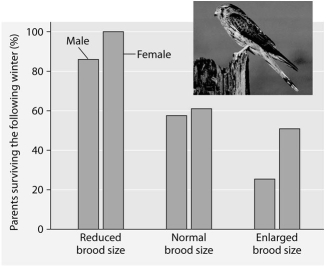 Brood size manipulations in the kestrel: Effects on offspring and parent survival.
-Which of the following is a likely graphic outcome of a population of deer introduced to an island with an adequate herbivory and without natural predators,parasites,or disease?
Brood size manipulations in the kestrel: Effects on offspring and parent survival.
-Which of the following is a likely graphic outcome of a population of deer introduced to an island with an adequate herbivory and without natural predators,parasites,or disease? (Multiple Choice)
4.8/5 (72)
(72) Imagine that you are managing a large game ranch.You know from historical accounts that a species of deer used to live there,but they have been extirpated.You decide to reintroduce them.After doing some research to determine what might be an appropriately sized founding population,you do so.You then watch the population increase for several generations,and graph the number of individuals (vertical axis)against the number of generations (horizontal axis).The graph will likely appear as
(Multiple Choice)
4.8/5 (74)
(74) The following questions refer to the figure below,which depicts the age structure of three populations.
-Assuming these age-structure diagrams describe human populations,in which population is unemployment likely to be a societal issue in the future?
-Assuming these age-structure diagrams describe human populations,in which population is unemployment likely to be a societal issue in the future? (Multiple Choice)
4.8/5 (84)
(84) Which of the following causes populations to shift most quickly from an exponential to a logistic population growth?
(Multiple Choice)
4.8/5 (73)
(73) The following questions refer to the figure below,which depicts the age structure of three populations.
-Which population(s)is (are)in the process of decreasing?
-Which population(s)is (are)in the process of decreasing? (Multiple Choice)
4.7/5 (69)
(69) An ecologist recorded 12 white-tailed deer,Odocoileus virginianus,per square mile in one woodlot and 20 per square mile in another woodlot.What was the ecologist comparing?
(Multiple Choice)
4.8/5 (84)
(84) Use the survivorship curves shown below to answer the following questions.
 -Which curve best describes survivorship in a marine crustacean that moults?
 (Multiple Choice)
4.7/5 (81)
(81) Which of the following assumptions have to be made regarding the capture-recapture estimate of population size?
I.Marked and unmarked individuals have the same probability of being trapped.
II.The marked individuals have thoroughly mixed with the population after being marked.
III.No individuals have entered or left the population by immigration or emigration,and no individuals have been added by birth or eliminated by death during the course of the estimate.
(Multiple Choice)
4.7/5 (89)
(89) Which variables define the ecological life history of a species?
(Multiple Choice)
4.8/5 (78)
(78) Which of the following is the best example of uniform distribution?
(Multiple Choice)
4.8/5 (93)
(93) Your friend comes to you with a problem.It seems his shrimp boats aren't catching nearly as much shrimp as they used to.He can't understand why because he used to catch all the shrimp he could handle.Each year he added a new boat,and for a long time each boat caught tons of shrimp.As he added more boats,there came a time when each boat caught somewhat fewer shrimp,and now,each boat is catching a lot less shrimp.Which of the following topics might help your friend understand the source of his problem?
(Multiple Choice)
4.8/5 (78)
(78) Use the survivorship curves shown below to answer the following questions.
-Which curve best describes survivorship in elephants?
-Which curve best describes survivorship in elephants? (Multiple Choice)
4.7/5 (84)
(84) Which of the following statements regarding ecological footprints is/are true?
(Multiple Choice)
4.8/5 (79)
(79) During the spring,you are studying the mice that live in a field near your home.The population density is high,but you realize that you rarely observe any reproductive female mice.This most likely indicates
(Multiple Choice)
4.9/5 (86)
(86) Consider two forests: one is an undisturbed old-growth forest,while the other has recently been logged.In which forest are species likely to experience exponential growth,and why?
(Multiple Choice)
4.8/5 (73)
(73) To construct a reproductive table for a sexual species,one needs to
(Multiple Choice)
4.9/5 (72)
(72) 
Filters
- Essay(0)
- Multiple Choice(0)
- Short Answer(0)
- True False(0)
- Matching(0)