



 Chat with AI
Exam 53: Population Ecology

Exam 1: Introduction: Evolution and Themes of Biology77 Questions
Exam 2: The Chemical Context of Life98 Questions
Exam 3: Water and Life92 Questions
Exam 4: Carbon and the Molecular Diversity of Life86 Questions
Exam 5: The Structure and Function of Large Biological Molecules131 Questions
Exam 6: A Tour of the Cell111 Questions
Exam 7: Membrane Structure and Function88 Questions
Exam 8: An Introduction to Metabolism92 Questions
Exam 9: Cellular Respiration and Fermentation128 Questions
Exam 10: Photosynthesis103 Questions
Exam 11: Cell Communication85 Questions
Exam 12: The Cell Cycle98 Questions
Exam 13: Meiosis and Sexual Life Cycles90 Questions
Exam 14: Mendel and the Gene Idea92 Questions
Exam 15: The Chromosomal Basis of Inheritance75 Questions
Exam 16: The Molecular Basis of Inheritance84 Questions
Exam 17: From Gene to Protein106 Questions
Exam 18: Regulation of Gene Expression116 Questions
Exam 19: Viruses71 Questions
Exam 20: DNA Tools and Biotechnology78 Questions
Exam 21: Genomes and Their Evolution64 Questions
Exam 22: Descent with Modification: A Darwinian View of Life68 Questions
Exam 23: The Evolution of Populations92 Questions
Exam 24: The Origin of Species76 Questions
Exam 25: The History of Life on Earth89 Questions
Exam 26: Phylogeny and the Tree of Life91 Questions
Exam 27: Bacteria and Archaea96 Questions
Exam 28: Protists82 Questions
Exam 29: Plant Diversity I: How Plants Colonized Land93 Questions
Exam 30: Plant Diversity II: The Evolution of Seed Plants119 Questions
Exam 31: Fungi105 Questions
Exam 32: An Overview of Animal Diversity93 Questions
Exam 33: An Introduction to Invertebrates111 Questions
Exam 34: The Origin and Evolution of Vertebrates126 Questions
Exam 35: Plant Structure,Growth,and Development82 Questions
Exam 36: Resource Acquisition and Transport in Vascular Plants100 Questions
Exam 37: Soil and Plant Nutrition99 Questions
Exam 38: Angiosperm Reproduction and Biotechnology107 Questions
Exam 39: Plant Responses to Internal and External Signals137 Questions
Exam 40: Basic Principles of Animal Form and Function98 Questions
Exam 41: Animal Nutrition87 Questions
Exam 42: Circulation and Gas Exchange112 Questions
Exam 43: The Immune System123 Questions
Exam 44: Osmoregulation and Excretion91 Questions
Exam 45: Hormones and the Endocrine System92 Questions
Exam 46: Animal Reproduction104 Questions
Exam 47: Animal Development106 Questions
Exam 48: Neurons,Synapses,and Signalling93 Questions
Exam 49: Nervous Systems85 Questions
Exam 50: Sensory and Motor Mechanisms106 Questions
Exam 51: Animal Behaviour91 Questions
Exam 52: An Introduction to Ecology and the Biosphere90 Questions
Exam 53: Population Ecology89 Questions
Exam 54: Community Ecology97 Questions
Exam 55: Ecosystems and Restoration Ecology98 Questions
Exam 56: Conservation Biology and Global Change90 Questions
Select questions type


Refer to the figure below to answer the following questions.
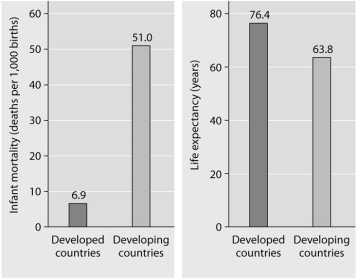 Infant mortality and life expectancy at birth in developed and developing countries (data as of 2005).
-What is a logical conclusion that can be drawn from the graphs above?
Infant mortality and life expectancy at birth in developed and developing countries (data as of 2005).
-What is a logical conclusion that can be drawn from the graphs above? (Multiple Choice)
5.0/5  (81)
(81) Why do some invertebrates,such as lobsters,show a "stair-step" survivorship curve?
(Multiple Choice)
4.8/5 (70)
(70) Which of the following graphs illustrates the growth curve of a small population of rodents that has grown to reach a static carrying capacity?
(Multiple Choice)
4.9/5 (71)
(71) Exponential growth of a population is represented by dN/dt =
(Multiple Choice)
4.8/5 (77)
(77) Which statement is true with regard to human population growth?
(Multiple Choice)
4.8/5 (79)
(79) A population of white-footed mice becomes severely overpopulated in a habitat that has been disturbed by human activity.Sometimes intrinsic factors cause the population to increase in mortality and lower reproduction rates to occur in reaction to the stress of overpopulation.Which of the following is an example of intrinsic population control?
(Multiple Choice)
4.9/5 (80)
(80) What is the primary limiting factor that determines why no female animal can produce a very large number of very large eggs?
(Multiple Choice)
4.9/5 (77)
(77) Uniform spacing patterns in plants such as the creosote bush are most often associated with
(Multiple Choice)
4.8/5 (76)
(76) Why do populations grow more slowly as they approach their carrying capacity?
(Multiple Choice)
4.9/5 (88)
(88) Scientific study of the population cycles of the snowshoe hare and its predator,the lynx,has revealed that
(Multiple Choice)
4.8/5 (73)
(73) You observe two female fish of the same species breeding.One female lays 100 eggs and the other female lays 1000 eggs.Which one of the following is least likely given the limits of fitness trade-offs?
(Multiple Choice)
4.9/5 (77)
(77) As N approaches K for a certain population,which of the following is predicted by the logistic equation?
(Multiple Choice)
4.7/5 (94)
(94) Which of the following statements about the evolution of life histories is correct?
(Multiple Choice)
4.8/5 (72)
(72) Long-term studies of Belding's ground squirrels show that immigrants move nearly 2 km from where they are born and become 1%-8% of the males and 0.7%-6% of the females in other populations.On an evolutionary scale,why is this significant?
(Multiple Choice)
4.9/5 (75)
(75) Which of the following is most key to understanding the demographic transition in human population growth?
(Multiple Choice)
4.7/5 (82)
(82) Where would you find the largest number of K-selected individuals?
(Multiple Choice)
4.7/5 (70)
(70) 
Filters
- Essay(0)
- Multiple Choice(0)
- Short Answer(0)
- True False(0)
- Matching(0)